New dinosaur dating technique paper released
Antonio Simonetti, a research associate professor in the Department of Civil Engineering and Geological Sciences at the University of Notre Dame, is the coauthor of an important new paper describing a novel method for age dating dinosaur fossils.
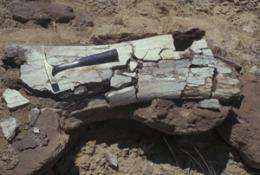
Simonetti and colleagues from the University of Alberta used a U-Pb (uranium-lead) dating technique to analyze a fossilized dinosaur bone discovered in New Mexico. In a paper in the prestigious journal Geology, the researchers discuss their method and reveal that it determined that the femur bone from a giant hadrosaur dinosaur was 64.8 million years old.
The finding has caused a significant stir in scientific circles. There has been wide agreement among paleontologists that dinosaurs became extinct roughly 65.5 million years ago. Various theories as to the cause of this extinction have been suggested, ranging from a huge asteroid striking the earth to changes in global sea levels and climate to sustained periods of volcanism.
However, the method used by Simonetti and his colleagues determined that the New Mexico plant eating dinosaur was alive roughly 700,000 years after the surmised giant extinction event.
Although the challenge to the accepted dinosaur extinction model has received the most attention, Simonetti believes that the dating method described in the paper is especially significant.
The current method paleontologists use to date dinosaur fossils is a technique called relative chronology. The method estimates a fossil’s age relative to the known age of deposits of sediment in which it was found.
However, the relative chronology technique does not take into account the possibility that millions of years of geological and environmental activity can cause a fossil to drift from its original position in a layer of sediment and be re-deposited in a younger sediment layer.
The U-Pb method Simonetti and his Alberta colleagues employed uses a laser beam to sample minute particles of the fossil, which are then subjected to isotopic analysis using state-of-the-art instrumentation.
Simonetti and his colleagues believe that if the uranium-lead dating technique is confirmed in additional fossil samples, prevailing theories about the end of the dinosaurs will need to be revised.
And much of that dating work will be done in a new laboratory facility at Notre Dame. Simonetti and Clive R. Neal, a professor of civil engineering and geological sciences, have received a National Science Foundation-MRI equipment grant to establish “MITERAC” — the Midwest Isotope and Trace Element Research Analytic Center — in Cushing Hall. The facility will expand the research endeavors of 18 researchers from six universities in Indiana and Michigan, including some who will use the facility for the new uranium-lead dating technique.
Provided by University of Notre Dame


.jpg)


