Organic chips - not just in your kitchen anymore
Feb 22, 2011 by Katie Gatto weblog
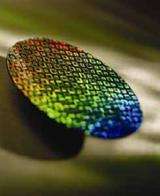
silicon wafer
A silicon wafer. (Image courtesy of NASA Space Research)

(PhysOrg.com) -- IMEC researchers at the International Solid-State Circuits Conference, in San Francisco, California are expected to introduce a microprocessor made with organic semiconductors.

This breakthrough, which will be a world's first, is going to have the of a chip from roughly the 1970's, with a 4000-transistor, 8-bit logic circuit. This is admittedly, not an amazing amount of power but this little chip, unlike its metal counterparts, is able to bend without breaking. So, while you may not be supercomputing with organic semiconductors anytime in the near future, these cheaper and more flexible chips could be used in a variety of flexible displays or to create sensors in areas where normal chips could never go.

Organic semiconductors do have one major difference from their silicon cousins. In a the chips have a monocrystalline structure that creates switches that act in a very predictable manner. When the voltage is above the known threshold the switch will turn on.

In the organic version of the transistors, silicon has been replaced by an unnamed that is a bit more unpredictable, each chip will have a slightly different switching threshold. In display based applications, such as in e-readers, this does not notably effect the performance of the device, but in a single transistor this variance can keep the chip from working properly.

In order to solve this problem researchers built an extra gate into the back of each transistor on the 25-micrometer-thick chip. The chip is backed by an extremely thin polyethylene naphthalate, which is about the thickness of the plastic wrap found in the average kitchen. Currently creating the chip is about one tenth the cost of more traditional chips.

Explore further: Google eyes emerging markets networks

More information: www2.imec.be/be_en/education/phd/smart-systems-energy-technology/organic-and-oxide-electronics.html
via IEEE

Related Stories

3-D Chip Design Challenges

Feb 21, 2010

(PhysOrg.com) -- With the increase functionality of electronic gadgets, the need to pack more transistors into a single package is becoming a needed necessity. There’s a big demand, in the consumer market, ...

New concept for bendable packaged ultra-thin chips presented

Apr 04, 2006

IMEC and its associated laboratory INTEC of the University of Ghent jointly developed a new process flow for ultra-thin chip packages resulting in bendable packaged chips of only 50µm thickness. The technology enables embedding ...

Organic flash memory developed

Dec 17, 2009

(PhysOrg.com) -- Researchers at the University of Tokyo have developed a non-volatile memory that has the same basic structure as a flash memory but is made from cheap, flexible, organic materials.

Recommended for you

Google eyes emerging markets networks

11 hours ago

Google has become deeply involved in a series of projects to build and operate wireless networks in emerging markets including sub-Saharan Africa and Southeast Asia, a report said Friday.

Facial-recognition technology proves its mettle

13 hours ago

(Phys.org) —In a study that evaluated some of the latest in automatic facial recognition technology, researchers at Michigan State University were able to quickly identify one of the Boston Marathon bombing ...

Mobile app to help fight against racism in France

14 hours ago

A French anti-racism association is launching a mobile application it hopes will help eradicate racist graffiti by enabling users to take photos of offensive tags, geo-locate them and get them removed.

User comments : 2

Adjust slider to filter visible comments by rank

Display comments: newest first

Beard
not rated yet Feb 22, 2011
Beautiful iridescence.
seb
not rated yet Feb 22, 2011
Interesting.. and since I know nothing about the technology other than "organic semiconductor", my first thought is: if it's organic.. what's the life cycle?

More news stories

Google eyes emerging markets networks

Google has become deeply involved in a series of projects to build and operate wireless networks in emerging markets including sub-Saharan Africa and Southeast Asia, a report said Friday.

Drones may violate international law

(Phys.org) —As President Obama gives a speech on national security—including defending U.S. use of drones to combat terrorism—Leila Sadat, JD, international law expert and professor of law at Washington University in ...

Facial-recognition technology proves its mettle

(Phys.org) —In a study that evaluated some of the latest in automatic facial recognition technology, researchers at Michigan State University were able to quickly identify one of the Boston Marathon bombing ...

The long road to the 2000-watt society

The vision of a society in which each inhabitant of the earth manages to consume only 2000 watts has already been around for 15 years. During this time, there has been a steady increase in environmental awareness ...

Galaxies fed by funnels of fuel

(Phys.org) —Computer simulations of galaxies growing over billions of years have revealed a likely scenario for how they feed: a cosmic version of swirly straws.