CeBIT 2011: Preparing for the unexpected
How can you plan for an emergency the nature of which you don’t know? Several Fraunhofer institutes are working on strategies and technologies that would help to predict and improve the response to crises. Their solutions are shown at the CeBIT in Hannover (March 1 – 5).
Extreme weather, major accidents, forest fires or attacks: Citizens, rescue services and the authorities need to receive as much advance warning as possible to be able to react as quickly as possible. “Independent warning systems for each of these catastrophes and for every situation that may affect people are not feasible financially, though,” observes project manager Ulrich Meissen of the Fraunhofer Institute for Software and System Technology ISST in Berlin. “In addition, that would lead to a large collection of parallel items of information that can even prove a mutual hindrance.” This is why in its KATWARN project, Meissen relies on multi-hazard and multi-channel technologies: this simply means that existing warning systems and concepts are interlinked and integrated to create a trend-setting and cross-functional warning system. In addition to the traditional communication channels such as the telephone or radio, other warning technologies are also being tested. For example, building alarms are installed in public or private buildings. These alarms operate independently of the power grid and like fire alarms, they can emit sound and light signals, but they can also send out language and text signals to issue warnings in extreme situations – even where other systems have already failed. To warn the elderly, in particular, special messages are being developed that will be inserted into television broadcasts that provide a clear notice of potential hazards and tell what is to be done.
Overview for rescue services
The automatic collection and assessment of information plays an important role in the PRONTO project of the EU that is coordinated by the Fraunhofer Institute for Intelligent Analysis and Information Systems IAIS in Sankt Augustin. The researchers are developing a system that helps individuals working in control and rescue to make sense of a situation. PRONTO collects a large number of pieces of information and evaluates them automatically: digital maps, GPS, signals transmitted by water or fire sensors, telephone calls, photos and videos, along with reports by the emergency personnel over digital transmitters. “This way, a clear picture of the situation emerges quickly on the monitors in the situation center: What does the location look like? Where are the emergency vehicles? Where is there room for emergency measures, such as for the injured?,” explains project manager Dr. Jobst Löffler. The visually enhanced information supports control personnel in their decision-making and they are able to initiate targeted measures.
End users are currently testing and evaluating the prototype system, which was developed in the course of the project, in field tests under real conditions. The Dortmund Fire Department will use the system in training exercises to better address crisis situations. PRONTO will also be used in a less-hazardous application: public transportation in Helsinki. The problem there is the same – minus the commotion and the pressure of a crisis situation. This provides an opportunity to optimize the collection and evaluation of the information, integrating it into the system, the data management and speech recognition. The intent is that later on, Fraunhofer technology will be used to provide support to security staff during major public events as well.
The intelligent control center
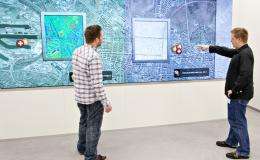
Today’s up-to-date situation rooms consist of a video wall or monitors on which incoming information is gathered and displayed in graphic form. Those processing this information have access to it via PC keyboards, mouse or touchscreens. As a rule, users need electronic authorization by means of a password. To accelerate and simplify control-room procedures, researchers at the Fraunhofer Institute of Optronics, System Technologies and Image Exploitation IOSB in Karlsruhe have developed the SmartControlRoom. It can identify the individuals present in the room based on facial-image and/or voice data recognition and pinpoint their location. This makes logon procedures superfluous, since the authorization who may access what data has already been preset in the system. Another feature is the intuitive operation of the video wall. Each user has a personal interface tailored to his or her requirements, tasks and skills. “In a crisis control room, the coordinator of emergency vehicles, for instance, needs functions that are different from those of the fire-fighting coordinator,” says IOSB researcher Florian van de Camp. In order to display the information for exactly the person it is intended for the persons are “tracked”, meaning their location in the room is monitored at any given time.
A scout for dangerous terrain
In an emergency, fire, radioactivity or poisonous substances make it difficult to obtain precise information about the current situation. However, this is just the information that is needed by the control personnel to deploy the rescue teams effectively without having them endanger their lives. For this reason, researchers at the IOSB have developed a software system that enables the use of mini-helicopters, for example, or helium-filled balloons equipped with cameras or gas sensors to be sent in to scout out the situation. The mobile ground station is located in the control center, and “by simply clicking on the display, the sensors can be sent to the appropriate location,” explains project manager Dr. Axel Bürkle. “From there, they send images or measurements in real time that permit a better assessment of the situation, even in inaccessible areas.”
Once the acute danger is over, getting information about possible damages is essential. For instance, unmanned mini-submarines can inspect dams or port facilities under water. The Fraunhofer Application Center System Technology AST in Ilmenau coordinates the work of several Fraunhofer institutes to develop autonomous underwater vehicles that can dive up to 6000 meters, for instance to inspect pipelines, transatlantic telephone lines, drill holes or offshore wind power plants.
Let’s get out of here!
The path out of the catastrophe is shown by a development of the Fraunhofer Institute for Integrated Circuits IIS: the awiloc positioning technology. A smartphone can identify its own location in cities or buildings. The technology is based on the measured signal strength of the many WLANs found in any modern city center. At any position in a city, you can register the signals of multiple WLAN transmitters – the closer to the router, the stronger the signal. The result is a characteristic pattern with which a position can be pinpointed on the mobile device. In a project sponsored by the Federal Ministry of Education and Research (BMBF) – “Regional Evacuation: Planning, Control and Adaptation” (REPKA), real-time movement data obtained during an evacuation exercise can be used to improve regional evacuation plans. In a crisis situation awiloc can be utilized as a part of a guidance system to find the way to safe ground. “We combine various positioning systems and this gives us far greater precision than using stand-alone systems,” notes Steffen Meyer. It works both inside and outside of buildings and even if cell phone networks fail.
Provided by Fraunhofer-Gesellschaft


