Artificial intestine helps fight bad gut bacteria
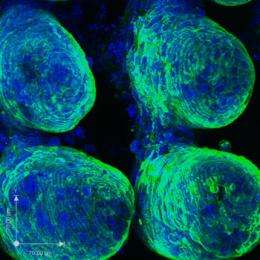
(PhysOrg.com) -- Cornell professor John March is attempting to transform bacteria in our gut into disease-fighting machines. Now, thanks to two members of his research team, he has a powerful new tool to help him do so: an artificial intestine.
The 3-D hydrogel scaffolds developed by graduate student Jiajie Yu and former postdoctoral researcher Jong Hwan Sung will allow scientists to grow cells under realistic physiological conditions, an important breakthrough. Until now, they have had to rely on two-dimensional cultures or live animal models.
"We knew the flat models weren't accurate. Cells behave differently in different three-dimensional environments," said March, an assistant professor of biological and environmental engineering at the College of Agriculture and Life Sciences. "This will enable us to better study drug absorptions and interactions between epithelia and bacteria in the intestine."
The research was published in the Feb. 7 issue of Lab on a Chip.
Yu and Sung created a hard plastic mold, then covered it with a softer so-called sacrificial mold made from calcium alginate that could be dissolved, leaving a collagen scaffold upon which live cells could be grown.
In this way, they avoided damaging the delicate shapes during separation of the molds. And the method does not use expensive or complicated equipment required by most microfabrication methods -- it can be carried out on a common lab bench or a sterilized biosafety cabinet.
The researchers tested the model by seeding it with human colon carcinoma cells. After being cultured for three weeks, it was covered with fingerlike structures mimicking the intestinal villi, the threadlike projections covering the surface of the mucous membrane in the small intestine where fluids and nutrients are absorbed.
All this was done on a tiny scale, about 1mm high and 200 microns across, visible under a scanning electron microscope. March said scientists had previously managed to fabricate models as small as 1 or 2 microns, but slightly larger sizes -- especially those with tricky aspect ratios or curvature -- have eluded them.
"This method will enable construction of in vitro tissue models with physiologically realistic geometries at microscale resolutions," he said. "I think we'll eventually be able to understand the 3-D physical environment of the gastrointestinal tract and other parts of the body much more effectively than we do now."
This will be particularly helpful as March studies how gut bacteria can be used to signal intestinal cells to function like insulin-producing beta cells in models of type 1 diabetes -- a project that could result in simple oral treatment of the disease and was recognized with a National Institutes of Health Director's New Innovators Award.
March is in the process of acquiring patents for the technology, which could be used in other areas of biomedical research, such as tissue engineering, pharmaceutical sciences and cell biology.
Provided by Cornell University


