Hi tech pays tribute to Eiffel Tower's 19th-century origins
January 12, 2011 by Laurent Banguet

In 2011, the tower will get its 19th coat of paint, and next year sees an overhaul of structures on its first floor.

Enlarge

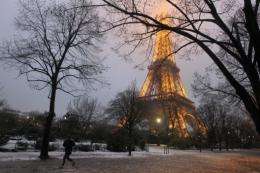
The Eiffel Tower peers through the gloom of a December day. Despite its having been designed to stand for only 20 years after it opened in 1889, the Eiffel Tower remains in rude health and is one of the world's most recognisable structures.

Arguably the most widely recognised structure in the world, the Eiffel Tower was designed to stand for only 20 years -- and some predicted it would collapse long before then.

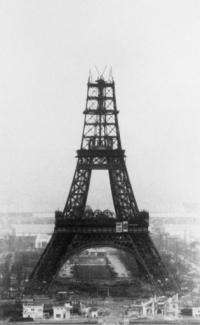
Even as it was being built for the 1889 Universal Exhibition, a professor of mathematics sagely calculated that when the tower was two-thirds complete, its legs would buckle and the whole thing would come tumbling down, crushing workers and houses alike.

Today, the is not only standing but remains in rude health, testifying to the soundness of Gustave Eiffel's design and the strength of "puddle iron," the hand-made wrought iron of the late 19th century, say engineers.

Specialists at the Technical Centre for Mechanical Industries, or CETIM, have put together a high-powered computer model based on the 18,000 pieces that comprise the world's greatest iron edifice and the emblem of Paris.

On screen, the tower has been exposed to hurricane-force winds, lashing rain, extreme heat, cold and thick snow, and each time emerges unbowed, they say.

"We have applied the most demanding test standards currently set in Europe and have found that the tower is in excellent shape," said Stephane Roussin, a former French naval officer in charge of structural safety at Eiffel Tower Operating Co., or SETE.

"We have even doubled its weight to see what happens. The tower moves but is not destroyed."
Engineers say Gustave Eiffel's design and the quality of the iron from which the tower was built provide great strength
Enlarge

In November 1888 the Eiffel Tower was more than six months from opening to the public, but its distinctive shape is clear. A professor of mathematics calculated that when the tower was two-thirds complete, its legs would buckle and the whole thing would come tumbling down, crushing workers and houses.

SETE commissioned the model in 2008 to fine tune its maintenance programme -- to get a better idea of the 324-metre (1,063-feet) tower's weak and strong points as important projects are carried out.

In 2011, the tower will get its 19th coat of paint, and next year sees an overhaul of structures on its first floor. The tower itself weighs around 8,500 tonnes, to which some 3,000 tonnes (restaurants, lifts, TV antenna and so on) have been added.

Computer simulation has become standard practice for modern-built buildings, such as the Petronas towers in Kuala Lumpur and the Burj Khalifa in Dubai, and for bridges, such as the Millau viaduct in southwestern France.

But creating the model for the Eiffel Tower presented a technical challenge of a completely new kind.

One thing was that the realisation that its materials -- puddle iron (iron that is super-heated, beaten by hand and then folded over) and rivets -- perform quite differently from modern-day steel, concrete and bolts.

"We had to start from scratch," said Roussin.

Materials scientists carried out mechanical and chemical tests on samples of puddle iron to assess its resilience, and stress engineers revisited Eiffel's own drawings to calculate how the tower would perform under load from the natural elements.
Computer modelling simulates the effects on buildings of strong winds, lashing rain and extreme temperatures
Enlarge

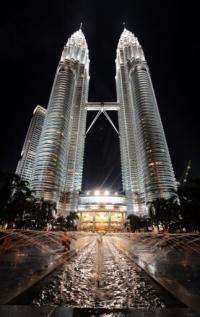
The Petronas Twin Towers in the Malaysian capital Kuala Lumpur were built with the aid of computer simulation, but no such technology was available to engineers in Paris in the late 19th century.

Outwardly simple, the geometry of the tower itself posed some mighty number-crunching problems.

The programme had to take into account a range of weather conditions on a latticework of 18,000 metal pieces and the tower's additions, calculating the load vertically, horizontally and in 3D: in all, the model has an astonishing million variables.

The tower has shrunk by some 13 centimetres (5.5 inches) over the past 120 years because it has settled under its own weight, says Roussin.

Looking to the future, the experiments show the tower's sensitivity to higher temperatures, so global warming is likely to become a bigger source of concern in decades to come.

Even so, the specialists say they are highly confident Paris' "Old Lady" will be around for the next two or three centuries.

(c) 2011 AFP

Filter


Move the slider to adjust rank threshold, so that you can hide some of the comments.


Display comments: newest first

Eikka
Jan 12, 2011

Rank: 3 / 5 (2)
Waste no opportunity to plug in global warming propaganda.
joefarah
Jan 12, 2011

Rank: 3 / 5 (2)
Congratulations on getting Global Warming into the mix. I couldn't see how it would be possible - just goes to show how global warming affects everything. Can't wait for the headlines in 300 years - GW causes Eiffel Tower to Collapse. You heard it first here.
shavera
Jan 12, 2011

Rank: not rated yet
you know, I'm even on the side of AGW and I think it was ridiculous to mention it in this article.
ekim
Jan 13, 2011

Rank: not rated yet
Would anybody here comment if Global Warming wasn't mentioned? Same with evolution, God, abortion and politics. Any boring story can be livened up with one of these references thrown in.
Rank 4 /5 (5 votes)
Relevant PhysicsForums posts

More news stories

SpotterRF debuts Radar Backpack Kit (w/ Video)

(Phys.org) -- SpotterRF has announced a special radar backpack kit designed to enhance situational awareness for soldiers on the ground. The company says its special radar is designed for warfighters as part ...

Technology / Hi Tech & Innovation

created 8 hours ago | popularity 5 / 5 (2) | comments 7 | with audio podcast report

Yahoo kills 'Livestand' just 6 months after debut

(AP) -- Yahoo is killing a tablet magazine called Livestand just six months its debut on the iPad.

Technology / Business

created 23 hours ago | popularity not rated yet | comments 1

Probability of contamination from severe nuclear reactor accidents is higher than expected: study

Catastrophic nuclear accidents such as the core meltdowns in Chernobyl and Fukushima are more likely to happen than previously assumed. Based on the operating hours of all civil nuclear reactors and the number ...

Technology / Energy & Green Tech

created May 22, 2012 | popularity 3.4 / 5 (17) | comments 49 | with audio podcast

Delphi gasoline-injection engine technique rivals hybrid's edge

(Phys.org) -- Running a diesel like engine on gasoline is something Delphi is doing in notable fashion. They claim they are on to a promising way to enjoy an engine that gives the vehicle owner high efficiency ...

Technology / Energy & Green Tech

created May 21, 2012 | popularity 4.6 / 5 (17) | comments 33 | with audio podcast report

HyperSolar shows dirty water no barrier to power world

(Phys.org) -- The Santa Barbara, California, company, HyperSolar, is set to transparently share the ups and downs of its research experiences toward the company’s ultimate vision, successfully producing ...

Technology / Energy & Green Tech

created May 24, 2012 | popularity 4.8 / 5 (14) | comments 17 | with audio podcast report


Australia hails surprise super-telescope decision

Australia has hailed a surprise decision giving it a role in a radio telescope project aimed at revolutionising astronomy, vowing to draw on its decades of experience in space science.

Astronomers seize last chance in lifetime for Venus Transit

Astronomers are gearing for one the rarest events in the Solar System: an alignment of Earth, Venus and the Sun that will not be seen for another 105 years.

Thousands of shellfish found dead in Peru

Thousands of crustaceans were found dead off the coast of Lima following the mystery mass death of dolphins and pelicans, the Peruvian Navy said Friday.

SpaceX capsule has 'new car' smell, astronauts say

SpaceX's Dragon cargo vessel smells like a new car, said astronauts at the International Space Station after opening the hatches Saturday following the spacecraft's landmark mission to the orbiting lab.

Family history of Alzheimer's affects functional connectivity

(HealthDay) -- Cognitively normal individuals with a family history of late-onset Alzheimer's disease (AD) may display lower resting state functional connectivity in the default mode network (DMN) of the brain, ...

High-speed method to aid search for solar energy storage catalysts

Eons ago, nature solved the problem of converting solar energy to fuels by inventing the process of photosynthesis.