Spiders adjust courtship signals for maximum effect
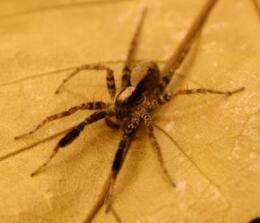
This is a male wolf spider, common to the eastern US and Canada, on leaf litter. Credit: George Uetz, University of Cincinnati
Communication is important in any relationship, but for spiders, it can be a matter of life or death.
After all, a male spider needs to convince potentially cannibalistic females that he is a suitable mate and not a meal. And new research from the University of Cincinnati shows that male wolf spiders are "leaving" little to chance when it comes to increasing their opportunities to successfully mate.
To improve the chances of the right message getting across, male Schizocosa ocreata wolf spiders, commonly found in the eastern United States and Canada, adjust the modes of their signaling (vibrations vs. visual cues) depending on the habitat (leaves, soil, rock, wood) on which they find themselves.
That's the finding of new research published in the February 2011 issue of the journal Animal Behavior. The research was carried out by George Uetz, UC professor of biology, and former UC doctoral student Shira Gordon, now a research fellow at the University of Strathclyde, Scotland.
This video is not supported by your browser at this time.
This is a male wolf spider making courtship signals on leaf litter. Credit: George Uetz, University of Cincinnati
In a series of studies by Gordon and Uetz, male wolf spiders were placed within laboratory containers on natural-habitat substrates including soil, rock, wood and leaf litter for equal amounts of time. It was found that males signaling via vibrations on leaf litter were more than twice as successful in inducing females to mate as were males signaling via vibrations on other substrates. Males signaling via vibrations on leaf litter successfully attracted a mate over 85 percent of the time. Males sending mating cues while positioned on other environmental surfaces successfully attracted a mate less than 30 percent of the time.When the spiders were given a choice of occupying any of the four substrate types, males and females visited all four but remained twice as long on leaf litter vs. the other substrates. They thus increased their opportunities for successful mating due to the efficacy of communication (seismic signaling) on leaf litter.
"Importantly, this indicates that the spiders likely recognized the difference between habitats and the efficacy of signaling via vibrations on leaf litter," said Gordon.
This efficacy of the seismic signaling for mating was measured via a laser vibrometer, a highly sensitive instrument capable of detecting the barely perceptible vibration signals of these tiny animals. The males send out these signals via body bounces and stridulation (rubbing opposing parts of special "file and scraper" organs) on these environmental surface substrates. The measurements found that such movements made atop leaves transmitted significantly more mating signal vibrations vs. those made upon other surfaces (rock, soil, wood). As a consequence, these different substrates can dramatically affect the spiders' ability to communicate.
While the male spiders did continue the leg taps and body bounces on surfaces that transmit faint or no vibrations (wood, soil, stone), the males also altered their communications to produce significantly more visual signals (raising and arching a foreleg) when placed on soil, rock or wood substrates vs. leaf-litter substrate.
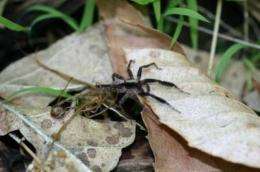
This is a male wolf spider, common to the eastern US and Canada, on leaf litter. Credit: George Uetz, University of Cincinnati
Said Uetz, "In other words, when the seismic signals aren't working due to the environment, male wolf spiders have the ability to vary their signals and shift to another communications mode. They then put more effort into another channel, this being visual cues, in order to get the desired response. We can think of it as going to plan B."He added that, traditionally, such behavioral flexibility has been considered a hallmark of vertebrate animals but not invertebrates: "These findings suggest that invertebrates have more ability to modify their behavior than has been traditionally thought to be the case. This ability enables them to compensate for the impact that an animal's environment has on its ability to communicate."
Provided by
University of Cincinnati
-
From lemons to lemonade: Reaction uses carbon dioxide to make carbon-based semiconductor,
28 comments
-
Thioridazine kills cancer stem cells in human while avoiding toxic side-effects of conventional cancer treatments,
3 comments
-
SpaceX private rocket blasts off for space station (Update),
41 comments
-
Climate scientists say they have solved riddle of rising sea,
30 comments
-
Scotland passes turbine test to harness tidal power,
41 comments
-
How do I identify different bacteria on culture plates?
8 hours ago
-
Why Do Dogs do Strange things...
May 25, 2012
-
What does exophillic and endophillic mean in terms of mosquito and their control?
May 24, 2012
-
Semen stains glows under black lights (uv light)?
May 23, 2012
-
Question on Human Chromosome 2
May 23, 2012
-
How important is composition of TBST in diluting antibodies and Western Blotting?
May 22, 2012
- More from Physics Forums - Biology
More news stories
Thousands of shellfish found dead in Peru
Thousands of crustaceans were found dead off the coast of Lima following the mystery mass death of dolphins and pelicans, the Peruvian Navy said Friday.
7 hours ago |
4.7 / 5 (3) |
4
It's in the genes: Research pinpoints how plants know when to flower
Scientists believe they've pinpointed the last crucial piece of the 80-year-old puzzle of how plants "know" when to flower.
22 hours ago |
3.9 / 5 (8) |
1
|
Researchers solve structure of human protein critical for silencing genes
In a study published in the journal Cell on May 24, Cold Spring Harbor Laboratory (CSHL) scientists describe the three-dimensional atomic structure of a human protein bound to a piece of RNA that "guides" the pr ...
23 hours ago |
4.7 / 5 (7) |
0
|
More plant species responding to global warming than previously thought
(Phys.org) -- Far more wild plant species may be responding to global warming than previous large-scale estimates have suggested.
May 22, 2012 |
4.6 / 5 (14) |
18
|
Totally rad: Scientists create rewritable digital data storage in DNA
(Phys.org) -- Scientists from Stanford's Department of Bioengineering have devised a method for repeatedly encoding, storing and erasing digital data within the DNA of living cells.
May 21, 2012 |
4.9 / 5 (15) |
11
|
SpotterRF debuts Radar Backpack Kit (w/ Video)
(Phys.org) -- SpotterRF has announced a special radar backpack kit designed to enhance situational awareness for soldiers on the ground. The company says its special radar is designed for warfighters as part ...
Australia hails surprise super-telescope decision
Australia has hailed a surprise decision giving it a role in a radio telescope project aimed at revolutionising astronomy, vowing to draw on its decades of experience in space science.
Astronomers seize last chance in lifetime for Venus Transit
Astronomers are gearing for one the rarest events in the Solar System: an alignment of Earth, Venus and the Sun that will not be seen for another 105 years.
SpaceX capsule has 'new car' smell, astronauts say
SpaceX's Dragon cargo vessel smells like a new car, said astronauts at the International Space Station after opening the hatches Saturday following the spacecraft's landmark mission to the orbiting lab.
Family history of Alzheimer's affects functional connectivity
(HealthDay) -- Cognitively normal individuals with a family history of late-onset Alzheimer's disease (AD) may display lower resting state functional connectivity in the default mode network (DMN) of the brain, ...
Astronauts enter world's 1st private supply ship
(AP) -- Space station astronauts floated into the Dragon on Saturday, a day after its heralded arrival as the world's first commercial supply ship.
