Sony stays loyal to 3D at CES gadget fest
January 6, 2011 by Glenn Chapman

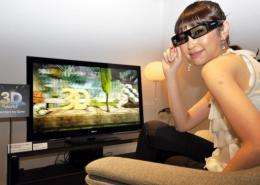
A model displays a new Sony 3D television in Tokyo

Enlarge

A model displays a new Sony 3D television in Tokyo in March 2010. Japanese electronics titan Sony is raising its bet that the future of home entertainment is 3D, as it unveils home video and photo gear in the format.

Japanese electronics titan Sony is raising its bet that the future of home entertainment is 3D, as it unveils home video and photo gear in the format.

Internet connectivity, 3D, and content streamed online were main themes as Sony showed off its latest TVs, cameras, and more during a press event on the eve of the opening of the Consumer Electronics (CES) show Thursday in Las Vegas.

"Sony has the knowledge, vision, assets and conviction to redefine television," said Sony chief executive Sir Howard Stringer.

"We are shaking up the television landscape and we will win."

Sony expanded its Bravia TV line-up with an array of new 3D models and internet-connected models.

Stringer said that Sony Entertainment film studio was pitching in major 3D films such as "The Green Hornet" slated to hit theaters this month and upcoming sequels to "Spider-Man" and "Men In Black."

Sony also has a Qriocity -- pronounced "curiosity" -- service that streams hit films on-demand to Internet-linked Bravia TVs.

A Qriocity-powered Music Unlimited service that hosts songs in the Internet "cloud" launched in Britain and Ireland in December and will expand to the United States, Canada and Europe by the end of March, according to Sony.

The Japanese giant intends to capitalize on its diversity and size by delivering films and music across a host of Internet-linked devices including Blu-Ray disc players, video game consoles, Bravia televisions, and Vaio personal computers.

Sony devoted a section of its display area at CES to its TVs that use the California Internet star's technology to merge the Internet and traditional broadcasting.

Sony also unveiled new Xperia smartphones based on the latest Android mobile operating system backed by Google.

Nearly 180 million people watch each month and more than 65 million Internet-enabled sets will ship this year, according to industry forecasts and statistics cited by Sony.

"The next big transformation is on us; the marriage between television sets and the Internet," Stringer said. "It is clear that consumers are ready for it."

Sony will add more 3D movies, video, games, and a 3Net 3D television channel to "further cement" its position in the market, according to Stringer.

The company introduced digital and still cameras for people to "personalize" the 3D experience by making their own pictures or videos in the format.

Sony also provided glimpses at prototypes of future products including "Headman" 3D headsets that can be worn like wrap-around eyeglasses but provide a theater style viewing experience.

The company is also working on a Blu-ray player that lets viewers see 3D films without the need for special glasses.

"We are showing these prototypes to provide you a glimpse into the future," said Sony executive deputy president Hiroshi Yoshioka.

"We want you to know they are on the Sony radar," he continued. "Sony is fully committed to bringing a 3D experience from every angle."

3D sets were a major theme at last year's CES, but they haven't proven to be hot sellers.

Analysts contend that people haven't been motivated to buy 3D TVs due to a dearth of content for such sets and the need to buy and keep track of special glasses for viewing.

(c) 2011 AFP

Filter


Move the slider to adjust rank threshold, so that you can hide some of the comments.


Display comments: newest first

winthrom
Jan 06, 2011

Rank: not rated yet
3D is most intriguing when the user is in a moving environment such as driving, watching races, parades, sports, and other venues that make location judgement useful. The current film, Gulliver's Travels, is a good example where this counts whereas watching "The Price is Right" is not. Given that some good content films are produced (and there are some lately) then 3D is a move forward just as color was over Black & White TV/Movies.

What is crucial is that the user should be free to watch, without special glasses (passive or active). Glasses Free technology is available, but not efficient for more than a few people and these people must be near the display screen.

Holographic projection uses so much bandwidth, that it can be broadcast only on small scale and with prodigious computing power. It can possibly be used in recorded fashion, but the player and display have not been invented yet.
Rank not rated yet
Relevant PhysicsForums posts

More news stories

MIT researchers devise new means to synchronize a group of robots (w/ Video)

(Phys.org) -- For several years, roboticists have been working out ways to get a group of robots to perform synchronized activities as demonstrated most often in dance routines. It’s not just about trying ...

Electronics / Robotics

created May 25, 2012 | popularity 5 / 5 (1) | comments 1 | with audio podcast report

Nvidia says Kai platform will turn price tide for tablets

(Phys.org) -- In March, Nvidia gave some signs that they were working to lower the cost of their Tegra 3 processors and they suggested consumers might see prices for Android tablets as low as $199. Connect ...

Electronics / Hardware

created May 24, 2012 | popularity 4.3 / 5 (4) | comments 3 | with audio podcast report

OmniVision tops up sensors for cameras, phones

(Phys.org) -- OmniVision has announced two high-resolution image sensors for the digital still and digital video camera market (DS/DVC) and higher end smartphones. In end-user language, it is a claim for superior ...

Electronics / Hardware

created May 25, 2012 | popularity 5 / 5 (6) | comments 3 | with audio podcast report

Raspberry Pi to add camera later this year

(Phys.org) -- The Raspberry Pi, a uniquely priced, no casing computer that plugs into your TV and a keyboard., will be given a camera accessory later this year. That may be “oh-so-what” news if this ...

Electronics / Hardware

created May 22, 2012 | popularity 5 / 5 (4) | comments 1 | with audio podcast report

Several iOS developers welcome Apple's larger-screen iPhone

The sixth-generation iPhone is expected to have a larger screen, and several iOS developers say they would receive that change with a warm welcome.

Electronics / Consumer & Gadgets

created May 24, 2012 | popularity 1 / 5 (4) | comments 0


SpotterRF debuts Radar Backpack Kit (w/ Video)

(Phys.org) -- SpotterRF has announced a special radar backpack kit designed to enhance situational awareness for soldiers on the ground. The company says its special radar is designed for warfighters as part ...

Australia hails surprise super-telescope decision

Australia has hailed a surprise decision giving it a role in a radio telescope project aimed at revolutionising astronomy, vowing to draw on its decades of experience in space science.

Astronomers seize last chance in lifetime for Venus Transit

Astronomers are gearing for one the rarest events in the Solar System: an alignment of Earth, Venus and the Sun that will not be seen for another 105 years.

Thousands of shellfish found dead in Peru

Thousands of crustaceans were found dead off the coast of Lima following the mystery mass death of dolphins and pelicans, the Peruvian Navy said Friday.

SpaceX capsule has 'new car' smell, astronauts say

SpaceX's Dragon cargo vessel smells like a new car, said astronauts at the International Space Station after opening the hatches Saturday following the spacecraft's landmark mission to the orbiting lab.

Family history of Alzheimer's affects functional connectivity

(HealthDay) -- Cognitively normal individuals with a family history of late-onset Alzheimer's disease (AD) may display lower resting state functional connectivity in the default mode network (DMN) of the brain, ...