Soft landing metal-based molecules create active, easy-to-separate catalyst
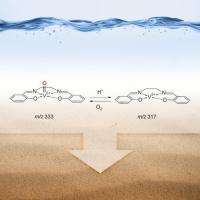
Scientists at Pacific Northwest National Laboratory, Purdue University, and National Dong Hwa University in China used an ion soft landing technique to gently deposit catalytic and acidic molecules on a tailored, “dry” surface. The dry catalyst drives the reaction in a similar fashion to the liquid-phase version; however, because the catalyst is on a solid surface, it is easy to separate from the remaining reactants and products.
A vanadium-based catalyst's effectiveness in acidic liquids can be mimicked on a solid, less-toxic surface, thanks to scientists at Pacific Northwest National Laboratory, Purdue University, and National Dong Hwa University in China. The team used an ion soft landing technique to gently deposit catalytic and acidic molecules on a tailored, "dry" surface. This new material drives the reaction in a similar fashion to the liquid-phase version, and it is better in one significant way: the catalyst is on a solid surface, making it easy to separate from the remaining reactants and products after the reactions. This avoids expensive post-processing steps.
Technologies to turn intermittent power sources into use-any-time sources of energy require fuel cells that use yet-to-be-invented catalysts. In addition, the chemical and petroleum industries crave more efficient catalysts for their reactions. Scientists at PNNL and elsewhere are working to design these efficient, easy-to-separate catalysts. But before the materials can be designed, scientists must understand how catalysts behave at the atomic and molecular levels.
"Our soft-landing study provides a fundamental understanding of the phenomena that occur when catalytic molecules are tethered to the surface," said Dr. Grant Johnson, a physical chemist and a Linus Pauling Distinguished Postdoctoral Fellow at PNNL.
Something happens when you tether a molecule to a surface. To understand what happens to certain catalyzing molecules, the scientists began with VVO(salen)+. This is an organometallic catalyst, meaning it has a metal center or active site wrapped in organic molecules. Vanadium was selected as the metal center because of its activity and ease of study.
The team generated the catalyst and a nickel-based acid or proton donor, [NiII(salen) + H]+, by electrospray ionization. Then, they used the ion soft-landing apparatus at EMSL to deposit the catalyst and the acid onto a specialized surface. This surface is a thin layer of gold topped with an inert nanometer-thick carbon-fluoride layer.
"Ion soft landing enables us to gently deposit a broad range of molecules on surfaces," said Dr. Julia Laskin, a physical chemist and principal investigator at PNNL. "And the soft landing method is selective, meaning that we know exactly what we deposit."
They studied the catalyst and acid under ultra-high vacuum. They found that over four days, the vanadium catalyst drove a reaction that combines oxygen and hydrogen, creating water. This reaction is critical to fuel cells.
After examining the results, the researchers decided to see if the reaction occurred when acids other than [NiII(salen) + H]+ were used. It did. They tried the reaction without an acid and found that the catalyst was inactive.
The researchers determined that the acid donated a proton to the surface. The proton, in turn, made the catalyst active. "A few years ago, we were watching molecules lose protons when attached to surfaces," said Laskin. "Here, we are seeing that the surface protons induce some very interesting chemistry."
The researchers are studying larger metal-centered catalysts and catalytically active nanoparticles using the soft landing approach.
More information: Peng WP, et al. 2011. "Redox Chemistry in Thin Layers of Organometallic Complexes Prepared Using Ion Soft Landing." Physical Chemistry Chemical Physics 13(1), 267-275. DOI: 10.1039/c0cp01457e
Provided by
Pacific Northwest National Laboratory
-
From lemons to lemonade: Reaction uses carbon dioxide to make carbon-based semiconductor,
28 comments
-
Thioridazine kills cancer stem cells in human while avoiding toxic side-effects of conventional cancer treatments,
3 comments
-
SpaceX private rocket blasts off for space station (Update),
41 comments
-
Climate scientists say they have solved riddle of rising sea,
30 comments
-
Scotland passes turbine test to harness tidal power,
41 comments
-
Schwartz reagent-- NMR/MS/IR
6 hours ago
-
Inversion temp
10 hours ago
-
High school chemistry EEI
17 hours ago
-
oxidation of I- by KMnO4
May 25, 2012
-
Invesion temp
May 25, 2012
-
Hybridization of SnCl3 -
May 25, 2012
- More from Physics Forums - Chemistry
More news stories
High-speed method to aid search for solar energy storage catalysts
Eons ago, nature solved the problem of converting solar energy to fuels by inventing the process of photosynthesis.
23 hours ago |
5 / 5 (3) |
3
|
From lemons to lemonade: Reaction uses carbon dioxide to make carbon-based semiconductor
(Phys.org) -- A materials scientist at Michigan Technological University has discovered a chemical reaction that not only eats up the greenhouse gas carbon dioxide, it also creates something useful. And, by ...
May 21, 2012 |
4.7 / 5 (88) |
28
|
New CO2-removing catalyst can take the heat
(Phys.org) -- The current method of removing the greenhouse gas carbon dioxide (CO2) from the flues of coal-fired power plants uses so much energy that no one bothers to use it. So says Roger Aines, principal ...
May 24, 2012 |
5 / 5 (7) |
7
|
Researchers demonstrate possible primitive mechanism of chemical info self-replication
(Phys.org) -- When scientists think about the replication of information in chemistry, they usually have in mind something akin to what happens in living organisms when DNA gets copied: a double-stranded molecule ...
May 25, 2012 |
5 / 5 (4) |
2
|
Castor oil: Action mechanism of one of the oldest drugs known to man elucidated
Castor oil is known primarily as an effective laxative; however, it was also used in ancient times with pregnant women to induce labour. Only now have scientists at the Max Planck Institute for Heart and Lung ...
May 21, 2012 |
3 / 5 (2) |
3
|
SpotterRF debuts Radar Backpack Kit (w/ Video)
(Phys.org) -- SpotterRF has announced a special radar backpack kit designed to enhance situational awareness for soldiers on the ground. The company says its special radar is designed for warfighters as part ...
Australia hails surprise super-telescope decision
Australia has hailed a surprise decision giving it a role in a radio telescope project aimed at revolutionising astronomy, vowing to draw on its decades of experience in space science.
Astronomers seize last chance in lifetime for Venus Transit
Astronomers are gearing for one the rarest events in the Solar System: an alignment of Earth, Venus and the Sun that will not be seen for another 105 years.
Thousands of shellfish found dead in Peru
Thousands of crustaceans were found dead off the coast of Lima following the mystery mass death of dolphins and pelicans, the Peruvian Navy said Friday.
SpaceX capsule has 'new car' smell, astronauts say
SpaceX's Dragon cargo vessel smells like a new car, said astronauts at the International Space Station after opening the hatches Saturday following the spacecraft's landmark mission to the orbiting lab.
Family history of Alzheimer's affects functional connectivity
(HealthDay) -- Cognitively normal individuals with a family history of late-onset Alzheimer's disease (AD) may display lower resting state functional connectivity in the default mode network (DMN) of the brain, ...