New predator 'dawn runner' discovered in early dinosaur graveyard
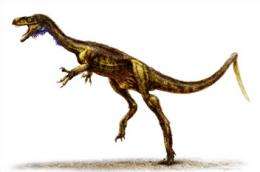
Pint-sized Eodromaeus (“dawn runner”) weighed only 10 to 15 pounds and measured about 4 feet in length from snout to tail tip. It lies very close to the ancestor of all meat-eating dinosaurs, including Tyrannosaurus. Illustration by Todd Marshall
(PhysOrg.com) -- A team of paleontologists and geologists from Argentina and the United States on Jan. 13 announced the discovery of a lanky dinosaur that roamed South America in search of prey as the age of dinosaurs began, approximately 230 million years ago.
Sporting a long neck and tail and weighing only 10 to 15 pounds, the new dinosaur has been named Eodromaeus, the "dawn runner."
"It really is the earliest look we have at the long line of meat eaters that would ultimately culminate in Tyrannosaurus rex near the end of the dinosaur era," said Paul Sereno, University of Chicago paleontologist and National Geographic Explorer-in-Residence. "Who could foretell what evolution had in store for the descendants of this pint-sized, fleet-footed predator?"
Sereno and his colleagues describe a near-complete skeleton of the new species, based on the rare discovery of two individuals found side-by-side, in the Jan. 14, 2011 issue of the journal Science. The paper presents a new snapshot of the dawn of the dinosaur eraa key period that has garnered less attention than the dinosaurs' demise. "It's more complex than some had supposed," Sereno said.
Set in picturesque foothills of the Andes, the site of discovery is known as the "Valley of the Moon," said the report's lead author, Ricardo Martinez of Argentina's National University of San Juan. For dinosaur paleontologists, it is like no other.
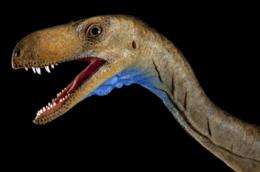
This reconstruction of Eodromaeus provides a look at the earliest stage in the evolution of the flesh-eating dinosaur lineage, called theropods, some 230 million years ago. “Dawn runner” features a scaled face for protection, saber-shaped upper teeth for snatching prey, draped neck skin for swallowing large prey and fringe of rudimentary, bristle-like feathers. Mike Hettwer
"Two generations of field work have generated the single best view we have of the birth of the dinosaurs," Martinez said. "With a hike across the valley, you literally walk over the graveyard of the earliest dinosaurs to a time when they ultimately dominate."The area was once a rift valley in the southwest corner of the supercontinent Pangaea. Sediments covered skeletons over a period of five million years, eventually accumulating a thickness of more than 2,000 feet (700 meters).
Volcanoes associated with the nascent Andes Mountains occasionally spewed volcanic ash into the valley, allowing the team to use radioactive elements in the ash layers to determine the age of the sediments.
"Radioisotopesour clocks in the rocksnot only placed the new species in time, about 230 million years ago, but also gave us perspective on the development of this key valley," said Paul Renne, director of the Berkeley Geochronology Center in California. "About five million years of time are represented in these layers, from one end to the other."
In the oldest rocks Eodromaeus lived alongside Eoraptor, a similar-sized, plant-eating dinosaur that Sereno and colleagues discovered in the valley in 1991. Eoraptor's descendants would eventually include the giant, long-necked sauropods. Eodromaeus, with stabbing canine teeth and sharp-clawed grasping hands, is the pint-sized precursor to later meat-eaters called theropods, and eventually to birds.
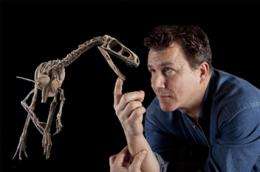
Paul Sereno, Professor in Organismal Biology & Anatomy and National Geographic Explorer-in-Residence, dates Eodromaeus from the dawn of the dinosaur era, some 230 million years ago. Photo: Mike Hettwer
"We're looking at a snapshot of early dinosaur life. Their storied evolutionary careers are just unfolding, but at this point they're actually quite similar," Sereno said.Eodromaeus at the root of the dinosaur family tree
Vexing scientific questions at the dawn of the dinosaur era include what gave them an edge over competitors, and how quickly did they rise to dominance? In Eodromaeus' day, other kinds of reptiles outnumbered dinosaurs, such as squat lizard-like rhynchosaurs and mammal-like reptiles. The authors logged thousands of fossils unearthed in the valley to find, as Martinez remarked, that "dinosaurs took their sweet time to dominate the scene."
Their competitors dropped out sequentially over several million years, not at a single horizon in the valley.
In the red cliffs on the far side of the valley, larger plant- and meat-eating dinosaurs had evolved many times the size of Eoraptor and Eodromaeus, but it would be even later when they dominated all land habitats in the succeeding Jurassic and Cretaceous periods.
"The story from this valley suggests that there was no single advantage or lucky break for dinosaurs but rather a long period of evolutionary experimentation in the shadow of other groups," Sereno said. Other researchers on the paper tracked climate change and other conditions across the layers of the valley. "The dawn of the age of dinosaurs," Martinez remarked, "is coming into focus."
More information: Ricardo N. Martinez, Paul C. Sereno, Oscar A. Alcober, Carina E. Colombi, Paul R. Renne, Isabel P. Montañez, Brian S. Currie, "A Basal Dinosaur from the Dawn of the Dinosaur Era in Southwestern Pangaea," early online edition of Science, Jan. 14, 2011.
Provided by
University of Chicago
-
From lemons to lemonade: Reaction uses carbon dioxide to make carbon-based semiconductor,
28 comments
-
Thioridazine kills cancer stem cells in human while avoiding toxic side-effects of conventional cancer treatments,
3 comments
-
SpaceX private rocket blasts off for space station (Update),
41 comments
-
Climate scientists say they have solved riddle of rising sea,
30 comments
-
Scotland passes turbine test to harness tidal power,
40 comments
-
How do I identify different bacteria on culture plates?
7 hours ago
-
Why Do Dogs do Strange things...
23 hours ago
-
What does exophillic and endophillic mean in terms of mosquito and their control?
May 24, 2012
-
Semen stains glows under black lights (uv light)?
May 23, 2012
-
Question on Human Chromosome 2
May 23, 2012
-
How important is composition of TBST in diluting antibodies and Western Blotting?
May 22, 2012
- More from Physics Forums - Biology
More news stories
Social welfare cuts ultimately come with heavy price, researchers say
(Phys.org) -- Slashing government funding for Medicaid, food stamps and other programs that serve the poor while politically popular with some lawmakers and many conservatives may do more harm ...
Other Sciences / Social Sciences
May 24, 2012 |
4.3 / 5 (12) |
98
Ancient Bethlehem seal unearthed in Jerusalem
Israeli archaeologists have discovered a 2,700-year-old seal that bears the inscription "Bethlehem," the Israel Antiquities Authority announced Wednesday, in what experts believe to be the oldest artifact ...
Other Sciences / Archaeology & Fossils
May 23, 2012 |
3.5 / 5 (14) |
22
Oldest Jewish archaeological evidence on the Iberian Peninsula
German archaeologists of the Friedrich Schiller University Jena found one of the oldest archaeological evidence so far of Jewish Culture on the Iberian Peninsula at an excavation site in the south of Portugal, ...
Other Sciences / Archaeology & Fossils
May 25, 2012 |
4.3 / 5 (4) |
12
Dollars and sense: Why are some people morally against tax?
As the U.S. presidential election campaigns heat up, the economic debate is dominated by bailouts, austerity and, inevitably, taxation. Now a new study published in Symbolic Interaction asks why tax is such an important issue ...
Other Sciences / Social Sciences
May 23, 2012 |
3 / 5 (2) |
12
Oldest art even older
New dates from Geißenklösterle Cave in Southwest Germany document the early arrival of modern humans and early appearance of art and music.
Other Sciences / Archaeology & Fossils
May 24, 2012 |
5 / 5 (2) |
6
SpotterRF debuts Radar Backpack Kit (w/ Video)
(Phys.org) -- SpotterRF has announced a special radar backpack kit designed to enhance situational awareness for soldiers on the ground. The company says its special radar is designed for warfighters as part ...
Australia hails surprise super-telescope decision
Australia has hailed a surprise decision giving it a role in a radio telescope project aimed at revolutionising astronomy, vowing to draw on its decades of experience in space science.
Astronomers seize last chance in lifetime for Venus Transit
Astronomers are gearing for one the rarest events in the Solar System: an alignment of Earth, Venus and the Sun that will not be seen for another 105 years.
Thousands of shellfish found dead in Peru
Thousands of crustaceans were found dead off the coast of Lima following the mystery mass death of dolphins and pelicans, the Peruvian Navy said Friday.
SpaceX capsule has 'new car' smell, astronauts say
SpaceX's Dragon cargo vessel smells like a new car, said astronauts at the International Space Station after opening the hatches Saturday following the spacecraft's landmark mission to the orbiting lab.
Family history of Alzheimer's affects functional connectivity
(HealthDay) -- Cognitively normal individuals with a family history of late-onset Alzheimer's disease (AD) may display lower resting state functional connectivity in the default mode network (DMN) of the brain, ...

