A pesky bacterial slime reveals its survival secrets
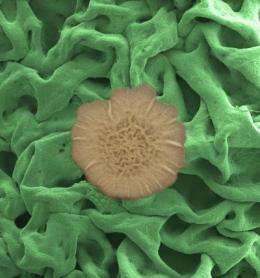
Slimy bacterial coatings known as biofilms (Bacillus subtilis colony superimposed at center) exhibit an unmatched ability to repel a wide range of liquids and even vapors. An electron microscope image shows the biofilm surface's resilient meshwork made from proteins and polysaccharides and assembled into a multiscale, hierarchical structure. Credit: Courtesy of the laboratory of Joanna Aizenberg, Harvard School of Engineering and Applied Sciences.
By rethinking what happens on the surface of things, engineers at Harvard University have discovered that Bacillus subtilis biofilm colonies exhibit an unmatched ability to repel a wide range of liquids -- and even vapors.
Centimeters across yet only hundreds of microns thick, such slimy bacterial coatings cling to the surfaces of everything from pipes to teeth and are notoriously resistant to antimicrobial agents. The researchers now suspect they know the secret to a biofilm's resiliency.
Published in the January 5th early edition of the Proceedings of the National Academy of Sciences (PNAS), the study holds promise for both creating bio-inspired non-wetting materials and developing better ways to eliminate harmful biofilms that can clog pipes, contaminate food production and water supply systems, and lead to infections.
"By looking at biofilms from a materials perspective rather than a cellular or biochemical one, we discovered that they have a remarkable ability to resist wetting to an extent never seen before in nature," says lead author Alex Epstein, a graduate student at the Harvard School of Engineering and Applied Sciences (SEAS). "In fact the biofilm literally resisted our initial efforts to study it."
The finding came about serendipitously, as the original intention of the researchers was to study the structure of the biofilm. To image the interior of the biofilm, the team had to soak it with liquids such as ethanol and acetone, which normally spread and seep easily into a surface.
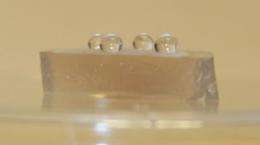
Four drops of ethanol solution placed on a Bacillus subtilis biofilm colony, the light-colored film on top of the sectioned agar gel, bead up instead of readily wetting and seeping in. This macroscopic phenomenon reveals a critical clue to what may be responsible for biofilms' broad antimicrobial resistance. Credit: Courtesy of the laboratory of Joanna Aizenberg, Harvard School of Engineering and Applied Sciences
"But to our surprise, it was impossible. The liquids kept beading up on the surface and wouldn't infiltrate the colonies," says Epstein, who is a member of the laboratory of Joanna Aizenberg, Amy Smith Berylson Professor of Materials Science at SEAS; Susan S. and Kenneth L. Wallach Professor at the Radcliffe Institute; and a core member of the Wyss Institute for Biologically Inspired Engineering at Harvard.As the Aizenberg lab studies materials and wetting, the engineers immediately recognized the significance of what they were observing. It turns out that biofilm has an unprecedented liquid-repellent surface, thereby revealing a critical clue to what may be responsible for its broad antimicrobial resistance.
Nature offers numerous examples of water-resistant surfaces, such as the lotus leaf, a longstanding inspiration for creating synthetic materials. Until now, however, no model natural systems have been found for broadly repellent materials.
While such surfaces can be manufactured, the top-down process is costly, labor intensive, and reliant on toxic chemicals and brittle structures. A biofilm, however, is living proof that only the simplest and most natural of components are requirednamely, a resilient meshwork made from proteins and polysaccharides assembled into a multi-scale, hierarchical structure.
At the same time, the finding offers a completely new perspective on how biofilms are immune to so many different types of biocides. Even the most sophisticated biochemical strategy will be ineffective if a biocide cannot enter the slime to reach the bacteria. In short, the antimicrobial activity of alcohols and other solvents becomes compromised by the strongly non-wetting behavior at clinically relevant concentrations.
The team expects that their newfound knowledge will help alert researchers to the need to consider this requirement when designing ways to destroy harmful biofilms.
"Their notorious resistance to a broad range of biocide chemistries has remained a mysterious and pressing problem despite two decades of biofilm research," says Aizenberg, a pioneer in the field of biomimicry. "By looking at it as a macroscopic problem, we found an explanation that was just slightly out of view: antimicrobials can be ineffective simply by being a non-wetting liquid that cannot penetrate into the biofilm and access subsurface cells."
Aizenberg and her colleagues speculate that such strong liquid repellence may have evolved in response to the bacteria's natural soil environment where water can leach heavy metals and other toxins.
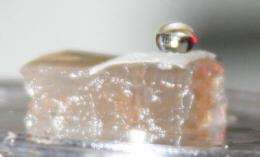
A Bacillus subtilis biofilm, the light-colored, slimy, bacterial coating on top, displays unprecedented liquid repellency as it beads up a drop of ethanol solution that has been placed on it. This remarkable ability offers both a completely new perspective on how biofilms can protect themselves from a wide range of biocides and introduces the first model natural system for broadly non-wetting materials. Credit: Courtesy of the laboratory of Joanna Aizenberg, Harvard School of Engineering and Applied Sciences.
Moreover, the property may underlie the recent success of the use of biofilm as an eco-friendly form of biocontrol for agriculture, protecting plant roots from water-borne pathogens.Looking ahead, the Harvard team plans to investigate precisely how the biochemical components of biofilms give rise to their exceptional resistance and to test the properties of other bacterial species.
"The applications are exciting, but we are equally thrilled that our findings have revealed a previously undocumented phenomenon about biofilms," says Aizenberg. "The research should be an inspiring reminder that we have only scratched the surface of how things really work."
Just as with biofilm, she adds, "It has been a challenge to get deep into the core of the problem."
Provided by
Harvard University
-
From lemons to lemonade: Reaction uses carbon dioxide to make carbon-based semiconductor,
28 comments
-
Thioridazine kills cancer stem cells in human while avoiding toxic side-effects of conventional cancer treatments,
3 comments
-
SpaceX private rocket blasts off for space station (Update),
41 comments
-
Climate scientists say they have solved riddle of rising sea,
30 comments
-
Scotland passes turbine test to harness tidal power,
40 comments
-
How do I identify different bacteria on culture plates?
7 hours ago
-
Why Do Dogs do Strange things...
23 hours ago
-
What does exophillic and endophillic mean in terms of mosquito and their control?
May 24, 2012
-
Semen stains glows under black lights (uv light)?
May 23, 2012
-
Question on Human Chromosome 2
May 23, 2012
-
How important is composition of TBST in diluting antibodies and Western Blotting?
May 22, 2012
- More from Physics Forums - Biology
More news stories
Thousands of shellfish found dead in Peru
Thousands of crustaceans were found dead off the coast of Lima following the mystery mass death of dolphins and pelicans, the Peruvian Navy said Friday.
6 hours ago |
4.7 / 5 (3) |
4
It's in the genes: Research pinpoints how plants know when to flower
Scientists believe they've pinpointed the last crucial piece of the 80-year-old puzzle of how plants "know" when to flower.
21 hours ago |
3.9 / 5 (8) |
1
|
Researchers solve structure of human protein critical for silencing genes
In a study published in the journal Cell on May 24, Cold Spring Harbor Laboratory (CSHL) scientists describe the three-dimensional atomic structure of a human protein bound to a piece of RNA that "guides" the pr ...
22 hours ago |
4.7 / 5 (7) |
0
|
More plant species responding to global warming than previously thought
(Phys.org) -- Far more wild plant species may be responding to global warming than previous large-scale estimates have suggested.
May 22, 2012 |
4.6 / 5 (14) |
18
|
Totally rad: Scientists create rewritable digital data storage in DNA
(Phys.org) -- Scientists from Stanford's Department of Bioengineering have devised a method for repeatedly encoding, storing and erasing digital data within the DNA of living cells.
May 21, 2012 |
4.9 / 5 (15) |
11
|
SpotterRF debuts Radar Backpack Kit (w/ Video)
(Phys.org) -- SpotterRF has announced a special radar backpack kit designed to enhance situational awareness for soldiers on the ground. The company says its special radar is designed for warfighters as part ...
Australia hails surprise super-telescope decision
Australia has hailed a surprise decision giving it a role in a radio telescope project aimed at revolutionising astronomy, vowing to draw on its decades of experience in space science.
Astronomers seize last chance in lifetime for Venus Transit
Astronomers are gearing for one the rarest events in the Solar System: an alignment of Earth, Venus and the Sun that will not be seen for another 105 years.
SpaceX capsule has 'new car' smell, astronauts say
SpaceX's Dragon cargo vessel smells like a new car, said astronauts at the International Space Station after opening the hatches Saturday following the spacecraft's landmark mission to the orbiting lab.
Family history of Alzheimer's affects functional connectivity
(HealthDay) -- Cognitively normal individuals with a family history of late-onset Alzheimer's disease (AD) may display lower resting state functional connectivity in the default mode network (DMN) of the brain, ...
Astronauts enter world's 1st private supply ship
(AP) -- Space station astronauts floated into the Dragon on Saturday, a day after its heralded arrival as the world's first commercial supply ship.

