Heart-targeting Listeria increase cardiac disease risk
January 26, 2011

Heart-targeting Listeria increase cardiac disease risk

Enlarge

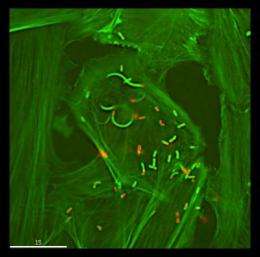
Listeria monocytogenes cardiac-invasive strain replicating and moving within infected heart cells. The bacteria (red rods) invade heart cells, multiply, and begin to move through the cell by rearranging cell structural proteins (green) that initially coat the bacteria (green and red rods) and then form long comet tails located directly behind moving bacteria. Credit: Francis Alonzo III

Certain strains of the food pathogen Listeria are uniquely adapted to infect heart tissues and may put people at a higher risk from serious cardiac disease, according to a new study published in the Journal of Medical Microbiology. Developing new diagnostic tests to identify these potentially fatal strains could protect those most at risk, such as those with heart valve replacements.

Researchers from the University of Illinois, Chicago have shown that a sub-population of the monocytogenes display an enhanced ability to infect . They found that mice infected with certain strains of L. monocytogenes had 10-15-fold more bacteria in their heart tissues than mice infected with other strains.

L. monocytogenes is a serious food-borne pathogen which may be found in soft cheeses and chilled ready-to-eat products. Less severe infections lead to gastroenteritis. Serious infections are most commonly associated with the or with the developing fetus in pregnant women. Dr Nancy Freitag who led the study explained how a subset of infections progress differently. "A significant number - about 10% - of L. monocytogenes infections involve the heart. In these cases death rate from cardiac illness is estimated to be up to 35% yet very little is known about how these bacteria infect heart tissues."

The results of the study suggest that these cardiac-associated strains display modified proteins on their surface that enable the bacteria to target the heart, leading to bacterial infection. "We found distinct genetic similarities between the cardioinvasive Listeria versus the other strains that we compared. These similarities all related to the surface proteins on the bacteria," said Dr Freitag.

The group are hoping to develop diagnostic tests based on bacterial . "These tests could be used to distinguish strains of Listeria isolated from food outbreaks, food processing plants, or from clinical infections that place patients at increased risk of ," suggested Dr Freitag. "This would allow health care workers and food safety officials to closely monitor exposed individuals."

The ability to identify cardiac-targeting strains of Listeria could improve infection outcomes and help protect vulnerable groups. "Patients with heart valve replacements or prior cardiac illness are believed to be more susceptible to Listeria cardiac infections. It is not clear exactly why this is so, but it could be that damaged tissue provides an additional entry way for infection," explained Dr Freitag. "We believe that this risk may be increased if the individuals are exposed to cardiac-targeting ," she said.

Provided by Society for General Microbiology


Rank not rated yet
Relevant PhysicsForums posts

More news stories

Thousands of shellfish found dead in Peru

Thousands of crustaceans were found dead off the coast of Lima following the mystery mass death of dolphins and pelicans, the Peruvian Navy said Friday.

Biology / Ecology

created 5 hours ago | popularity 5 / 5 (1) | comments 0

It's in the genes: Research pinpoints how plants know when to flower

Scientists believe they've pinpointed the last crucial piece of the 80-year-old puzzle of how plants "know" when to flower.

Biology / Biotechnology

created 20 hours ago | popularity 3.9 / 5 (8) | comments 1 | with audio podcast

Researchers solve structure of human protein critical for silencing genes

In a study published in the journal Cell on May 24, Cold Spring Harbor Laboratory (CSHL) scientists describe the three-dimensional atomic structure of a human protein bound to a piece of RNA that "guides" the pr ...

Biology / Cell & Microbiology

created 21 hours ago | popularity 4.7 / 5 (7) | comments 0 | with audio podcast

More plant species responding to global warming than previously thought

(Phys.org) -- Far more wild plant species may be responding to global warming than previous large-scale estimates have suggested.

Biology / Ecology

created May 22, 2012 | popularity 4.6 / 5 (14) | comments 18 | with audio podcast

Totally rad: Scientists create rewritable digital data storage in DNA

(Phys.org) -- Scientists from Stanford's Department of Bioengineering have devised a method for repeatedly encoding, storing and erasing digital data within the DNA of living cells.

Biology / Biotechnology

created May 21, 2012 | popularity 4.9 / 5 (15) | comments 11 | with audio podcast


SpotterRF debuts Radar Backpack Kit (w/ Video)

(Phys.org) -- SpotterRF has announced a special radar backpack kit designed to enhance situational awareness for soldiers on the ground. The company says its special radar is designed for warfighters as part ...

Australia hails surprise super-telescope decision

Australia has hailed a surprise decision giving it a role in a radio telescope project aimed at revolutionising astronomy, vowing to draw on its decades of experience in space science.

Astronomers seize last chance in lifetime for Venus Transit

Astronomers are gearing for one the rarest events in the Solar System: an alignment of Earth, Venus and the Sun that will not be seen for another 105 years.

SpaceX capsule has 'new car' smell, astronauts say

SpaceX's Dragon cargo vessel smells like a new car, said astronauts at the International Space Station after opening the hatches Saturday following the spacecraft's landmark mission to the orbiting lab.

Family history of Alzheimer's affects functional connectivity

(HealthDay) -- Cognitively normal individuals with a family history of late-onset Alzheimer's disease (AD) may display lower resting state functional connectivity in the default mode network (DMN) of the brain, ...

Astronauts enter world's 1st private supply ship

(AP) -- Space station astronauts floated into the Dragon on Saturday, a day after its heralded arrival as the world's first commercial supply ship.