GM chickens that don't transmit bird flu developed
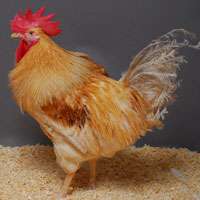
(PhysOrg.com) -- Chickens genetically modified to prevent them spreading bird flu have been produced by researchers at the Universities of Cambridge and Edinburgh.
The scientists have successfully developed genetically modified (transgenic) chickens that do not transmit avian influenza virus to other chickens with which they are in contact. This genetic modification has the potential to stop bird flu outbreaks spreading within poultry flocks. This would not only protect the health of domestic poultry but could also reduce the risk of bird flu epidemics leading to new flu virus epidemics in the human population.
The study, funded by the Biotechnology and Biological Sciences Research Council (BBSRC), is to be published in the Friday, 14 January issue of the journal Science.
Dr Laurence Tiley, Senior Lecturer in Molecular Virology from the University of Cambridge, Department of Veterinary Medicine, said: "Chickens are potential bridging hosts that can enable new strains of flu to be transmitted to humans. Preventing virus transmission in chickens should reduce the economic impact of the disease and reduce the risk posed to people exposed to the infected birds. The genetic modification we describe is a significant first step along the path to developing chickens that are completely resistant to avian flu. These particular birds are only intended for research purposes, not for consumption."
Professor Helen Sang, from The Roslin Institute at the University of Edinburgh, said, "The results achieved in this study are very encouraging. Using genetic modification to introduce genetic changes that cannot be achieved by animal breeding demonstrates the potential of GM to improve animal welfare in the poultry industry. This work could also form the basis for improving economic and food security in many regions of the world where bird flu is a significant problem."
To produce these chickens, the Cambridge and Edinburgh scientists introduced a new gene that manufactures a small "decoy" molecule that mimics an important control element of the bird flu virus. The replication machinery of the virus is tricked into recognising the decoy molecule instead of the viral genome and this interferes with the replication cycle of the virus.
When the transgenic chickens were infected with avian flu, they became sick but did not transmit the infection on to other chickens kept in the same pen with them. This was the case even if the other chickens were normal (non-transgenic) birds.
Dr Tiley continued, "The decoy mimics an essential part of the flu virus genome that is identical for all strains of influenza A. We expect the decoy to work against all strains of avian influenza and that the virus will find it difficult to evolve to escape the effects of the decoy. This is quite different from conventional flu vaccines, which need to be updated in the face of virus evolution as they tend only to protect against closely matching strains of virus and do not always prevent spread within a flock."
Professor Douglas Kell, BBSRC Chief Executive, said: "Infectious diseases of livestock represent a significant threat to global food security and the potential of pathogens, such as bird flu, to jump to humans and become pandemic has been identified by the Government as a top level national security risk. The BBSRC funds world-class research to help to protect the UK from such eventualities and the present approach provides a very exciting example of novel approaches to producing disease-resistant poultry."
More information: The paper 'Suppression of avian influenza transmission in genetically modified chickens' will be published in the 14 December 2011 edition of Science.
Provided by
University of Cambridge
-
From lemons to lemonade: Reaction uses carbon dioxide to make carbon-based semiconductor,
28 comments
-
Thioridazine kills cancer stem cells in human while avoiding toxic side-effects of conventional cancer treatments,
3 comments
-
SpaceX private rocket blasts off for space station (Update),
41 comments
-
Climate scientists say they have solved riddle of rising sea,
30 comments
-
Scotland passes turbine test to harness tidal power,
40 comments
-
How do I identify different bacteria on culture plates?
6 hours ago
-
Why Do Dogs do Strange things...
22 hours ago
-
What does exophillic and endophillic mean in terms of mosquito and their control?
May 24, 2012
-
Semen stains glows under black lights (uv light)?
May 23, 2012
-
Question on Human Chromosome 2
May 23, 2012
-
How important is composition of TBST in diluting antibodies and Western Blotting?
May 22, 2012
- More from Physics Forums - Biology
More news stories
Thousands of shellfish found dead in Peru
Thousands of crustaceans were found dead off the coast of Lima following the mystery mass death of dolphins and pelicans, the Peruvian Navy said Friday.
5 hours ago |
5 / 5 (1) |
0
It's in the genes: Research pinpoints how plants know when to flower
Scientists believe they've pinpointed the last crucial piece of the 80-year-old puzzle of how plants "know" when to flower.
20 hours ago |
3.9 / 5 (8) |
1
|
Researchers solve structure of human protein critical for silencing genes
In a study published in the journal Cell on May 24, Cold Spring Harbor Laboratory (CSHL) scientists describe the three-dimensional atomic structure of a human protein bound to a piece of RNA that "guides" the pr ...
21 hours ago |
4.7 / 5 (7) |
0
|
More plant species responding to global warming than previously thought
(Phys.org) -- Far more wild plant species may be responding to global warming than previous large-scale estimates have suggested.
May 22, 2012 |
4.6 / 5 (14) |
18
|
Totally rad: Scientists create rewritable digital data storage in DNA
(Phys.org) -- Scientists from Stanford's Department of Bioengineering have devised a method for repeatedly encoding, storing and erasing digital data within the DNA of living cells.
May 21, 2012 |
4.9 / 5 (15) |
11
|
SpotterRF debuts Radar Backpack Kit (w/ Video)
(Phys.org) -- SpotterRF has announced a special radar backpack kit designed to enhance situational awareness for soldiers on the ground. The company says its special radar is designed for warfighters as part ...
Australia hails surprise super-telescope decision
Australia has hailed a surprise decision giving it a role in a radio telescope project aimed at revolutionising astronomy, vowing to draw on its decades of experience in space science.
Astronomers seize last chance in lifetime for Venus Transit
Astronomers are gearing for one the rarest events in the Solar System: an alignment of Earth, Venus and the Sun that will not be seen for another 105 years.
SpaceX capsule has 'new car' smell, astronauts say
SpaceX's Dragon cargo vessel smells like a new car, said astronauts at the International Space Station after opening the hatches Saturday following the spacecraft's landmark mission to the orbiting lab.
Family history of Alzheimer's affects functional connectivity
(HealthDay) -- Cognitively normal individuals with a family history of late-onset Alzheimer's disease (AD) may display lower resting state functional connectivity in the default mode network (DMN) of the brain, ...
Astronauts enter world's 1st private supply ship
(AP) -- Space station astronauts floated into the Dragon on Saturday, a day after its heralded arrival as the world's first commercial supply ship.
Jan 14, 2011
Rank: not rated yet
I wonder what shits have haters to say now for that, all I know is it will be funny.
Jan 14, 2011
Rank: not rated yet
Jan 14, 2011
Rank: not rated yet
Havin only one (or just a few) breeds is nice, until the day some illness starts spreading in them. If they are similar, then that illness will spread much faster and wider.
Jan 14, 2011
Rank: not rated yet
In theory, you'd cross-breed the GM birds with the normal stock of each type of chicken. Some offspring would therefore have the new trait, some wouldn't. The fact that roughly half the crop would be immune should make it extremely unlikely to see mass infections.
However, there is an obvious problem with any GM solution, which is to say, "New genes and new protiens equals new vulnerabilities."
A hacker might design a new virus that turns the computer's anti-virus against itself.
Similarly, modified animals and plants could be vulnerable to common things "normal flora" so to speak, normally "harmless" bacteria and viruses which we don't even normally think of as causing disease in the specified species. To me, this is especially dangerous in certain types of GM where they take genes from one species and introduce them to another (i.e. eel to salmon).
You are correct. The most likely problem here is vulnerability of a single "strain" of bird to a new virus.
Jan 14, 2011
Rank: 5 / 5 (1)
So in the end, engineering the chickens to resist one disease will lead to genetic bottleneck which will make them more vulnerable to other diseases known and un-known.
Jan 14, 2011
Rank: not rated yet
And just about the record can you tell us a real example of how one breed is resistant to some chicken illnes and another isnt, not teoretically but real example. And if this gene are going to be applied , this doesn mean only this breed will be used, there are chickens for eggs, for meat ets., and about the diversity there are lots of people that looks after starnge breeds of chickens, the variety is much greater than you think, and by cross breading them you can take this gene pretty easily.
Jan 14, 2011
Rank: not rated yet
Eh? This is a known fact in the realm of pathology in humans and in animals. Although in modern times it isn't "politically correct" to say so, historically, different races of people have been shown to be more or less vulnerable to various strains of bacteria and viruses.
Smallpox was one of the things which helped finish off the easter island civilization. The Dutch sailors were carriers of the disease and transmitted it to the natives, who had no natural resistance.
Jan 14, 2011
Rank: not rated yet
In this case the chicken is resistant to something that will kill any bird, and birds are really diverse.