New glass tops steel in strength and toughness
January 10, 2011 by Lynn Yarris
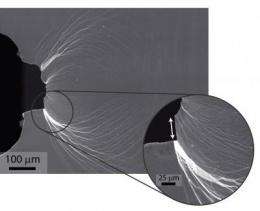
This micrograph of a deformed notch in palladium-based metallic glass shows extensive plastic shielding of an initially sharp crack. The inset is a magnified view of a shear offset (arrow) developed during plastic sliding before the crack opened. Credit: Image courtesy of Ritchie and Demetriou
(PhysOrg.com) -- Glass stronger and tougher than steel? A new type of damage-tolerant metallic glass, demonstrating a strength and toughness beyond that of any known material, has been developed and tested by a collaboration of researchers with the U.S. Department of Energy (DOE)'s Lawrence Berkeley National Laboratory (Berkeley Lab)and the California Institute of Technology. What's more, even better versions of this new glass may be on the way.
"These results mark the first use of a new strategy for metallic glass fabrication and we believe we can use it to make glass that will be even stronger and more tough," says Robert Ritchie, a materials scientist who led the Berkeley contribution to the research.
The new metallic glass is a microalloy featuring palladium, a metal with a high "bulk-to-shear" stiffness ratio that counteracts the intrinsic brittleness of glassy materials.
"Because of the high bulk-to-shear modulus ratio of palladium-containing material, the energy needed to form shear bands is much lower than the energy required to turn these shear bands into cracks," Ritchie says. "The result is that glass undergoes extensive plasticity in response to stress, allowing it to bend rather than crack."
Ritchie, who holds joint appointments with Berkeley Lab's Materials Sciences Division and the University of California (UC) Berkeley's Materials Science and Engineering Department, is one of the co-authors of a paper describing this research published in the journal Nature Materials under the title "A Damage-Tolerant Glass."
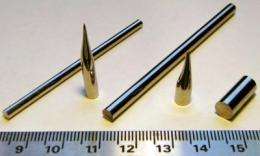
These are glassy palladium rods, with diameters ranging from 3 to 6 mm. Credit: Caltech/Marios D. Demetriou
Co-authoring the Nature Materials paper were Marios Demetriou (who actually made the new glass), Maximilien Launey, Glenn Garrett, Joseph Schramm, Douglas Hofmann and William Johnson of Cal Tech, one of the pioneers in the field of metallic glass fabrication.Glassy materials have a non-crystalline, amorphous structure that make them inherently strong but invariably brittle. Whereas the crystalline structure of metals can provide microstructural obstacles (inclusions, grain boundaries, etc.,) that inhibit cracks from propagating, there's nothing in the amorphous structure of a glass to stop crack propagation. The problem is especially acute in metallic glasses, where single shear bands can form and extend throughout the material leading to catastrophic failures at vanishingly small strains.
In earlier work, the Berkeley-Cal Tech collaboration fabricated a metallic glass, dubbed "DH3," in which the propagation of cracks was blocked by the introduction of a second, crystalline phase of the metal. This crystalline phase, which took the form of dendritic patterns permeating the amorphous structure of the glass, erected microstructural barriers to prevent an opened crack from spreading. In this new work, the collaboration has produced a pure glass material whose unique chemical composition acts to promote extensive plasticity through the formation of multiple shear bands before the bands turn into cracks.
"Our game now is to try and extend this approach of inducing extensive plasticity prior to fracture to other metallic glasses through changes in composition," Ritchie says. "The addition of the palladium provides our amorphous material with an unusual capacity for extensive plastic shielding ahead of an opening crack. This promotes a fracture toughness comparable to those of the toughest materials known. The rare combination of toughness and strength, or damage tolerance, extends beyond the benchmark ranges established by the toughest and strongest materials known."
The initial samples of the new metallic glass were microalloys of palladium with phosphorous, silicon and germanium that yielded glass rods approximately one millimeter in diameter. Adding silver to the mix enabled the Cal Tech researchers to expand the thickness of the glass rods to six millimeters. The size of the metallic glass is limited by the need to rapidly cool or "quench" the liquid metals for the final amorphous structure.
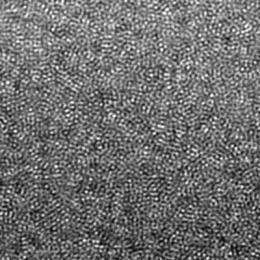
A transmission electron micrograph shows the amorphous structure of glassy palladium. (The area shown is 10 nm x 10 nm.) Credit: Caltech/Marios D. Demetriou
"The rule of thumb is that to make a metallic glass we need to have at least five elements so that when we quench the material, it doesn't know what crystal structure to form and defaults to amorphous," Ritchie says.The new metallic glass was fabricated by co-author Demetriou at Cal Tech in the laboratory of co-author Johnson. Characterization and testing was done at Berkeley Lab by Ritchie's group.
"Traditionally strength and toughness have been mutually exclusive properties in materials, which makes these new metallic glasses so intellectually exciting," Ritchie says. "We're bucking the trend here and pushing the envelope of the damage tolerance that's accessible to a structural metal."
Provided by
Lawrence Berkeley National Laboratory
-
From lemons to lemonade: Reaction uses carbon dioxide to make carbon-based semiconductor,
28 comments
-
Thioridazine kills cancer stem cells in human while avoiding toxic side-effects of conventional cancer treatments,
3 comments
-
SpaceX private rocket blasts off for space station (Update),
41 comments
-
Climate scientists say they have solved riddle of rising sea,
30 comments
-
Scotland passes turbine test to harness tidal power,
40 comments
-
Transparency of molten substances?
May 25, 2012
-
saturated paramagnetic and ferromagnetic
May 24, 2012
-
How to calculate the bandstructure of Twisted Bilayer Graphene
May 23, 2012
-
vast computational richness from swapping one proton
May 22, 2012
-
Oscillator strength of mixed LH- and HH-excitons
May 22, 2012
-
2D Quantum Well and k-values
May 21, 2012
- More from Physics Forums - Atomic, Solid State, Comp. Physics
More news stories
Landmark calculation clears the way to answering how matter is formed
(Phys.org) -- An international collaboration of scientists, including Thomas Blum, associate professor of physics, is reporting in landmark detail the decay process of a subatomic particle called a kaon ...
May 25, 2012 |
4.6 / 5 (15) |
42
|
Is a classical electrodynamics law incompatible with special relativity?
(Phys.org) -- The laws of classical electromagnetism that were developed in the 19th century are the same laws that scientists use today. They include Maxwell’s four equations along with the Lorentz la ...
Lying in wait for WIMPs: Researchers seek to dramatically increase sensitivity of Large Underground Xenon detector
Although it's invisible, dark matter accounts for at least 80 percent of the matter in the universe. No one knows what it is, but most scientists would bet on weakly interacting massive particles, or WIMPs.
May 23, 2012 |
4 / 5 (5) |
14
|
Hall effect at the speed of light: How can you demonstrate relativistic effects with your mobile phone?
The relativistic Hall effect describing objects rotating at speeds comparable with the speed of light has been reported.
May 21, 2012 |
4.3 / 5 (3) |
8
Cloak of invisibility: Engineers use plasmonics to create an invisible photodetector
A team of engineers at Stanford and the University of Pennsylvania has for the first time used "plasmonic cloaking" to create a device that can see without being seen - an invisible machine that detects light. It is the first ...
May 21, 2012 |
4.8 / 5 (16) |
7
|
SpotterRF debuts Radar Backpack Kit (w/ Video)
(Phys.org) -- SpotterRF has announced a special radar backpack kit designed to enhance situational awareness for soldiers on the ground. The company says its special radar is designed for warfighters as part ...
Australia hails surprise super-telescope decision
Australia has hailed a surprise decision giving it a role in a radio telescope project aimed at revolutionising astronomy, vowing to draw on its decades of experience in space science.
Astronomers seize last chance in lifetime for Venus Transit
Astronomers are gearing for one the rarest events in the Solar System: an alignment of Earth, Venus and the Sun that will not be seen for another 105 years.
SpaceX capsule has 'new car' smell, astronauts say
SpaceX's Dragon cargo vessel smells like a new car, said astronauts at the International Space Station after opening the hatches Saturday following the spacecraft's landmark mission to the orbiting lab.
Family history of Alzheimer's affects functional connectivity
(HealthDay) -- Cognitively normal individuals with a family history of late-onset Alzheimer's disease (AD) may display lower resting state functional connectivity in the default mode network (DMN) of the brain, ...
Thousands of shellfish found dead in Peru
Thousands of crustaceans were found dead off the coast of Lima following the mystery mass death of dolphins and pelicans, the Peruvian Navy said Friday.


Jan 10, 2011
Rank: not rated yet
Jan 10, 2011
Rank: 5 / 5 (6)
Star Trek will never die.
Jan 10, 2011
Rank: 5 / 5 (3)
Usually not.
Jan 10, 2011
Rank: 5 / 5 (3)
Jan 10, 2011
Rank: 5 / 5 (3)
"Metals reflect most of the light because they have free electrons. These electrons are shaken by the electric field of the the light which is an electromagnetic wave. Shaken electrons emit two waves. One in the direction of the incoming wave that is seen as the reflected wave and one similar in the same direction as the incoming wave which, added with it, give a zero amplitude wave."
Ah, the power of the interwebs.
Jan 10, 2011
Rank: 3.7 / 5 (3)
LOL, you beat me to it. I was thinking the same thing as soon as I read the article.
@jwalkeriii Wasn't there recent news of Japan finding a way to produce Palladium artificially? Maybe a joint production could be worked out.
Jan 10, 2011
Rank: 5 / 5 (5)
Jan 10, 2011
Rank: 1 / 5 (2)
I am sure the Chinese are licking their chops as
they control 97% of the worlds rare materials.
Jan 10, 2011
Rank: 4.9 / 5 (8)
Jan 10, 2011
Rank: 5 / 5 (2)
Transparent aluminum, in the form of aluminum oxide, has been around for millions of years, as evidenced by sapphires and rubies.
Jan 10, 2011
Rank: 2.7 / 5 (6)
And a Sapphire is no more transparent aluminum than rust is red steel.
Jan 10, 2011
Rank: not rated yet
You are right that there was a discovery, but it was Japan that discovered it. The article is here about China's artificial Palladium:
physorg.com/news/2010-12-japan-nano-tech-team-palladium-like-alloy.html
Jan 10, 2011
Rank: 5 / 5 (7)
Just because the most common glass is that stuff in your window doesn't mean all glass has to be made of silicon oxide.
The term "glass" describes a solid with an amorphous crystaline structure, it can be made from lots of things including metals.
Jan 11, 2011
Rank: 3 / 5 (4)
Deliberate hypebole for the uninformed. This is metallic glass, not the stuff your see through beyond your steering wheels. Certainly this nose-bleed inducing pricey Paladium microalloys will have its use, but Star Trek fans looking for transparent aluminum will have to wait or look elsewhere.
Jan 11, 2011
Rank: 2.3 / 5 (3)
Jan 11, 2011
Rank: not rated yet
Jan 11, 2011
Rank: 2 / 5 (4)
No kidding. Glass is commonly known as the see through silicon stuff, not metal. To refer to metals as glass is wrong I don't care what the dictionary definition is. It should be called amorphous if it isn't common glass. And while the scientific usage is correct this is recent, the word glass was around long before we knew what amorphous was. In other words we got it wrong, (common) glass is amorphous, amorphous isn't necessarily glass. That's my opinion and I'm sticking with it (unless I'm wrong). I demand that all dictionary and Wikipedia definitions be changed immediately too.
Jan 11, 2011
Rank: 2.3 / 5 (3)
If we made common glass crystalline with grains would we call it metal?
Jan 11, 2011
Rank: not rated yet
Graphene is approx. 217 stronger than steel and harder than diamonds. The elementary constituent of graphene is carbon. Graphene is transparent but is neither glass nor metal.
Jan 11, 2011
Rank: 1 / 5 (2)
No, what you really meant was "'it seems to imply' glass that has metal's characteristic" The term has already been coined to mean exactly what it is. I am sorry they didnt consult you when deciding what to call their material when Caltech first created them.
Jan 11, 2011
Rank: 1 / 5 (2)
–adjective
1.
of, pertaining to, or consisting of metal.
2.
of the nature of or suggesting metal, as in luster, resonance, or hardness: metallic green; a harsh metallic sound.
-- Random House
knock off the arrogant (and wrong) grammar checks. Metalic Glass is correct. Mostly because those who created the material decided to call it that (and they have naming rights). But also because the english language supports their use.
Jan 11, 2011
Rank: 3 / 5 (4)
Jan 11, 2011
Rank: 2.3 / 5 (3)
So metallic glass is glass that has metal's properties (which is wrong in this discussion). Just like red shirt, black face, ...arrogant, sanctimonious pricks. There is plenty more. Tradition doesn't mean it is grammatically right.
Jan 12, 2011
Rank: not rated yet
Jan 16, 2011
Rank: 1 / 5 (6)
Jan 17, 2011
Rank: not rated yet
I am sure the Chinese are licking their chops as
they control 97% of the worlds rare materials.
They control 97% of the worlds rare earth mineral production. There is a ridiculous difference between that and actually controlling 97% of all rare earth minerals. Ridiculous.
No, we as a nation are ridiculous for not strategically supporting our rare earth mining companies that all went out of business under the GW Bush administration - when he let that strategically important business go to China. Another example of how Bush and our self-serving politicians/government made us more secure.