Calculating water footprints of animal, plant proteins
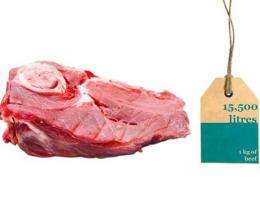
Many times more water is needed for the production of meat and other animal products, such as eggs and dairy produce, than for the production of plant products. The University of Twente (The Netherlands) has for the first time calculated the exact water footprint of both animal and plant products per kilo, per calorie and per protein. Among the results of the calculations are that beef uses up twenty times more water per calorie than grain or potatoes. In combination with the growing world population, this is putting pressure on the earth's freshwater resources: only three percent of all the water on earth is fresh, and only a small proportion of this is available for human use.
The Twente Water Centre, the University of Twente's centre of expertise in the area of water systems and governance, has developed a specialism in the calculation of the water footprint of products and production methods. Many companies make use of this expertise, out of cost considerations and because they are increasingly confronted with water shortages. For the first time, it has now been calculated how much fresh water is needed for the production of all common protein products. For a kilo of beef, for example, 15,000 litres are needed. Pork uses up 6,000 litres of water per kilo and chicken 4,300 litres. 4,000 litres of water are needed for a kilo of pulses, while a kilo of soya beans uses up 'just' 2,100 litres. Per gram of protein, meat has a water footprint that is 1.5 to 6 times larger than that for pulses. There are also great differences between animal and plant products when the water use per calorie is calculated. Beef, for example, scores on average twenty times higher than grain or potatoes.
The key distinguishing factor between the various types of meat is the type and amount of feed that is needed to allow the animal to grow. For example, a cow has to eat much more to put on a kilo of flesh than a chicken or a pig does. According to Arjen Hoekstra, professor of Water Engineering & Management at the University of Twente, "what is known as feed conversion efficiency partly determines the water footprint. After all, all animal feed is produced with the use of water. Irrigation is therefore needed in large parts of the world because there is too little rainfall in general or in particular periods."
The location where the livestock is raised also determines the water footprint. Livestock that grazes outdoors uses up rainwater that is naturally present in grass, while livestock in industrialized animal production is given more feed, which originates from fields that sometimes have to be irrigated. The researchers from the University of Twente have therefore also taken into account the type of feed and its origin, which is sometimes in areas with a water shortage. The water demands of livestock breeding in the western world can therefore contribute to water shortages elsewhere. For example, a number of rivers in China are drying up before they reach the sea, partly because of the irrigation of agricultural land where animal feed is grown.
Johan van de Gronden, director of the WWF in the Netherlands, says: "The figures say a lot about the often hidden consequences of our everyday consumption pattern for the natural world. We already knew that a low-meat diet is not only healthier, but also better for nature and the climate. Now we can also see that unbridled meat consumption contributes to water shortages in other parts of the world. We don't need to become vegetarians en masse to give nature a helping hand. Just one meat-free day per week already makes a world of difference."
More information: The report The green, blue and grey water footprint of farm animals and animal products can be downloaded from: www.waterfootprint.org/Reports … malProducts-Vol1.pdf .
Provided by University of Twente


