Fluorescent color of coral larvae predicts whether they'll settle or swim
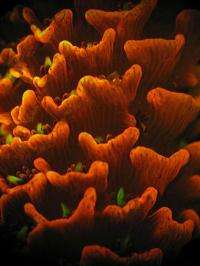
This is a red fluorescent variety of an adult Acropora millepora coral. Credit: Mikhail Matz, The University of Texas at Austin
Young staghorn coral that fluoresce redder are less likely to settle and develop into coral polyps than their greener peers, University of Texas at Austin biologists have discovered.
The finding may help scientists monitor how corals adapt to global warming because the less likely coral larvae are to settle, the more likely they will disperse from their reef of origin.
"By simply looking at the color of a larval population, we may soon be able to say which larvae are going to be long-range dispersers and which will be short-range dispersers," says Mikhail "Misha" Matz, assistant professor of biology. "Under global warming, we expect a lot of evolution of this particular life history trait."
Matz says researchers expect to see long-range dispersers starting to win, because the corals need to shift to cooler latitudes.
The research was published this week in Proceedings of the Royal Society B.
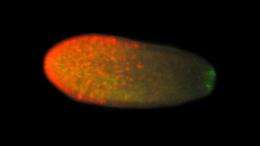
This is a 5-day-old Acropora millepora coral larva, ready for settlement. Credit: Mikhail Matz, The University of Texas at Austin
For the study, Matz and his colleagues crossed different color morphs of the small staghorn coral, Acropora millepora, and exposed the offspring larvae to a settlement cue ground-up calcareous red algae. The scientists observed that larvae inheriting redder fluorescent color from their parents were less likely to settle and metamorphose into reef-building polyps than greener larvae.Coral response to the settlement cue is under strong genetic control, but it's not clear yet how that is linked with fluorescence.
Matz says the correlation between settlement and fluorescence could be completely random, that the genes that determine color and the genes that determine settlement are only next to each other in the chromosome and have no functional connection. In that case, they would simply be inherited together.
Alternatively, fluorescence could somehow be related genetically to the capacity of larvae to sense the proximity of a coral reef, and thus have a more direct correlation.
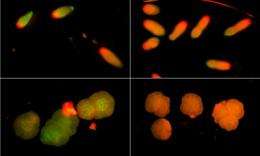
Sibling larvae of the coral Acropora millepora before metamorphosis (top) and young polyps after metamorphosis (bottom) represent two of the most contrasting family groups obtained by crossing various color morphs of adult corals (greener on the left, redder on the right). Credit: Mikhail Matz, The University of Texas at Austin
Matz and his colleagues will be investigating these two possibilities in further research. But in either case, Matz says the color of coral larvae fluorescence could serve as a viable marker as to whether they are settlers or swimmers.The big question still remains as to why corals fluoresce in such spectacular colors.
"Bright, multicolored fluorescence of reef-building corals is one of the most spectacular and least understood visual phenomena in the ocean," says Matz, "and we still have no idea what purpose it serves. But our discovery is a really good lead towards determining the function of fluorescence."
Provided by
University of Texas at Austin
-
From lemons to lemonade: Reaction uses carbon dioxide to make carbon-based semiconductor,
28 comments
-
Thioridazine kills cancer stem cells in human while avoiding toxic side-effects of conventional cancer treatments,
3 comments
-
SpaceX private rocket blasts off for space station (Update),
41 comments
-
Climate scientists say they have solved riddle of rising sea,
30 comments
-
Scotland passes turbine test to harness tidal power,
40 comments
-
How do I identify different bacteria on culture plates?
5 hours ago
-
Why Do Dogs do Strange things...
21 hours ago
-
What does exophillic and endophillic mean in terms of mosquito and their control?
May 24, 2012
-
Semen stains glows under black lights (uv light)?
May 23, 2012
-
Question on Human Chromosome 2
May 23, 2012
-
How important is composition of TBST in diluting antibodies and Western Blotting?
May 22, 2012
- More from Physics Forums - Biology
More news stories
Thousands of shellfish found dead in Peru
Thousands of crustaceans were found dead off the coast of Lima following the mystery mass death of dolphins and pelicans, the Peruvian Navy said Friday.
4 hours ago |
5 / 5 (1) |
0
It's in the genes: Research pinpoints how plants know when to flower
Scientists believe they've pinpointed the last crucial piece of the 80-year-old puzzle of how plants "know" when to flower.
19 hours ago |
3.9 / 5 (8) |
1
|
Researchers solve structure of human protein critical for silencing genes
In a study published in the journal Cell on May 24, Cold Spring Harbor Laboratory (CSHL) scientists describe the three-dimensional atomic structure of a human protein bound to a piece of RNA that "guides" the pr ...
19 hours ago |
4.7 / 5 (7) |
0
|
More plant species responding to global warming than previously thought
(Phys.org) -- Far more wild plant species may be responding to global warming than previous large-scale estimates have suggested.
May 22, 2012 |
4.7 / 5 (13) |
17
|
Totally rad: Scientists create rewritable digital data storage in DNA
(Phys.org) -- Scientists from Stanford's Department of Bioengineering have devised a method for repeatedly encoding, storing and erasing digital data within the DNA of living cells.
May 21, 2012 |
4.9 / 5 (15) |
11
|
SpotterRF debuts Radar Backpack Kit (w/ Video)
(Phys.org) -- SpotterRF has announced a special radar backpack kit designed to enhance situational awareness for soldiers on the ground. The company says its special radar is designed for warfighters as part ...
Australia hails surprise super-telescope decision
Australia has hailed a surprise decision giving it a role in a radio telescope project aimed at revolutionising astronomy, vowing to draw on its decades of experience in space science.
Astronomers seize last chance in lifetime for Venus Transit
Astronomers are gearing for one the rarest events in the Solar System: an alignment of Earth, Venus and the Sun that will not be seen for another 105 years.
SpaceX capsule has 'new car' smell, astronauts say
SpaceX's Dragon cargo vessel smells like a new car, said astronauts at the International Space Station after opening the hatches Saturday following the spacecraft's landmark mission to the orbiting lab.
Family history of Alzheimer's affects functional connectivity
(HealthDay) -- Cognitively normal individuals with a family history of late-onset Alzheimer's disease (AD) may display lower resting state functional connectivity in the default mode network (DMN) of the brain, ...
Transvaginal mesh op restores pelvic organ prolapse at price
(HealthDay) -- Transvaginal mesh (TVM) procedures are effective for anatomical restoration of pelvic organ prolapse (POP), but patients report a worsening of sexual function following surgery, according to ...

