Different evolutionary paths lead plants and animals to the same crossroads
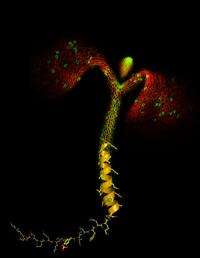
Despite their divergent evolutionary history, membrane-bound kinase receptors in animals and plants rely on similar regulatory mechanisms to control their activity. Credit: Image: Courtesy of Yvon Jaillard, Michael Hothorn and Jamie Simon, Salk Institute for Biological Studies
In analyzing the molecular sensor for the plant growth hormone brassinolide, researchers at the Salk Institute for Biological Studies discovered that although plants took an evolutionary path different from their animal cousins, they arrived at similar solutions to a common problem: How to reliably receive and process incoming signals.
The team's findings, published in the February 1, 2011 issue of Genes and Development, revealed that so-called tyrosine phosphorylationused as an "on" or "off" switch and long thought to be a feature unique to animal cellsis a mechanism conserved across the animal and plant kingdoms.
"There seem to be only so many ways to build a robust signaling system," says Howard Hughes Medical Institute investigator Joanne Chory, Ph.D., professor and director of the Plant Molecular and Cellular Biology Laboratory and holder of the Howard H. and Maryam R. Newman Chair, "and plants and animals have hit upon the same mechanisms."
As different as they may seem, both mammalian and plant cells need to be able to perceive small molecule hormones to respond to changes in the environment. While human cells draw on a wide variety of sensor molecules, including more than 800 different G-protein-coupled receptors, 48 known nuclear hormone receptors and 72 receptor kinases, plants rely mostly on the latter.
"This group of receptors is by far the largest one in plants," says postdoctoral researcher and co-first author Michael Hothorn, "but we don't know much about the activation mechanism apart from 'there's a bunch of new phosphorylations.'"
Kinases transfer phosphate groups to proteins and come in two principal flavors: They either attach the phosphate group to the amino acid tyrosine within the protein or to serine or threonine. The vast majority of receptor kinases in animals possess tyrosine kinase activity, while only a few are specific for serine-threonine.
With the exception of a small handful of dual-specificity kinases, all plant receptor kinases have been pegged as serine-threonine kinases. One of few known outliers is the receptor for brassinolide, a key element of plants' response to light. "Binding of brassinolide to its receptor allows plants to adjust growth when they need to outcompete their neighbors to reach more light or water," explains postdoctoral researcher and co-first author Yvon Jaillais. "But at the same time the receptor needs to be tightly regulated so plants don't waste their resources when they don't have to."
The brassinolide receptor BRI1 is kept in a relatively inactive state by its intracellular tail and a small inhibitory protein known as BKI1. Based on earlier studies in Chory's lab, the Salk researchers knew that autophosphorylation of the receptor was necessary, but what triggered the release of the inhibitory protein remained unclear.
In an effort to understand the activation mechanism, the Salk researchers discovered that BKI1 acts through two evolutionarily conserved motifs: a 20-amino- acid sequence that binds the receptor kinase domain and a lysine-arginine-rich motif that anchors the inhibitory peptide to the plasma membrane. Phosphorylation of a key tyrosine within the membrane-targeting motif releases BKI1 from the membrane, relieving kinase inhibition and allowing the formation of an active signaling complex.
The phosphorylation of BKI1 is not only the first documented example of tyrosine transphosphorylation in plants, the underlying principle also closely resembles the mechanism used by bona fide receptor tyrosine kinases to regulate their activity. "Plant and animal receptor kinases evolved independently, yet their activation relies on similar mechanisms," says Chory.
By defining common features in plant and animal receptor signaling pathways, the Salk researchers hope to learn more about what the requirements for a robust signaling system are. Although plants don't encode canonical tyrosine kinases in their genomes, tyrosine phosphorylation will emerge as an important topic in plant signaling, predicts Hothorn.
Provided by
Salk Institute
-
From lemons to lemonade: Reaction uses carbon dioxide to make carbon-based semiconductor,
28 comments
-
Thioridazine kills cancer stem cells in human while avoiding toxic side-effects of conventional cancer treatments,
3 comments
-
SpaceX private rocket blasts off for space station (Update),
41 comments
-
Climate scientists say they have solved riddle of rising sea,
30 comments
-
Scotland passes turbine test to harness tidal power,
40 comments
-
How do I identify different bacteria on culture plates?
5 hours ago
-
Why Do Dogs do Strange things...
21 hours ago
-
What does exophillic and endophillic mean in terms of mosquito and their control?
May 24, 2012
-
Semen stains glows under black lights (uv light)?
May 23, 2012
-
Question on Human Chromosome 2
May 23, 2012
-
How important is composition of TBST in diluting antibodies and Western Blotting?
May 22, 2012
- More from Physics Forums - Biology
More news stories
Thousands of shellfish found dead in Peru
Thousands of crustaceans were found dead off the coast of Lima following the mystery mass death of dolphins and pelicans, the Peruvian Navy said Friday.
4 hours ago |
5 / 5 (1) |
0
It's in the genes: Research pinpoints how plants know when to flower
Scientists believe they've pinpointed the last crucial piece of the 80-year-old puzzle of how plants "know" when to flower.
19 hours ago |
3.9 / 5 (8) |
1
|
Researchers solve structure of human protein critical for silencing genes
In a study published in the journal Cell on May 24, Cold Spring Harbor Laboratory (CSHL) scientists describe the three-dimensional atomic structure of a human protein bound to a piece of RNA that "guides" the pr ...
19 hours ago |
4.7 / 5 (7) |
0
|
More plant species responding to global warming than previously thought
(Phys.org) -- Far more wild plant species may be responding to global warming than previous large-scale estimates have suggested.
May 22, 2012 |
4.7 / 5 (13) |
17
|
Totally rad: Scientists create rewritable digital data storage in DNA
(Phys.org) -- Scientists from Stanford's Department of Bioengineering have devised a method for repeatedly encoding, storing and erasing digital data within the DNA of living cells.
May 21, 2012 |
4.9 / 5 (15) |
11
|
SpotterRF debuts Radar Backpack Kit (w/ Video)
(Phys.org) -- SpotterRF has announced a special radar backpack kit designed to enhance situational awareness for soldiers on the ground. The company says its special radar is designed for warfighters as part ...
Australia hails surprise super-telescope decision
Australia has hailed a surprise decision giving it a role in a radio telescope project aimed at revolutionising astronomy, vowing to draw on its decades of experience in space science.
Astronomers seize last chance in lifetime for Venus Transit
Astronomers are gearing for one the rarest events in the Solar System: an alignment of Earth, Venus and the Sun that will not be seen for another 105 years.
SpaceX capsule has 'new car' smell, astronauts say
SpaceX's Dragon cargo vessel smells like a new car, said astronauts at the International Space Station after opening the hatches Saturday following the spacecraft's landmark mission to the orbiting lab.
Family history of Alzheimer's affects functional connectivity
(HealthDay) -- Cognitively normal individuals with a family history of late-onset Alzheimer's disease (AD) may display lower resting state functional connectivity in the default mode network (DMN) of the brain, ...
Transvaginal mesh op restores pelvic organ prolapse at price
(HealthDay) -- Transvaginal mesh (TVM) procedures are effective for anatomical restoration of pelvic organ prolapse (POP), but patients report a worsening of sexual function following surgery, according to ...
Jan 31, 2011
Rank: 5 / 5 (4)
Feb 01, 2011
Rank: 1 / 5 (1)
Feb 01, 2011
Rank: 1 / 5 (11)
Evolutionists have a really big, big, BIG headache with plants. There is no clear evidence of ANY kind of evolutionary development. Most of the fossils dated in their billions of years look exactly like the stuff that exists today. There's no easily expressed method to classify or build an evolutionary tree. Right now there's multiple suggestions and lots of arguments about what is related to what or what preceded what. The word "conserved" gives away the nonsense that is evolutionary thought: It basically means "we're stumped that there should even be a hint of commonality between X and Y".
It makes so much more sense from a biblical perspective that all animal and human life was given plants to eat in the beginning by a common designer.
Feb 01, 2011
Rank: 1 / 5 (6)
Feb 01, 2011
Rank: 4.2 / 5 (5)
Feb 01, 2011
Rank: 5 / 5 (3)
Why yes, that makes perfect sense!
Everything just suddenly existed because of the whim of some sort of being that existed...before everything existed? Wait I'm confused now. Did this entity exist before it made everything exist, or does it exist because it made everything exist?
Feb 01, 2011
Rank: 5 / 5 (7)
Utter rubbish. You, literally, just made that up, obviously.
For anyone interested in the evolution of plants, I'd suggest the wiki article "Plant_Evolution" as a decent starter, with the references as further light reading.
Also known as 'scientific debate'.
Feb 01, 2011
Rank: 5 / 5 (7)
Oh, what a tangled web we weave, when first we practice to deceive, eh Kevin?
Animals have evolved to eat what's available. Of *course* they have. As always you stress the "random" element of evolution - which is to say, mutation - but fail to account for selection. Which is not random.
Mutation + selection = evolution. Pretty simple stuff. No magical sky fairy required. And I must say - you do your cause no favours with your flimsy attempts. What you think to achieve with your dishonest posts, so lacking in logic is beyond me. Perhaps I should say: 'god only knows' ;-) lol
Feb 01, 2011
Rank: 5 / 5 (4)
What motivates such a strange bird?
Feb 02, 2011
Rank: 5 / 5 (3)
More
Feb 02, 2011
Rank: 5 / 5 (2)
When was the Flood Kevin?Except that the Earth is vastly more than 10,000 years old, the designer needs a designer, the flood never happened and we have megatons of evidence for evolution.
If the Flood happened why can't you tell us when it did, Kevin?
Ethelred
Feb 05, 2011
Rank: not rated yet
Feb 06, 2011
Rank: not rated yet
Random mutation. They usually don't breed.
Mar 03, 2011
Rank: not rated yet