Study shows plants moved downhill, not up, in warming world
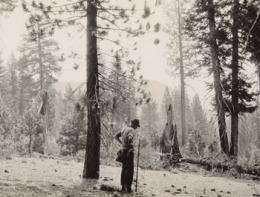
Data collected during the Wieslander vegetation survey in the 1920s and 1930s were used in the new climate study. (Marian Koshland Library, UC Berkeley archival photo)
(PhysOrg.com) -- In a paper published today in the journal Science, a University of California, Davis, researcher and his co-authors challenge a widely held assumption that plants will move uphill in response to warmer temperatures.
Between 1930 and 2000, instead of colonizing higher elevations to maintain a constant temperature, many California plant species instead moved downhill an average of 260 feet, said Jonathan Greenberg, an assistant project scientist at the UC Davis Center for Spatial Technologies and Remote Sensing.
"While the climate warmed significantly in this period, there was also more precipitation. These wetter conditions are allowing plants to exist in warmer locations than they were previously capable of," Greenberg said.
Many forecasts say climate change will cause a number of plants and animals to migrate to new ranges or become extinct. That research has largely been based on the assumption that temperature is the dominant driver of species distributions. However, Greenberg said the new study reveals that other factors, such as precipitation, may be more important than temperature in defining the habitable range of these species.
The findings could have global relevance, because many locations north of 45 degrees latitude (which includes the northernmost United States, virtually all of Canada and Russia, and most of Europe) have had increased precipitation in the past century, and global climate models generally predict that trend will continue, the authors said.
"As we continue to improve our understanding of climate-change impacts on species, we will help land managers and policy makers to make more informed decisions on, for instance, conservation efforts for threatened and endangered species," Greenberg said.
He added that the study underlines the importance of an investment in basic science, as the results are based on historical data collected by the U.S. Forest Service in the 1930s, a program that was supported by New Deal spending after the Great Depression.
Provided by
UC Davis
-
Soviet find of water on the Moon in the 1970s ignored by the West,
50 comments
-
Teenager reportedly finds solution to 350 year old math and physics problem,
70 comments
-
New small solid oxide fuel cell reaches record efficiency,
77 comments
-
Global wave of Flame cyber attacks called staggering,
28 comments
-
Hubble shows Milky Way is destined for head-on collision with Andromeda galaxy,
82 comments
-
bacterial pathways for water contamination, asking resident microbiologist
Jun 02, 2012
-
Relation between reproduction and age
Jun 01, 2012
-
Animals with Pre frontal Cortex?
May 31, 2012
-
mechanisms for waking you up
May 29, 2012
-
osmotic pressure vs diffusion
May 27, 2012
-
How do I identify different bacteria on culture plates?
May 26, 2012
- More from Physics Forums - Biology
More news stories
First genome-wide assessment of secretion in human cells
(Phys.org) -- An international collaboration between scientists in University College Dublin and the European Molecular Biology Laboratory (EMBL) has revealed for the first time that 15% of the proteins encoded ...
5 hours ago |
5 / 5 (1) |
0
|
Molecular algebra in mammalian cells
(Phys.org) -- Mammalian cells can now do what an electronic calculator can: perform logical calculations. Swiss researchers have equipped cells with a complex genetic network that can do more than just one ...
6 hours ago |
5 / 5 (1) |
2
|
Solved: Two of the historic riddles of horse racing
(Phys.org) -- A team of researchers examining DNA extracted from the skeletons of historic horses in order to throw light on the origin of diseases found in modern horses have, in the course of their work, solved some of ...
6 hours ago |
not rated yet |
0
|
'Most comprehensive' genetic analysis of maize plant will help raise yields, expand its range
An international research team involving 17 institutions including Cold Spring Harbor Laboratory has published the most comprehensive analysis to date of the maize genome. It is an achievement that substantially increases sc ...
4 hours ago |
not rated yet |
0
Filming life in the fast lane
New microscope enabled scientists at EMBL Heidelberg to film a fruit fly embryo, in 3D, from when it was about two-and-a-half hours old until it walked away from the microscope as a larva.
4 hours ago |
5 / 5 (1) |
0
Underground search for neutrino properties unveils first results
Scientists studying neutrinos have found with the highest degree of sensitivity yet that these mysterious particles behave like other elementary particles at the quantum level. The results shed light on the ...
Friction almost vanishes in microscale graphite
(Phys.org) -- In the phenomenon of superlubricity, two solid surfaces can slide past each other with almost no friction. The effect occurs when the solid surfaces have crystalline structures and their lattices ...
Giant black hole kicked out of home galaxy
(Phys.org) -- Astronomers have found strong evidence that a massive black hole is being ejected from its host galaxy at a speed of several million miles per hour. New observations from NASA's Chandra X-ray ...
Ancient jugs hold the secret to practical mathematics in Biblical times
Archaeologists in the eastern Mediterranean region have been unearthing spherical jugs, used by the ancients for storing and trading oil, wine, and other valuable commodities. Because we're used to the metric system, which ...
SpaceX has big plans for launches
SpaceX, the upstart company that shot a capsule to the International Space Station and back last week, won't have much time to savor its first major success.
Scientists create faster, more sensitive photodetector by tricking graphene
(Phys.org) -- Researchers at the Center for Nanophysics and Advanced Materials of the University of Maryland have developed a new type of hot electron bolometer a sensitive detector of infrared light, that ...
Jan 20, 2011
Rank: 1 / 5 (1)
Jan 20, 2011
Rank: 3.7 / 5 (3)
If you look at high mountains, when you go higher in elevation the temperature gets colder. There is a point where the trees change from broad leaf to conifer and then a higher point where the trees thin out and then stop. Above that, there is only ground plants like grass and shrubs. If you go even higher, there is almost no vegitation at all, and even higher you'll find permanent ice caps. It was assumed that if you warm up the air, then those plants will all be able to grow at higher elevations because it's not as cold as it used to be.
This article doesn't really say whether the max elevation of the tree line changed or not. It says that the minimum elevations went lower, but it didn't say if the total area increased or decreased. I wonder which it was?
Jan 21, 2011
Rank: 1 / 5 (1)
The guy was saying that this study only applies to a part of northern California. He said that plants in other places ARE moving up hill and that this is a special case, which is why they are studying it. He said that the main conclusion for him is that it shows how different areas will respond differently to temperature changes, and that the old assumption that temperature is the biggest factor is wrong in at least this cases.
Jan 21, 2011
Rank: 1 / 5 (1)