'Cornell Dots' that light up cancer cells go into clinical trials
January 31, 2011 By Bill Steele

'Cornell Dots' that light up cancer cells go into clinical trials

Enlarge

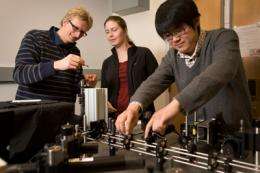
Ulrich Wiesner, left, works with graduate students Jennifer Drewes and Kai Ma to characterize the size and brightness of C dots in their Bard Hall lab. Photo: Jason Koski

(PhysOrg.com) -- "Cornell Dots" – brightly glowing nanoparticles – may soon be used to light up cancer cells to aid in diagnosing and treating cancer. The U.S. Food and Drug Administration (FDA) has approved the first clinical trial in humans of the new technology. It is the first time the FDA has approved using an inorganic material in the same fashion as a drug in humans.

"The FDA approval finally puts a federal approval stamp on all the assumptions we have been working under for years. This is really, really nice," said Ulrich Wiesner, the Spencer T. Olin Professor of Materials Science and Engineering, who has devoted eight years of research to developing the .

"Cancer is a terrible disease, and my family has a long history of it. I, thus, have a particular personal motivation to work in this area."

The trial with five melanoma patients at Memorial Sloan-Kettering Center (MSKCC) in New York City will seek to verify that the dots, also known as C dots, are safe and effective in humans, and to provide data to guide future applications. "This is the first product of its kind. We want to make sure it does what we expect it to do," said Michelle Bradbury, M.D., radiologist at MSKCC and assistant professor of radiology at Weill Cornell Medical College.

C dots are silica spheres less than 8 nanometers in diameter that enclose several dye molecules. The silica shell, essentially glass, is chemically inert and small enough to pass through the body and out in the urine. For clinical applications, the dots are coated with polyethylene glycol so the body will not recognize them as foreign substances.

To make the dots stick to tumor cells, organic molecules that bind to tumor surfaces or even specific locations within tumors can be attached to the shell. When exposed to near-infrared light, the dots fluoresce much brighter than unencapsulated dye to serve as a beacon to identify the target cells. The technology, the researchers say, can show the extent of a tumor's blood vessels, cell death, treatment response and invasive or metastatic spread to lymph nodes and distant organs. The safety and ability to be cleared from the body by the kidneys has been confirmed by studies in mice at MSKCC, reported in the January 2009 issue of the journal (Vol. 9 No. 1).

For the human trials, the dots will be labeled with radioactive iodine, which makes them visible in PET scans to show how many dots are taken up by tumors and where else in the body they go and for how long.

"We do expect it to go to other organs," Bradbury said. "We get numbers, and from that curve derive how much dose each organ gets. And we need to find out how fast it passes through. Are they cleared from the kidney at the same rate as in mice?"

One of many advantages of C dots, Bradbury noted, is that they remain in the body long enough for surgery to be completed. "Surgeons love optical," she said. "They don't need the radioactivity, but [our study] confirms what the optical signal is. As you learn that, eventually you no longer need the radioactivity."

On the other hand, she added, the dots also may serve as a carrier to deliver radioactivity or drugs to tumors. "This is step one to jump-start a process we think will do multiple things with one platform," she said.

First-generation Cornell dots were developed in 2005 by Hooisweng Ow, then a graduate student working with Wiesner. Wiesner, Ow and Kenneth Wang '77 have co-founded the company Hybrid Silica Technologies to commercialize the invention. The dots, Wiesner said, also have possible applications in displays, optical computing, sensors and such microarrays as DNA chips.

Provided by Cornell University search and more info website

Filter


Move the slider to adjust rank threshold, so that you can hide some of the comments.


Display comments: newest first

joefarah
Jan 31, 2011

Rank: 5 / 5 (1)
Great to see this technology finally going to trials. I suspect it will turn out to be even more useful than expected in treating cancer. So please move quickly. Hopefully production and training can ramp up fast.
Rank 5 /5 (11 votes)
Relevant PhysicsForums posts

More news stories

Dopant gives graphene solar cells highest efficiency yet

(Phys.org) -- By taking advantage of graphene’s favorable electrical and optical properties, and then adding an organic dopant, researchers have achieved the highest power conversion efficiency yet for ...

Nanotechnology / Nanophysics

created May 21, 2012 | popularity 5 / 5 (10) | comments 14 | with audio podcast feature

Nanomedicine: Quantum dots appear safe in pioneering study on primates

A pioneering study to gauge the toxicity of quantum dots in primates has found the tiny crystals to be safe over a one-year period, a hopeful outcome for doctors and scientists seeking new ways to battle diseases ...

Nanotechnology / Bio & Medicine

created May 20, 2012 | popularity 4.3 / 5 (3) | comments 8 | with audio podcast

In nanorod crystal growth, nanoparticles seen as artificial atoms

In the growth of crystals, do nanoparticles act as "artificial atoms" forming molecular-type building blocks that can assemble into complex structures? This is the contention of a major but controversial theory ...

Nanotechnology / Nanophysics

created May 24, 2012 | popularity 4.8 / 5 (6) | comments 0 | with audio podcast

Synthetic nano-waste does not disappear

(Phys.org) -- Tiny particles of cerium oxide do not burn or change in the heat of a waste incineration plant. They remain intact on combustion residues or in the incineration system, as a new study by Swiss ...

Nanotechnology / Bio & Medicine

created May 25, 2012 | popularity 5 / 5 (1) | comments 1 | with audio podcast

First direct observation of oriented attachment in nanocrystal growth

Berkeley Lab researchers have reported the first direct observation of nanoparticles undergoing oriented attachment, the critical step in biomineralization and the growth of nanocrystals. A better understanding ...

Nanotechnology / Nanophysics

created May 24, 2012 | popularity 4.7 / 5 (3) | comments 0 | with audio podcast


SpotterRF debuts Radar Backpack Kit (w/ Video)

(Phys.org) -- SpotterRF has announced a special radar backpack kit designed to enhance situational awareness for soldiers on the ground. The company says its special radar is designed for warfighters as part ...

Family history of Alzheimer's affects functional connectivity

(HealthDay) -- Cognitively normal individuals with a family history of late-onset Alzheimer's disease (AD) may display lower resting state functional connectivity in the default mode network (DMN) of the brain, ...

Transvaginal mesh op restores pelvic organ prolapse at price

(HealthDay) -- Transvaginal mesh (TVM) procedures are effective for anatomical restoration of pelvic organ prolapse (POP), but patients report a worsening of sexual function following surgery, according to ...

Travel to high altitudes tied to Crohn's, colitis flare-ups

(HealthDay) -- People with inflammatory bowel disease, which includes Crohn's disease and colitis, may be at increased risk for flare-ups when they fly or travel to high altitudes for skiing or mountain climbing, ...

Thousands of shellfish found dead in Peru

Thousands of crustaceans were found dead off the coast of Lima following the mystery mass death of dolphins and pelicans, the Peruvian Navy said Friday.

Astronomers seize last chance in lifetime for Venus Transit

Astronomers are gearing for one the rarest events in the Solar System: an alignment of Earth, Venus and the Sun that will not be seen for another 105 years.