Getting salty: Can beet juice, other alternatives help to keep the nation's highways ice-free?
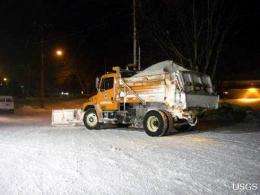
While beautiful to look at, snow turns roadways into skating rinks. Coming to the rescue is the humble sodium chloride, also known as salt, which is far and away the simplest and most frequently used deicing agent on the planet.
But some cities are exploring new ways to make salt work smarter this winter. Perfect timing and beet juice may help put winter roads on a low-sodium diet.
But whatever is used to clear the roads, there needs to be a lot of it since the United States uses 20 million tons of salt per year in road maintenance. Most of that salt comes from American mines, where it's both plentiful and nearly dirt cheap (road salt costs about $60per ton).
"Cost certainly is a factor -- because salt is around in big quantities, it's basically a commodity, and it's not too expensive," said Wilfrid Nixon, a professor of civil and environmental engineering at the University of Iowa in Iowa City. "Getting the substance on the road and having it act to stop the snow and ice to stop sticking from the road is relatively easy with salt."
Salt dissolves into ice molecules and lowers the temperature at which they will melt, keeping more ice from forming on roads. But when temperatures drop below 15 degrees Farenheit, regular salt loses its oomph.
There are also environmental concerns. When melting snow washes the salt from the roads, the chemicals can end up in local streams and rivers, spiking salinity and threatening aquatic life. A 2010 study found that water samples from streams in 13 northern cities showed levels of chloride that, according to Environmental Protection Agency criteria, indicate a potentially toxic environment.
"We were actually surprised about what we saw in the water samples," said Steven Corsi, an hydrologist with the U.S. Geological Survey's Wisconsin Water Center and one of the researchers who conducted the study. "The severity and the frequency of high concentrations of salt weren't expected."
Corsi said that because road salt can take a long time to make its way into shallow groundwater, salt levels can spike long after the snow is gone.
Cutting Back On The Salt
"It's all about understanding the nature of each storm," said Bret Hodne, director of public works in West Des Moines, Iowa.
Hodne monitors pavement temperatures -- which can be very different from ambient air temperatures during a storm.
When pavement is frozen it forms a molecular bond with water and ice. Breaking that bond requires lot of salt. Hodne said studies have shown that if the bond between the snow and the pavement is stopped before it starts, a coating effect makes the snow slide off the pavement, and four times less salt is needed. That translates to big savings for cities and towns.
At lower temperatures, Hodne's team mixes salt with calcium chloride or magnesium chloride. These salts release energy when mixed with water, creating instant heat to melt ice; however, they aren't as readily available and they need to be stored in a special way. To make it stick more firmly to the roadway, they pre-wet this mixture before it's sprayed on the roads.
"It depends on the roadway, but pre-wetting [the roadways] can reduce the amount of salt we use by 30 percent because it prevents salt from being blown off the road by trucks," said Hodne.
Adding carbohydrates can increase the stickiness of salt brine. Hodne's team mixes liquid sugar beet derivatives from a farm into their salt. Other cities use whey from cheese-making facilities. These organic materials reduce the amount of corrosion from the salt, keep it working at lower temperatures and make the coating last longer.
"Where maybe we had a treatment that lasted 24 hours in the past, now we're seeing it stick for five to 10 days," said Hodne.
For these cities, a one-size-fits-all approach to salt is becoming a thing of the past.
"Most cities are aware that they don't want to overuse," said Nixon. "Instead of just putting the same amount of chemical down all the way along a route, it's becoming possible to automatically change the quantity of chemical along the road."
Even with advances in chemistry and new techniques, salt is likely to remain the best way to clear the roads in the near future.
Provided by Inside Science News Service


