New research shows rivers cut deep notches in the Alps' broad glacial valleys
December 5, 2010

New research shows rivers cut deep notches in the Alps' broad glacial valleys

Enlarge

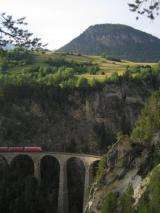
A train crosses a river gorge in the Swiss Alps that drops steeply from the floor of the broad glacial valley above it. Credit: Oliver Korup

For years, geologists have argued about the processes that formed steep inner gorges in the broad glacial valleys of the Swiss Alps.

The U-shaped valleys were created by slow-moving that behaved something like road graders, eroding the bedrock over hundreds or thousands of years. When the glaciers receded, carved V-shaped notches, or inner gorges, into the floors of the glacial valleys. But scientists disagreed about whether those notches were erased by subsequent glaciers and then formed all over again as the second round of glaciers receded.

New research led by a University of Washington scientist indicates that the notches endure, at least in part, from one glacial episode to the next. The glaciers appear to fill the gorges with ice and rock, protecting them from being scoured away as the glaciers move.

When the glaciers receded, the resulting rivers returned to the gorges and easily cleared out the debris deposited there, said David Montgomery, a UW professor of Earth and space sciences.

"The alpine inner gorges appear to lay low and endure glacial attack. They are topographic survivors," Montgomery said.

"The answer is not so simple that the glaciers always win. The river valleys can hide under the glaciers and when the glaciers melt the rivers can go back to work."

Montgomery is lead author of a paper describing the research, published online Dec. 5 in Nature Geoscience. Co-author is Oliver Korup of the University of Potsdam in Germany, who did the work while with the Swiss Federal Research Institutes in Davos, Switzerland.

The researchers used topographic data taken from laser-based (LIDAR) measurements to determine that, if the gorges were erased with each glacial episode, the rivers would have had to erode the bedrock from one-third to three-quarters of an inch per year since the last to get gorges as deep as they are today.

"That is screamingly fast. It's really too fast for the processes," Montgomery said. Such erosion rates would exceed those in all areas of the world except the most tectonically active regions, the researchers said, and they would have to maintain those rates for 1,000 years.

Montgomery and Korup found other telltale evidence, sediment from much higher elevations and older than the last glacial deposits, at the bottom of the river gorges. That material likely was pushed into the gorges as glaciers moved down the valleys, indicating the gorges formed before the last glaciers.

"That means the glaciers aren't cutting down the bedrock as fast as the rivers do. If the glaciers were keeping up, each time they'd be able to erase the notch left by the river," Montgomery said.

"They're locked in this dance, working together to tear the mountains down."

The work raises questions about how common the preservation of gorges might be in other mountainous regions of the world.

"It shows that inner gorges can persist, and so the question is, 'How typical is that?' I don't think every inner gorge in the world survives multiple glaciations like that, but the are a classic case. That's where mountain glaciation was first discovered."

Provided by University of Washington search and more info website

4.2 /5 (5 votes)  

Filter


Move the slider to adjust rank threshold, so that you can hide some of the comments.


Display comments: newest first

kevinrtrs
Dec 06, 2010

Rank: 1 / 5 (9)
The one huge assumption here is that gorges form over thousands of years at a nice slow "geologic" rate. This is because the researchers are blindly adhering to the uniformatarian timescales and rejecting the very evidence in front of them that contradict it.
Note the exclamation against fast formation in this statement:
That is screamingly fast. Its really too fast for the processes, Montgomery said. Such erosion rates would exceed those in all areas of the world except the most tectonically active regions, the researchers said, and they would have to maintain those rates for 1,000 years.
They have the same problem with the formation of the Grand Canyon-which couldn't have formed over millions of years since the necessary erosion isn't present.Instead all these gorges formed very quickly when gigantic amounts of water drained off in a short period of months. Yes, it was during the worldwide flood. All the evidence is there, people just don't like the implications. God exists.
Nik_2213
Dec 06, 2010

Rank: 5 / 5 (1)
"Yes, it was during the worldwide flood."

Sorry, the geological evidence does NOT support your hypothesis. The Scabbed Badlands etc were due to the repeated sudden draining of a massive glacial lake when its ice-dam failed. FWIW, the Grand Canyon's origins may still be a puzzle, but it does NOT show the characteristics of a mega-flood. Please, go Google.....
R_R
Dec 06, 2010

Rank: 1 / 5 (5)
Perhaps these georges contridict that glaciers flowed here 12000 years ago because glaciers did not flow here 12000 years ago.
SDMike
Dec 06, 2010

Rank: 1 / 5 (2)
This is the first time the glaciers have melted because this is the first time that man produced all the CO2. Therefore these so called river valleys must have been created by the glaciers themselves. (The World according to Gore)
R_R
Dec 08, 2010

Rank: 1 / 5 (1)
So even though these supposed mighty glaciers carved massive valleys out of solid bedrock, the gorges were protected their entire path as though with some miraculous forcefield. I guess just about any nonsense will suffice these days to protect the Ice Age lie. Just ignore the obvious explanation and "puff", problem solved.
Rank 4.2 /5 (5 votes)
Relevant PhysicsForums posts

More news stories

Astronomers seize last chance in lifetime for Venus Transit

Astronomers are gearing for one the rarest events in the Solar System: an alignment of Earth, Venus and the Sun that will not be seen for another 105 years.

Space & Earth / Astronomy

created 2 hours ago | popularity 5 / 5 (1) | comments 0

Australia hails surprise super-telescope decision

Australia has hailed a surprise decision giving it a role in a radio telescope project aimed at revolutionising astronomy, vowing to draw on its decades of experience in space science.

Space & Earth / Astronomy

created 2 hours ago | popularity not rated yet | comments 0

SpaceX capsule has 'new car' smell, astronauts say

SpaceX's Dragon cargo vessel smells like a new car, said astronauts at the International Space Station after opening the hatches Saturday following the spacecraft's landmark mission to the orbiting lab.

Space & Earth / Space Exploration

created 2 hours ago | popularity not rated yet | comments 0

Astronauts enter world's 1st private supply ship

(AP) -- Space station astronauts floated into the Dragon on Saturday, a day after its heralded arrival as the world's first commercial supply ship.

Space & Earth / Space Exploration

created 2 hours ago | popularity 5 / 5 (2) | comments 0

Dragon makes history with space station docking

The private company SpaceX made history Friday with the docking of its Dragon capsule to the International Space Station, the most impressive feat yet in turning routine spaceflight over to the commercial ...

Space & Earth / Space Exploration

created 17 hours ago | popularity 4.9 / 5 (7) | comments 0


Family history of Alzheimer's affects functional connectivity

(HealthDay) -- Cognitively normal individuals with a family history of late-onset Alzheimer's disease (AD) may display lower resting state functional connectivity in the default mode network (DMN) of the brain, ...

SpotterRF debuts Radar Backpack Kit (w/ Video)

(Phys.org) -- SpotterRF has announced a special radar backpack kit designed to enhance situational awareness for soldiers on the ground. The company says its special radar is designed for warfighters as part ...

Transvaginal mesh op restores pelvic organ prolapse at price

(HealthDay) -- Transvaginal mesh (TVM) procedures are effective for anatomical restoration of pelvic organ prolapse (POP), but patients report a worsening of sexual function following surgery, according to ...

Travel to high altitudes tied to Crohn's, colitis flare-ups

(HealthDay) -- People with inflammatory bowel disease, which includes Crohn's disease and colitis, may be at increased risk for flare-ups when they fly or travel to high altitudes for skiing or mountain climbing, ...

Thousands of shellfish found dead in Peru

Thousands of crustaceans were found dead off the coast of Lima following the mystery mass death of dolphins and pelicans, the Peruvian Navy said Friday.

Oldest Jewish archaeological evidence on the Iberian Peninsula

German archaeologists of the Friedrich Schiller University Jena found one of the oldest archaeological evidence so far of Jewish Culture on the Iberian Peninsula at an excavation site in the south of Portugal, ...