Quantum dots are not dots: physicists
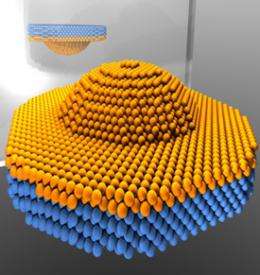
Quantum dots are solid-state "artificial atoms" that are made up of thousands of atoms (yellow spheres) embedded in a semiconductor (blue spheres). Despite this complexity, the photon emission properties of quantum dots were hitherto believed to be like traditional atoms, where a point-emitter description is sufficient. Due to their mesoscopic dimensions, however, the point-emitter description is revealed to break down by comparing photon emission from quantum dots with opposite orientations relative to a metallic mirror.
Researchers from the Quantum Photonics Group at DTU Fotonik in collaboration with the Niels Bohr Institute, University of Copenhagen surprise the scientific world with the discovery that light emission from solid-state photon emitters, the so-called quantum dots, is fundamentally different than hitherto believed. The new insight may find important applications as a way to improve efficiency of quantum information devices. Their findings are published on December 19th 2010 in Nature Physics.
Today it is possible to fabricate and tailor highly efficient light sources that emit a single photon at a time, which constitutes the fundamental unit of light. Such emitters are referred to as quantum dots and consist of thousands of atoms. Despite the expectations reflected in this terminology, quantum dots cannot be described as point sources of light, which leads to the surprising conclusion: quantum dots are not dots!
This new insight was realized by experimentally recording photon emission from quantum dots positioned close to a metallic mirror. Point sources of light have the same properties whether or not they are flipped upside down, and this was expected to be the case for quantum dots as well. However, this fundamental symmetry was found to be violated in the experiments at DTU where a very pronounced dependence of the photon emission on the orientation of the quantum dots was observed.
The experimental findings are in excellent agreement with a new theory of light-matter interaction developed by DTU-researchers in collaboration with Anders S. Sørensen from the Niels Bohr Institute. The theory takes the spatial extent of quantum dots into account.
At the metal mirror surface, highly confined optical surface modes exist; the so-called plasmons. Plasmonics is a very active and promising research field, and the strong confinement of photons, available in plasmonics, may have applications for quantum information science or solar energy harvesting. The strong confinement of plasmons also implies that photon emission from quantum dots can be strongly altered, and that quantum dots can excite plasmons with very large probability. The present work demonstrates that the excitation of plasmons can be even more efficient than previously thought. Thus the fact that quantum dots are extended over areas much larger than atomic dimensions implies that they can interact more efficiently with plasmons.
The work may pave the way for new nanophotonic devices that exploit the spatial extent of quantum dots as a novel resource. The new effect is expected to be important also in other research areas than plasmonics, including photonic crystals, cavity quantum electrodynamics, and light harvesting.
More information: Article in Nature Physics: http://dx.doi.org/ … 38/NPHYS1870
Provided by University of Copenhagen
-
From lemons to lemonade: Reaction uses carbon dioxide to make carbon-based semiconductor,
28 comments
-
Thioridazine kills cancer stem cells in human while avoiding toxic side-effects of conventional cancer treatments,
3 comments
-
SpaceX private rocket blasts off for space station (Update),
41 comments
-
Climate scientists say they have solved riddle of rising sea,
30 comments
-
Scotland passes turbine test to harness tidal power,
40 comments
-
How can squinting be used by both a myopic & hyperopic eye?
1 hour ago
-
The need for practical electronic and mechanical skills for aspiring experimentalists
6 hours ago
-
Refraction and splitting of a photon
8 hours ago
-
Total pressure load on a chain...
9 hours ago
-
Water under pressure and temperature effects
12 hours ago
-
Flow, different liquid, pressure
12 hours ago
- More from Physics Forums - General Physics
More news stories
Dopant gives graphene solar cells highest efficiency yet
(Phys.org) -- By taking advantage of graphenes favorable electrical and optical properties, and then adding an organic dopant, researchers have achieved the highest power conversion efficiency yet for ...
Nanomedicine: Quantum dots appear safe in pioneering study on primates
A pioneering study to gauge the toxicity of quantum dots in primates has found the tiny crystals to be safe over a one-year period, a hopeful outcome for doctors and scientists seeking new ways to battle diseases ...
Nanotechnology / Bio & Medicine
May 20, 2012 |
4.3 / 5 (3) |
8
|
In nanorod crystal growth, nanoparticles seen as artificial atoms
In the growth of crystals, do nanoparticles act as "artificial atoms" forming molecular-type building blocks that can assemble into complex structures? This is the contention of a major but controversial theory ...
May 24, 2012 |
4.8 / 5 (6) |
0
|
Synthetic nano-waste does not disappear
(Phys.org) -- Tiny particles of cerium oxide do not burn or change in the heat of a waste incineration plant. They remain intact on combustion residues or in the incineration system, as a new study by Swiss ...
Nanotechnology / Bio & Medicine
May 25, 2012 |
5 / 5 (1) |
1
|
First direct observation of oriented attachment in nanocrystal growth
Berkeley Lab researchers have reported the first direct observation of nanoparticles undergoing oriented attachment, the critical step in biomineralization and the growth of nanocrystals. A better understanding ...
May 24, 2012 |
4.7 / 5 (3) |
0
|
Family history of Alzheimer's affects functional connectivity
(HealthDay) -- Cognitively normal individuals with a family history of late-onset Alzheimer's disease (AD) may display lower resting state functional connectivity in the default mode network (DMN) of the brain, ...
SpotterRF debuts Radar Backpack Kit (w/ Video)
(Phys.org) -- SpotterRF has announced a special radar backpack kit designed to enhance situational awareness for soldiers on the ground. The company says its special radar is designed for warfighters as part ...
Transvaginal mesh op restores pelvic organ prolapse at price
(HealthDay) -- Transvaginal mesh (TVM) procedures are effective for anatomical restoration of pelvic organ prolapse (POP), but patients report a worsening of sexual function following surgery, according to ...
Travel to high altitudes tied to Crohn's, colitis flare-ups
(HealthDay) -- People with inflammatory bowel disease, which includes Crohn's disease and colitis, may be at increased risk for flare-ups when they fly or travel to high altitudes for skiing or mountain climbing, ...
Thousands of shellfish found dead in Peru
Thousands of crustaceans were found dead off the coast of Lima following the mystery mass death of dolphins and pelicans, the Peruvian Navy said Friday.
Astronomers seize last chance in lifetime for Venus Transit
Astronomers are gearing for one the rarest events in the Solar System: an alignment of Earth, Venus and the Sun that will not be seen for another 105 years.
Dec 21, 2010
Rank: 3 / 5 (2)
Dec 21, 2010
Rank: 3.3 / 5 (3)
Dec 21, 2010
Rank: 3.6 / 5 (5)
I get the application in spintronics and potentially optical/plasmonic devices, but the scale they are talking about "thousands of atoms" is really huge compared to the smallest transistors that have already been made.
The 4nm transistor that Intel has promised by 2022 ( slower than Moore's Law predicts,) has only 7 atoms in a planar configuration.
Optical transistors should be useful for future 3d architectures, but the electronic transistors we have are already strictly better than these things in pure 2d applications, (except in true "quantum" device,) re. problem of scale.
A 1000 atom "dot" is 143 times the volume of the 7 atom, 4nm transistor. A 16nm transistor would have volume under 905 atoms if it thickness equal width.
the nano-lasers I've seen are much larger than the 16nm process, and have often 2 or 3 layers of metals. To be useful, they need to be down to the scale of 2 shells of atoms around 1 atom: ~50 - 60 atoms
Dec 21, 2010
Rank: 4.5 / 5 (2)
This means fewer would fit in the same space, and because they are farther apart...because they're bigger...you have longer signal delay, defeating one of the main purpose of using them in the first place.
Dec 21, 2010
Rank: not rated yet
Dec 21, 2010
Rank: not rated yet
Dec 21, 2010
Rank: not rated yet
Dec 21, 2010
Rank: 5 / 5 (2)
Precisely. I suggested that the Koch Snowflake in discusing how to transition to a "psuedo 3-d" architecture a few days ago on the main forum.
Intel's 3-d transistor is a step in the right direction, as are optical transistors which will become integral, but this sort of "fractal" architecture is going to require a manufacturing technology that doesn't exist yet: nano-machines.
You will require nano-machines to build a psuedo-fractal architecture beyond maybe 2 or 3 layers of complexity. Lithography cannot even remotely do this.
You need to be able to build surfaces like tubes and cubes in 3-d, like inside and outside surface of a lego block, and then send a nano-machine down into it and build the circuitry a few atoms at a time, like an automatic plasma welder in a ship yard, except on a nano-scale...
Dec 21, 2010
Rank: 5 / 5 (1)
Dec 21, 2010
Rank: 5 / 5 (1)
Dec 21, 2010
Rank: 5 / 5 (1)
Get a piece of paper or a towel and fold it in half once. then imagine the space between the halves is as small as we can make it.
Imagine that devices that are hard to miniaturize any farther are on the outside surface, while other devices are on the inside surface. Further, imagine that whenever possible, optical buses are used to "jump" the space between halfs, rather than going around the bend/fold.
Next imagine folding the paper again along the other axis, and again imagine devices that can't be further miniaturized stay on the outside edges.
Further, imagine similar "folding" having been done the circuitry for each individual chipset, RAM stick, processor, peripheral (video/sound card,) etc, and that the layers of the folds both on the motherboard and the individual devices are as close together as possible.
This is what we envision for future optical computers.
Dec 21, 2010
Rank: 5 / 5 (3)
Now, that said, the large size isn't necessarily an issue; as other people have noted, the really interesting application of quantum dots to computing lies in creating a quantum computer, which would be powerful enough that the larger size of the quantum dots (relative to these new transistors being discussed; incidentally, that 7-atom transistor sounds amazing) wouldn't matter too much.
Dec 21, 2010
Rank: 5 / 5 (1)
Look at an electronic motherboard at all the electronic buses. Often the buses take up more area than the devices they connect.
In an optical computer almost NONE of that circuitry is needed, except initial power supply circuits.
At the motherboard and "expansion card" scale, all of that is space that is completely freed for more chipsets (processors, RAM, video, sound, ports, wi-fi, etc.)
While at the individual chip scale with a bit of folding and optical circuits, the chip itself shrinks both because you're folding more and more into 3 dimensions, AND because most of the electrical circuity is no longer needed at all, except initial power supply.
Because you have almost no wires to make leaks and heat waste, you probably don't even need as much cooling either.
Dec 21, 2010
Rank: 5 / 5 (2)
Unlike electrical buses and ports, optical buses and ports would be able to safely cross one another in the same plane without destroying data.
With existing architecture, power circuits and buses have to go completely the long way around one another in 2 dimensions.
With optical buses this would not happen, as two beams of light can just cross one another, no problem, even if they are both "on" at the same time.
IN electronics, your wires can run left/right, top/bottom, or diagonal on one plane only.
With optical circuits, yu have no wires, and the light can pass any combination you need from among: orthogonal in all planes, orthogonal in 2 planes diagonal in 1 plane, or even diagonal in 2 planes, like the edge of a "hip" roof or a pyramid.
This gives much more flexibility in how things "line up" when you perform the "folding" described above.
Dec 21, 2010
Rank: not rated yet
http://en.wikiped..._antenna
Dec 21, 2010
Rank: not rated yet
Dec 21, 2010
Rank: 5 / 5 (1)
Huh, yes.
There is just go down some from this article.
there is a "sensor" quantum dot that can convert photons to electrons desribed in another recent article on this site. So yes, all the components for optical circuitry exist at these scales.
Dec 22, 2010
Rank: not rated yet
Emiri how much energy should be a point particle if it emits photons in all directions? or emitted in one direction only if emitted in all directions recipients receive as much energy? and as you can measure if the photon energy received if each receptorno receive a complete package according to the quantum energy ..... because if you write a full apaquete energy in each direction may then or is emitting a single photon .. ... that would be my question
Dec 22, 2010
Rank: not rated yet
Dec 28, 2010
Rank: not rated yet
Replicator nanotechnology (molecular assemblers) is the first thing that comes to mind.
Dec 29, 2010
Rank: not rated yet
the quantum consciousness field to produce
particle matter without going into infinite
fractal, cause no travel medium, teleportate
without medium, disappear and reappear through
particle phasing