Natural reforestation in southern Pyrenees favors orchid
December 1, 2010

Natural reforestation in southern Pyrenees favors orchid

Enlarge

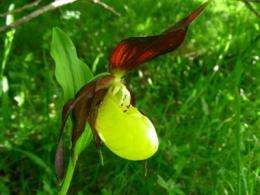
Natural reforestation in southern Pyrenees favors orchids. Credit: Maria B. García et al.

A 13-year study has been key to understanding how and why an orchid species (Cypripedium calceolus), which is endangered in some countries in Europe, is surviving and recovering in the Pyrenees. The results suggest that the abandonment of farming and grazing, which is enabling reforestation to take place, is benefiting this orchid.

Populations of species at the edges of their distribution areas, as is the case with the 'lady's slipper' (Cypripedium calceolus) on the southern side of the Pyrenees, have always been considered to be more vulnerable than those at the centre of their range.

This is what led to researchers from the Pyrenean Institute of Ecology (CSIC) publishing the first ever count-based plant demographic model to find out whether populations of this rare Euro-Asian orchid are in a worse situation than those in countries such as Poland or Estonia.

"The populations on the southern edges of the Pyrenees are similar in size, reproduce better, and are as stable or even growing at a faster pace than those in Central Europe", María B. García, lead author of the study and a researcher at the Pyrenean Institute of Ecology (CSIC), tells SINC.

According to the study, published in the journal Conservation Biology, this "unusual" result seems to be related to in the areas of the Pyrenees studied. The ending of traditional practices such as farming and grazing could help some endangered forest plants to recover.

"For a plant that is used to colder temperatures (such as in Central and Northern Europe), reforestation in more southerly areas could represent an improvement to its habitat, thereby leading to an increase in the population growth rate", says García, who confirmed that the highest such rate found to date is in the Pyrenees.

The research also highlights the fact that landscape changes and the expansion of forests over the past 50 years in mountainous regions are providing "new opportunities" and giving "hope for the recovery of forest species at the edge of their range against a future backdrop dominated by biodiversity loss".

The duration of the study (from 1997 to 2010) was of key importance in arriving at these conclusions. Before now "there have not been any similar studies over such a long time", the researcher explains.

The resurgence of an endangered plant

Cypripedium calceolus is classified as 'endangered' in the whole of Europe and "represents almost 100 forest plants that are at the limits of their range on the southern slopes of the Pyrenees", the researcher points out.

Climate change and global warming are threat factors that could have dramatic implications for orchids, as well as other plant species. "However, at this time of global warming, the increase in forest area along this mountain range could be benefiting this group of species", the biologist says.

In the absence of severe manmade alterations to the environment, the immediate future for these orchid populations in the Pyrenees "seems to be favourable", the study concludes.

More information: García, María B.; Goñi, Daniel; Guzmán, David. "Living at the Edge: Local versus Positional Factors in the Long-Term Population Dynamics of an Endangered Orchid" Conservation Biology 24(5): 1219-1229, Oct 2010.

Provided by FECYT - Spanish Foundation for Science and Technology


Rank 4 /5 (1 vote)
Relevant PhysicsForums posts

More news stories

Thousands of shellfish found dead in Peru

Thousands of crustaceans were found dead off the coast of Lima following the mystery mass death of dolphins and pelicans, the Peruvian Navy said Friday.

Biology / Ecology

created 1 hour ago | popularity not rated yet | comments 0

Researchers solve structure of human protein critical for silencing genes

In a study published in the journal Cell on May 24, Cold Spring Harbor Laboratory (CSHL) scientists describe the three-dimensional atomic structure of a human protein bound to a piece of RNA that "guides" the pr ...

Biology / Cell & Microbiology

created 16 hours ago | popularity 4.7 / 5 (7) | comments 0 | with audio podcast

It's in the genes: Research pinpoints how plants know when to flower

Scientists believe they've pinpointed the last crucial piece of the 80-year-old puzzle of how plants "know" when to flower.

Biology / Biotechnology

created 16 hours ago | popularity 4.3 / 5 (7) | comments 1 | with audio podcast

Copy of the genetic makeup travels in a protein suitcase

Scientists from the Institute for Physical and Theoretical Chemistry at the University of Bonn have succeeded for the first time in the real time filming of the transport of an important information carrier in biological ...

Biology / Cell & Microbiology

created 22 hours ago | popularity not rated yet | comments 0 | with audio podcast

'Transformer' protein makes different sized transport pods

These spheres may look almost identical, but subtle differences between them revealed a molecular version of the robots from Transformers. Each sphere is a vesicle, a pod that cells use to transport materials ...

Biology / Cell & Microbiology

created 22 hours ago | popularity 5 / 5 (1) | comments 0


Transvaginal mesh op restores pelvic organ prolapse at price

(HealthDay) -- Transvaginal mesh (TVM) procedures are effective for anatomical restoration of pelvic organ prolapse (POP), but patients report a worsening of sexual function following surgery, according to ...

Family history of Alzheimer's affects functional connectivity

(HealthDay) -- Cognitively normal individuals with a family history of late-onset Alzheimer's disease (AD) may display lower resting state functional connectivity in the default mode network (DMN) of the brain, ...

SpotterRF debuts Radar Backpack Kit (w/ Video)

(Phys.org) -- SpotterRF has announced a special radar backpack kit designed to enhance situational awareness for soldiers on the ground. The company says its special radar is designed for warfighters as part ...

Travel to high altitudes tied to Crohn's, colitis flare-ups

(HealthDay) -- People with inflammatory bowel disease, which includes Crohn's disease and colitis, may be at increased risk for flare-ups when they fly or travel to high altitudes for skiing or mountain climbing, ...

Astronomers seize last chance in lifetime for Venus Transit

Astronomers are gearing for one the rarest events in the Solar System: an alignment of Earth, Venus and the Sun that will not be seen for another 105 years.

Australia hails surprise super-telescope decision

Australia has hailed a surprise decision giving it a role in a radio telescope project aimed at revolutionising astronomy, vowing to draw on its decades of experience in space science.