Meat-eating dinosaurs not so carnivorous after all
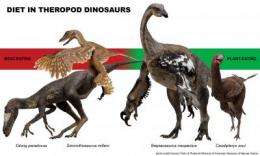
New research by Field Museum scientists finds widespread herbivory in bird-like theropod dinosaurs. Four of the 90-theropod species involved in the study shown with dietary interpretations. All four species derive from the famous feathered dinosaur beds of the Early Cretaceous Yixian Formation, P. R. China, leading the scientists to speculate that dietary diversity may have contributed to the large numbers of contemporaneous theropods in ecosystems like those of the Yixian. Credit: Dennis Finnin and Roderick Mickens, copyright American Museum of Natural History
Field Museum scientists used statistical analyses to determine the diet of 90 species of theropod dinosaurs. Their results challenge the conventional view that nearly all theropods hunted prey, especially those closest to the ancestors of birds.
Tyrannosaurus rex may have been a flesh-eating terror but many of his closest relatives were more content with vegetarian fare, a new analysis by Field Museum scientists has found.
The scientists, Lindsay Zanno and Peter Makovicky, who will publish their findings in the journal Proceedings of the National Academy of Sciences, used statistical analyses to determine the diet of 90 species of theropod dinosaurs. Their results challenge the conventional view that nearly all theropods hunted prey, especially those closest to the ancestors of birds. Rather, Zanno and Makovicky show that among the most bird-like dinosaursknown as coelurosaursplant eating was a common way of life. "Most theropods are clearly adapted to a predatory lifestyle, but somewhere on the line to birds, predatory dinosaurs went soft," Zanno says.
Theropods are a group of bipedal dinosaurs colloquially known as "predatory" dinosaurs. Among theropod dinosaurs, all modern birds and several groups of their closest extinct relatives belong to a subgroup known as Coelurosauria. Coelurosauria also includes the iconic hunters Tyrannosaurus and Velociraptor. Most coelurosaurs were feathered. The most intelligent dinosaurs and those with the smallest body sizes also belong to this group.
The study was funded in part by the National Science Foundation. Lead author Lindsay Zanno's research was supported by a John Caldwell-Meeker Fellowship and by a Bucksbaum Fellowship for young scientists.
Pinning the Diet on the Dinosaur
Deducing the diet of extinct animals isn't always straightforward. In all but the rarest cases, paleontologists have nothing but fossilized bones and teeth to work with. Sometimes figuring out what a dinosaur ate is fairly obvious. No one doubts, for example, that the bone-crunching teeth and jaws of Tyrannosaurus rex were the tools of a megapredator or that the tooth batteries of Triceratops were used for shearing plant material. However, many coelurosaurian dinosaurs have more ambiguous adaptations such as peg-like teeth at the front of the mouth or no teeth at all so determining their diet has been a challenge. "These oddball dinosaurs have been the subject of much speculation" says Makovicky, "but until now, we have not had a reliable way to choose between competing theories as to what they ate."
Fortunately a small percentage of these species also preserve clear-cut evidence of diet with their skeletal remains. Fossilized dinosaur dung, stomach contents, tooth marks, the presence of stones within the stomach that serve as a gastric mill for digesting vegetation, and even two dinosaur species preserved locked in the throes of combat all provide a direct window on diet. After collecting dietary data for almost 100 coelurosaur species, Zanno and Makovicky used statistical analyses to test whether certain skeletal traits (such as the loss of teeth or a long neck) could be found to correlate with direct evidence of plant eating among coelurosaurian dinosaurs.
They found almost two dozen anatomical features statistically linked to direct evidence of herbivory including a toothless beak. "Once we linked certain adaptations with direct evidence of diet, we looked to see which other theropod species had the same traits," Zanno said, "then we could say who was likely a plant eater and who was not."
Applying their data on diet, the researchers found that 44 theropod species distributed across six major lineages were eating plants and that the ancestor to most feathered dinosaurs and modern birds had probably already lost its appetite for flesh alone. Because plant eating was found to be so widespread in Coelurosauria, the hypercarnivorous habits of T. rex and other meat eating coelurosaurs like Velociraptor should be viewed "more as the exception than the rule," Zanno says. "This new research firmly supports what we've have been speculating about for some time," she says. "Its time to start seeing these animals in a new evolutionary context." The researcher's findings also suggest that iconic predators such as the Velociraptor of Jurassic Park fame and their close relatives may have evolved from omnivorous ancestorsan idea Zanno proposed last year in 2009 based on the discovery of a new plant-eating coleurosaur, Nothronychus graffami.
How to Make a Plant Eating "Predator"
Besides identifying diet, the researchers analyzed whether different groups of coelurosaurs followed the same evolutionary pathways toward an herbivorous diet. They found that over time, species lost their flesh-rending teeth, developing strange tooth types such as peg-, wedge-, and leaf-shaped teeth, and ultimately, some lost most or all of their teeth altogether and replaced them with a bird-like beak. While the new research suggests that dinosaurs evolved beaks to aid their transition to plant eating, once that innovation was accomplished, beaks continued evolving into a myriad of forms and help support a high degree of dietary diversity in modern birds. "This is a clear-cut indication that the repeated evolution of a toothless beak in theropod dinosaurs is linked to plant eating," Zanno says. However, "once a beak appeared on the scene, it continued to evolve. Theropods would have used their beaks in a myriad of ways; they still do," she said.
Zanno and Makovicky also found that a toothless beak only evolved in lineages known to have had a gastric mill for grinding plants. In lineages where a gastric mill is not yet known, such as the bizarre, sickle-clawed therizinosaurs, the species retain teeth at the back of the mouth for shredding plant material.
Besides losing teeth and evolving beaks, the researchers found that as several lineages of coelurosaur turned to plant eating, they also evolved longer necks, which may have helped the animals to expand their browsing range.
A Dietary Advantage?
Coelurosaurian theropods were an extremely successful group of dinosaurs throughout the Cretaceous Period (145-65 million years ago) and many different species of coelurosaurs inhabited the same ancient environments but scientists have yet to figure out why. One theory is that the break up of continents and origin of new habitat opened up new dietary niches for coelurosaurs to explore. Zanno and Makovicky speculate that dietary diversification also may have played a role in their success. "The ability to eat plant materials may have played a pivotal role in allowing coelurosaurian dinosaurs to achieve such remarkable species diversity," Zanno noted, "but more study is needed to understand what role dietary shifts may play in evolutionary processes."
Because ceolurosaurian dinosaurs include the closest extinct relatives of birds, understanding their biology is also extremely important to understanding how, why, and under what conditions birds evolved and first took flight.
"We don't know what drove the ancestors to birds to take flight," she says, "seeking food in the trees is just one of many possibilities."
Using statistical analysis to find correlations between physical traits and diet could offer a new window as to how evolution works, the researchers said, and these techniques could be used to provide new insight into the common practice of becoming an herbivore throughout vertebrate history. Makovicky summarizes, "Being able to establish diet in extinct animals with confidence will allow us to start tackling even broader questions, such as whether animals tend to increase in body and diversity when they evolve herbivory."
Provided by Field Museum
-
From lemons to lemonade: Reaction uses carbon dioxide to make carbon-based semiconductor,
28 comments
-
Thioridazine kills cancer stem cells in human while avoiding toxic side-effects of conventional cancer treatments,
3 comments
-
SpaceX private rocket blasts off for space station (Update),
41 comments
-
Climate scientists say they have solved riddle of rising sea,
30 comments
-
Scotland passes turbine test to harness tidal power,
40 comments
-
Why Do Dogs do Strange things...
16 hours ago
-
What does exophillic and endophillic mean in terms of mosquito and their control?
May 24, 2012
-
Semen stains glows under black lights (uv light)?
May 23, 2012
-
Question on Human Chromosome 2
May 23, 2012
-
How important is composition of TBST in diluting antibodies and Western Blotting?
May 22, 2012
-
Does the medulla monitor blood pH
May 20, 2012
- More from Physics Forums - Biology
More news stories
Math predicts size of clot-forming cells
UC Davis mathematicians have helped biologists figure out why platelets, the cells that form blood clots, are the size and shape that they are. Because platelets are important both for healing wounds and in strokes and other ...
16 hours ago |
not rated yet |
0
|
Oldest Jewish archaeological evidence on the Iberian Peninsula
German archaeologists of the Friedrich Schiller University Jena found one of the oldest archaeological evidence so far of Jewish Culture on the Iberian Peninsula at an excavation site in the south of Portugal, ...
Other Sciences / Archaeology & Fossils
20 hours ago |
4.3 / 5 (4) |
12
Dinosaur with tiny arms unearthed in Argentina
Argentine experts have discovered the near-complete remains of a new species of Jurassic-era dinosaur that stood on its rear legs and had tiny arms, according to a leading paleontologist.
Other Sciences / Archaeology & Fossils
May 25, 2012 |
5 / 5 (2) |
0
Earliest musical instruments in Europe 40,000 years ago
The first modern humans in Europe were playing musical instruments and showing artistic creativity as early as 40,000 years ago, according to new research from Oxford and Tübingen universities.
Other Sciences / Archaeology & Fossils
23 hours ago |
5 / 5 (3) |
1
Talking works: UB professor develops method to analyze creative problem solving
(Phys.org) -- Talk -- if it's the right kind -- can increase creativity, leading students to create useful, new ideas that solve problems, a University at Buffalo professor has found by using a statistical tool that he invented.
Other Sciences / Social Sciences
May 25, 2012 |
not rated yet |
0
Of mice and mental models: Neuroscientific implications of risk-optimized behavior in the mouse
(Medical Xpress) -- Regardless of an organism’s biological complexity, every encephalized animal continuously makes under-informed behavioral choices that can have serious consequences. Despite its ubiquity, ...
Dragon arrives at space station in historic 1st (Update 2)
The privately bankrolled Dragon capsule made a historic arrival at the International Space Station on Friday, triumphantly captured by astronauts wielding a giant robot arm.
Landmark calculation clears the way to answering how matter is formed
(Phys.org) -- An international collaboration of scientists, including Thomas Blum, associate professor of physics, is reporting in landmark detail the decay process of a subatomic particle called a kaon ...
High-speed method to aid search for solar energy storage catalysts
Eons ago, nature solved the problem of converting solar energy to fuels by inventing the process of photosynthesis.
It's in the genes: Research pinpoints how plants know when to flower
Scientists believe they've pinpointed the last crucial piece of the 80-year-old puzzle of how plants "know" when to flower.
Researchers solve structure of human protein critical for silencing genes
In a study published in the journal Cell on May 24, Cold Spring Harbor Laboratory (CSHL) scientists describe the three-dimensional atomic structure of a human protein bound to a piece of RNA that "guides" the pr ...
Dec 21, 2010
Rank: 1 / 5 (11)
The change in diet happened AFTER the flood when God gave people {and also animals} the right to eat flesh(Genesis 9}:
Notice how animals and birds etc. became fearful of human beings AFTER the flood.
To the moderators - this is a distinct alternative to the statements made by the researchers and is of value to chew upon.
Dec 21, 2010
Rank: 1 / 5 (9)
Great admission by Zanno.
The answer is of course that birds did NOT evolve from anything, they were created the way the are - fully capable of flight.
Just think how impossible it is for NEW INFORMATION to arise from random physical processes. New information to make new materials and from that to make new features [ feathers and wings and bone sacs ] and then new information to USE those new features.
It is simply impossible. No amount of time will make it happen because new functional information does not arise from random physical processes. Period.
Dec 21, 2010
Rank: 4.2 / 5 (10)
please go back to the cave where you came from
Dec 21, 2010
Rank: 4.4 / 5 (7)
Dec 21, 2010
Rank: 5 / 5 (1)
(a) AT no point does God command a diet for the sea creatures.
(b) God doesn't say the animals can or will eat meat after the Flood. So when did that happen?
Like so much else in the Bible it's easy to imagine an interpretation, but then that's reading one's own ideas into the text isn't it?
Dec 21, 2010
Rank: not rated yet
Dec 21, 2010
Rank: not rated yet
Dec 21, 2010
Rank: 4.4 / 5 (7)
Dec 21, 2010
Rank: 3.7 / 5 (3)
Dec 21, 2010
Rank: 5 / 5 (3)
You see, this life is nothing more then a test of our worthiness to enter the kingdom of god. Those who correctly identify truth get to spend eternity with god, and those who are tricked by all the deception in this world are condemned to an eternity of suffering.
Thank you, Kevinrtrs for pointing out this deception so that we might be saved.
Dec 21, 2010
Rank: 5 / 5 (3)
Dec 21, 2010
Rank: 5 / 5 (1)
For whatsoever man he be that hath a blemish, he shall not approach: a blind man, or a lame, or he that hath a flat nose, or any thing superfluous, Or a man that is brokenfooted, or brokenhanded, Or crookbackt, or a dwarf, or that hath a blemish in his eye, or be scurvy, or scabbed, or hath his stones broken; No man that hath a blemish of the seed of Aaron the priest shall come nigh to offer the offerings of the LORD made by fire: he hath a blemish; he shall not come nigh to offer the bread of his God. He shall eat the bread of his God, both of the most holy, and of the holy. Only he shall not go in unto the vail, nor come nigh unto the altar, because he hath a blemish; that he profane not my sanctuaries: for I the LORD do sanctify them.
Dec 21, 2010
Rank: 5 / 5 (3)
Dec 21, 2010
Rank: 5 / 5 (4)
Dec 21, 2010
Rank: 5 / 5 (2)
Dec 22, 2010
Rank: 5 / 5 (1)
Got nothing against God, but seriously the first 5 books in the old testament are nothing but the laws and fairy tales of the ancient Jewish people.
Dec 22, 2010
Rank: not rated yet
if it is of so much value to this discussion, why wont you join us in discussing it?
Dec 29, 2010
Rank: 1 / 5 (2)
I hope you realize crystalization, in and of itself, has nothing whatsoever to do with complex machinery of life. You're not going to get a life form from a crystal, nor anything remotely similar. You cannot be seriously claiming that crystalization is somehow evidence for abiogenesis or evolution. You're ridiculous.
You're claiming that complex molecular machinery arises totally by accident, and even SH calling it "probable" is absolutely lying BS.
Biological mechanisms are forward thinking design, whereby often we find one component of an organism would be completely meaningless and useless without another component.
Let's take speech. Without ears, it's meaningless.
And without a sufficient brain, both speech and ears are meaningless.
Then there's sexual reproduction, particularly in mammals, which is so irreducibly complex that you people look like a bunch of lunatics trying to claim that something like this could happen by chance.