'Magnetic sponge' could be a new form of cell and drug delivery
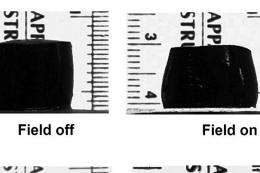
Called a "magnetic sponge," a novel macroporous ferrogel is shown being compressed by an applied magnetic field. The reversible compression quickly forces out the drugs, cells, or proteins embedded in the ferrogel. Photo courtesy of SEAS
(PhysOrg.com) -- Engineers at Duke and Harvard universities have developed a "magnetic sponge" that after implantation into a patient can "squeeze" out drugs, cells, or other agents when passed over by a magnet.
The researchers demonstrate that the new material called a macroporous ferrogel can be compressed as much as 70 percent by an applied magnetic field. The reversible compression quickly forces out the drugs, cells, or proteins embedded in the ferrogel.
While porous biomaterials are used today as scaffolds for tissue regeneration and cell therapy, they are mostly passive in that the drug or cells usually diffuse or migrate out of the materials. The new scaffold the Duke and Harvard engineers have developed, on the other hand, can be controlled by external cues to release drugs and cells on command.
The macroporous ferrogel contains magnetic iron nanoparticles, which respond to magnetic fields. Just as important, the researchers said, the new ferrogel has much larger pores than existing ferrogels.
These bigger pores allow us to use drugs with larger molecules such as proteins and cells, and result in a much more significant squeeze when in the presence of a magnetic field, said Xuanhe Zhao, assistant professor of mechanical engineering and materials science at Dukes Pratt School of Engineering. Zhao performed much of the work while a postdoctoral fellow at the Harvard School of Engineering and Applied Sciences (SEAS) in the laboratory of David Mooney, Robert P. Pinkas Family Professor of Bioengineering and a core Member of the Wyss Institute for Biologically Inspired Engineering at Harvard.
The large pores were created by freezing the ferrogel.
When you freeze a gel, the water inside it crystallizes and damages part of the gel, Zhao said. After melting, a hole is left behind. By varying the temperature and the duration of the freezing, we can control the size of the pores.
Unlike conventional scaffolds, our ferrogel gives us a great deal of active control over whatever it is to be administered, Zhao said. For example, we can vary the size of the pores or the level of magnetism, depending on how the ferrogel is processed.
The results of the study were published online in the Proceedings of the National Academy of Sciences.
The scientists tested ferrogels loaded with human and mouse cells in animal models, and were encouraged by the way the ferrogel responded to magnetic stimulation.
This is the first demonstration, to the best of our knowledge, of the use of these porous ferrogels for controlled cell delivery, Mooney said. More broadly, this provides the first demonstration of on-demand release of cells from porous scaffolds, which could lead to widespread use in tissue regeneration and other cell therapies.
Mooney also said it would be possible to place living cells within the ferrogels that could conceivably produce new cells for years.
While this particular study focused on the ability to deliver drugs and cells on demand, we also expect that these ferrogels could have much wider applications, including serving as actuators and sensors in biomedical and other areas, thanks to their large and quick volume change under magnetism, Mooney said.
These ferrogels are made of a biodegradable substance, so they would not need to be removed, the scientists said.
Other members of the research team were Jaeyun Kim, Christine Cezar, Nathanial Huebsch, Kangwon Lee, and Kamal Bouhadir, all from Harvard. The research was supported by the National Institutes of Health, the Defense Advanced Research Projects Agency (DARPA), Harvard, and Duke.
More information: http://www.pnas.org/
Provided by
Harvard University
-
From lemons to lemonade: Reaction uses carbon dioxide to make carbon-based semiconductor,
28 comments
-
Thioridazine kills cancer stem cells in human while avoiding toxic side-effects of conventional cancer treatments,
3 comments
-
SpaceX private rocket blasts off for space station (Update),
41 comments
-
Climate scientists say they have solved riddle of rising sea,
30 comments
-
Scotland passes turbine test to harness tidal power,
40 comments
-
Why Do Dogs do Strange things...
16 hours ago
-
What does exophillic and endophillic mean in terms of mosquito and their control?
May 24, 2012
-
Semen stains glows under black lights (uv light)?
May 23, 2012
-
Question on Human Chromosome 2
May 23, 2012
-
How important is composition of TBST in diluting antibodies and Western Blotting?
May 22, 2012
-
Does the medulla monitor blood pH
May 20, 2012
- More from Physics Forums - Biology
More news stories
Synthetic nano-waste does not disappear
(Phys.org) -- Tiny particles of cerium oxide do not burn or change in the heat of a waste incineration plant. They remain intact on combustion residues or in the incineration system, as a new study by Swiss ...
Nanotechnology / Bio & Medicine
23 hours ago |
5 / 5 (1) |
1
|
Nanotechnology for solar energy conversion systems
EU researchers extensively characterised the self-organisation of nanotubes and developed novel compositions particularly appropriate to solar energy conversion applications.
Nanotechnology / Nanomaterials
21 hours ago |
not rated yet |
0
Nano-structured polymer-based materials from scrap
EU researchers developed polymer blends and processing techniques facilitating recovery of scrap from industrial processes. Advances in this area have the potential to decrease costs and waste while protecting ...
Nanotechnology / Nanomaterials
22 hours ago |
not rated yet |
0
Dopant gives graphene solar cells highest efficiency yet
(Phys.org) -- By taking advantage of graphenes favorable electrical and optical properties, and then adding an organic dopant, researchers have achieved the highest power conversion efficiency yet for ...
Nanomedicine: Quantum dots appear safe in pioneering study on primates
A pioneering study to gauge the toxicity of quantum dots in primates has found the tiny crystals to be safe over a one-year period, a hopeful outcome for doctors and scientists seeking new ways to battle diseases ...
Nanotechnology / Bio & Medicine
May 20, 2012 |
4.3 / 5 (3) |
8
|
Of mice and mental models: Neuroscientific implications of risk-optimized behavior in the mouse
(Medical Xpress) -- Regardless of an organism’s biological complexity, every encephalized animal continuously makes under-informed behavioral choices that can have serious consequences. Despite its ubiquity, ...
Dragon arrives at space station in historic 1st (Update 2)
The privately bankrolled Dragon capsule made a historic arrival at the International Space Station on Friday, triumphantly captured by astronauts wielding a giant robot arm.
Landmark calculation clears the way to answering how matter is formed
(Phys.org) -- An international collaboration of scientists, including Thomas Blum, associate professor of physics, is reporting in landmark detail the decay process of a subatomic particle called a kaon ...
High-speed method to aid search for solar energy storage catalysts
Eons ago, nature solved the problem of converting solar energy to fuels by inventing the process of photosynthesis.
It's in the genes: Research pinpoints how plants know when to flower
Scientists believe they've pinpointed the last crucial piece of the 80-year-old puzzle of how plants "know" when to flower.
Researchers solve structure of human protein critical for silencing genes
In a study published in the journal Cell on May 24, Cold Spring Harbor Laboratory (CSHL) scientists describe the three-dimensional atomic structure of a human protein bound to a piece of RNA that "guides" the pr ...
Dec 14, 2010
Rank: not rated yet