Image: Sotra Facula, Titan
Dec 20, 2010
Image Credit: NASA/JPL-Caltech/USGS/University of Arizona

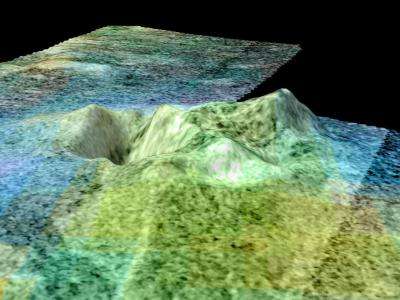
Based on data from NASA's Cassini spacecraft, this image shows an area of Saturn's moon Titan, known as Sotra Facula.

Scientists believe Sotra is the best case for a cryovolcano, or ice .

The flyover shows two peaks more than 3,000 feet (about 1,000 meters) tall and multiple craters as deep as 5,000 feet (1,500 meters).

The image also shows finger-like flows, which also indicate the presence cryovolcanism.

The 3-D comes from Cassini's radar instrument. Topography has been vertically exaggerated by a factor of 10.

The false color in the initial frames shows different compositions of surface material as detected by Cassini's visual and .

In this color scheme, dunes tend to look relatively brown-blue.

Blue suggests the presence of some exposed ice. Scientists think the bright areas have an organic coating that hides the ice and is different and lighter than the dunes.

The finger-like flows appear bright yellowish-white, like the mountain and caldera.

The second set of colors shows elevation, with blue being lowest and yellow and white being the highest. Dunes here appear blue because they tend to occupy low areas.

The finger-like flows are harder to see in the elevation data, indicating that they are thin, maybe less than about 300 feet (about 100 meters) thick.

Explore further: Research says Mars had oxygen-rich atmosphere 4000 million years ago

add to favorites email to friend print save as pdf

Related Stories

Dazzling Dunes on Mars

Aug 10, 2004

As NASA's Opportunity rover creeps farther into "Endurance Crater," the dune field on the crater floor appears even more dramatic. On the left, an approximate true-color image highlights the reddish-colored ...

Rhea's Wisps in Color

Feb 28, 2006

Bright, wispy markings stretch across a region of darker terrain on Saturn's moon Rhea. In this extreme false-color view, the roughly north-south fractures occur within strips of material (which appear greenish ...

Cassini Doubleheader: Flying By Titan and Dione

Apr 05, 2010

(PhysOrg.com) -- In a special double flyby early next week, NASA's Cassini spacecraft will visit Saturn's moons Titan and Dione within a period of about a day and a half, with no maneuvers in between. A fortuitous ...

Mars Odyssey Snaps Rabe Crater Contours

Nov 15, 2005

Rabe Crater lies among hundreds of thousands of other impact craters in the rough-hewn southern highlands of Mars. Spanning 108 kilometers (67 miles), Rabe is halfway between the martian equator and the south pole, and west ...

Recommended for you

Super-hurricane-force winds on Venus are getting stronger

Jun 18, 2013

(Phys.org) —As the closest planet to Earth, Venus is a relatively easy object to observe. However, many mysteries remain, not least the super-rotation of Venus' atmosphere, which enables high altitude winds ...

ExoMars 2016 set to complete construction

Jun 18, 2013

ESA's mission to Mars in 2016 has entered the final stage of construction with the signature of a contract today with Thales Alenia Space at the Paris Air & Space Show.

User comments : 1

Adjust slider to filter visible comments by rank

Display comments: newest first

yyz
not rated yet Dec 20, 2010
It's impossible to follow much of the text in the article above, since it refers to a JPL animation that is not included here. Check out the missing video: http://www.jpl.na...m?id=951

More news stories