US southwest could see 60-year drought: study
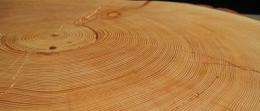
Annual tree rings record a detailed history of drought (narrow rings) and wetness (wide rings). This sample from a dead Douglas-fir tree in the Santa Catalina Mountains near Tucson, Ariz., has nearly 400 rings and dates back to the year 1600. Stress cracks, visible in the foreground of the image, occur as the dead wood dries and contracts. Credit: Copyright Daniel Griffin.
An unprecedented combination of heat plus decades of drought could be in store for the Southwest sometime this century, suggests new research from a University of Arizona-led team.
To come to this conclusion, the team reviewed previous studies that document the region's past temperatures and droughts.
"Major 20th century droughts pale in comparison to droughts documented in paleoclimatic records over the past two millennia," the researchers wrote. During the Medieval period, elevated temperatures coincided with lengthy and widespread droughts.
By figuring out when and for how long drought and warm temperatures coincided in the past, the team identified plausible worst-case scenarios for the future. Such scenarios can help water and other resource managers plan for the future, the team wrote.
"We're not saying future droughts will be worse than what we see in the paleo record, but we are saying they could be as bad," said lead author Connie A. Woodhouse, a UA associate professor of geography and regional development. "However, the effects of such a worst-case drought, were it to recur in the future, would be greatly intensified by even warmer temperatures."
The team's paper is part of the special feature, "Climate Change and Water in Southwestern North America," scheduled for publication Dec. 13 in the Early Online edition of the Proceedings of the National Academy of Sciences.
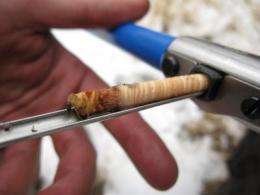
A core extracted from a living Douglas-fir tree in the Santa Rita Mountains south of Tucson, Ariz. Scientists use such cores to study the annual rings of trees, visible on the core as banding. Collecting such cores causes only temporary injury to the tree. Credit: Copyright 2009 Daniel Griffin
The paper by Woodhouse and her colleagues is titled, "A 1,200‑year perspective of 21st century drought in the southwestern North America." Co‑authors are Glen M. MacDonald of the University of California, Los Angeles; Dave W. Stahle of the University of Arkansas in Fayetteville; and Edward R. Cook of Lamont‑Doherty Earth Observatory of Columbia University, Palisades, N.Y.The analysis in the current paper includes previous research by Woodhouse, co-author David M. Meko and others that documented past droughts that lasted several decades. Moreover, some of those droughts occurred during times of relatively warm temperatures.
Within the last 2,000 years, there have been several periods of severe and sustained drought that affected much of western North America.
Droughts that are accompanied by warm temperatures have more severe impacts on ecosystems, said Meko, an associate research professor in the UA's Laboratory of Tree-Ring Research.
During the Medieval period, temperatures were about 1.8 degrees Fahrenheit (1 C) above the long-term average. Average temperatures in the Southwest have been warmer than that since 1990 and are projected to increase at least another 3.6 F (2 C) by 2100, Woodhouse said.
The most severe warm-climate drought in the Southwest within the last 1,200 years was 60 years long and occurred during the mid-12th century, according to research by Meko and others. That drought covered most of the western U.S. and northern Mexico.
For a 25-year period during that drought, Colorado River flow averaged 15 percent below normal, according to the tree-ring-based reconstruction of stream flow at Lees Ferry.
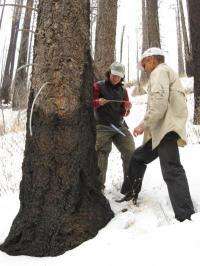
Connie Woodhouse and Mark Losleben of the University of Arizona examine a tree-ring core from a drought-stressed Douglas-fir tree in the Santa Rita Mountains south of Tucson, Ariz. Credit: Copyright 2009 Daniel Griffin
For every 1.8 degree Fahrenheit (1 C) of warming in the future, Colorado River flow is projected to decrease between two and eight percent, Woodhouse and her co-authors wrote.The Colorado River supplies water for cities and agriculture in seven western states in the U.S. and two states in northwestern Mexico. Los Angeles, Las Vegas, Denver, Phoenix, Tucson and Albuquerque are among the many cities dependent on Colorado River water.
"Even without warming, if you had one of those medieval droughts now, the impact would be devastating," she said. "Our water systems are not built to sustain us through that length of drought."
Noting that the Colorado River flows recorded at Lees Ferry from 2000 to 2009 are the lowest on record, Woodhouse said the current drought could be part of a longer dry period. The instrumental record from Lees Ferry goes back to 1906.
"As this drought unfolds you can't really evaluate it until you're looking back in time," she said.
In recent decades, temperatures have been higher than during the previous 1,200 years, and future temperatures are predicted to be even warmer, Woodhouse said.
In addition, other research predicts that changes in atmospheric circulation will reduce the amount of winter precipitation the Southwest receives in the future, she said.
"The bottom line is, we could have a Medieval-style drought with even warmer temperatures," Woodhouse said.
Provided by
University of Arizona
-
From lemons to lemonade: Reaction uses carbon dioxide to make carbon-based semiconductor,
28 comments
-
Thioridazine kills cancer stem cells in human while avoiding toxic side-effects of conventional cancer treatments,
3 comments
-
SpaceX private rocket blasts off for space station (Update),
41 comments
-
Climate scientists say they have solved riddle of rising sea,
30 comments
-
Scotland passes turbine test to harness tidal power,
40 comments
-
More human population = greater mass?
19 hours ago
-
Conversion from aircraft bearing to normal degrees
May 23, 2012
-
Interpretation/Analysis of the Lab results(HEPA filter)
May 22, 2012
-
Has anyone here attended the The Urbino Summer School in Paleoclimatology?
May 22, 2012
-
Earthquakes: Mag 6 N. Italy and Mag 5.6 W. Bulgaria
May 21, 2012
-
determining time frame for most recent geological layers
May 17, 2012
- More from Physics Forums - Earth
More news stories
Dragon arrives at space station in historic 1st (Update 2)
The privately bankrolled Dragon capsule made a historic arrival at the International Space Station on Friday, triumphantly captured by astronauts wielding a giant robot arm.
Space & Earth / Space Exploration
20 hours ago |
5 / 5 (8) |
11
Dragon makes history with space station docking
The private company SpaceX made history Friday with the docking of its Dragon capsule to the International Space Station, the most impressive feat yet in turning routine spaceflight over to the commercial ...
Space & Earth / Space Exploration
13 hours ago |
4.8 / 5 (6) |
0
Aliens don't want to eat us, says former SETI director
Alien life probably isnt interested in having us for dinner, enslaving us or laying eggs in our bellies, according to a recent statement by former SETI director Jill Tarter.
Space & Earth / Space Exploration
21 hours ago |
4.8 / 5 (10) |
26
SKA super telescope to be built in Australia, South Africa (Update 2)
A long-running joust to host a radio telescope that would give mankind its farthest peek into the Universe ended on Friday with a Solomon-like judgement to split the site between Australia and South Africa.
21 hours ago |
5 / 5 (5) |
2
NASA sees Hurricane Bud threaten western Mexico's coast
NASA satellites are providing rainfall, temperature, pressure, visible and infrared data to forecasters as Hurricane Bud is expected to make a quick landfall in western Mexico this weekend before turning back ...
Space & Earth / Earth Sciences
15 hours ago |
not rated yet |
0
Of mice and mental models: Neuroscientific implications of risk-optimized behavior in the mouse
(Medical Xpress) -- Regardless of an organism’s biological complexity, every encephalized animal continuously makes under-informed behavioral choices that can have serious consequences. Despite its ubiquity, ...
Landmark calculation clears the way to answering how matter is formed
(Phys.org) -- An international collaboration of scientists, including Thomas Blum, associate professor of physics, is reporting in landmark detail the decay process of a subatomic particle called a kaon ...
High-speed method to aid search for solar energy storage catalysts
Eons ago, nature solved the problem of converting solar energy to fuels by inventing the process of photosynthesis.
It's in the genes: Research pinpoints how plants know when to flower
Scientists believe they've pinpointed the last crucial piece of the 80-year-old puzzle of how plants "know" when to flower.
Researchers solve structure of human protein critical for silencing genes
In a study published in the journal Cell on May 24, Cold Spring Harbor Laboratory (CSHL) scientists describe the three-dimensional atomic structure of a human protein bound to a piece of RNA that "guides" the pr ...
MIT researchers devise new means to synchronize a group of robots (w/ Video)
(Phys.org) -- For several years, roboticists have been working out ways to get a group of robots to perform synchronized activities as demonstrated most often in dance routines. Its not just about trying ...


Dec 13, 2010
Rank: 3.4 / 5 (5)
Desalinization
Dec 13, 2010
Rank: 1.8 / 5 (10)
So what's new?
Drought is one suspect in the disappearance of the Anazazi's from the Grand Canyon.
Dec 13, 2010
Rank: 4.6 / 5 (10)
Dec 13, 2010
Rank: 2 / 5 (12)
Adapt or die. That's why technology was invented.
Should anyone be surprised it is cold in the Great Plains? I recall -30F mornings with highs ~-10F.
AZ is a desert, SURPRISE?
Dec 13, 2010
Rank: 3.7 / 5 (9)
Alas, mangy's complete delusional disconnect from reality is made stunningly obvious.
It is entirely correct to TOTALLY IGNORE any comments posted by shill-entity users "marjon" -aka "mangy", or its newest alias,"ryqqesoqn2"
Dec 13, 2010
Rank: 2.7 / 5 (7)
Ok. So it might be worse.. but it might not. In any case, humanity will adapt or die, as has always been the case.
There is scientific evidence that the human population of earth was reduced to a mere 50-75k by some extraordinary event approximately 60k years ago. A hiccup in the span of the planet's existence.
Earth will survive. Humanity may not be around to see it, but life on earth will survive.
Dec 13, 2010
Rank: 2 / 5 (4)
Pretty amazing I think,
Max
Dec 13, 2010
Rank: 1 / 5 (6)
Israel has turned their desert into highly productive ag land. The Saudis are as well.
Some Vegas hotels are recycling gray water.
Dec 13, 2010
Rank: 3.4 / 5 (9)
Hey, lets give the Israelis the Mojave Desert! Only condition is that they move lock stock and barrel. Think of it! Middle East peace!
Well... for at least 5 minutes, anyway.. But WE would be out of it!
Dec 13, 2010
Rank: 3.2 / 5 (9)
At the expense of reducing the Jordan to a trickle, possibly irreversibly.
You could not have picked a soundbite that is more illustrative and to the point.
Moron.
Dec 14, 2010
Rank: 4.6 / 5 (7)
Syria and Lebanon have dammed up the tributaries that in the past supplied the Jordan.
So, with all that the Jordan is going away and the Dead Sea is evaporating. It is not just Israel that is the problem here although it is fashionable to blame them for just about everything that happens in the Middle East...
Dec 14, 2010
Rank: 2 / 5 (4)
Dec 14, 2010
Rank: 3.4 / 5 (5)
Most city and state planning boards look at possible worst case scenario studies, like having a drought, a chemical accident, a disease outbreak, etc. The title is a bit misleading, as are some of the editorial comments mainly in the second half of the article. They aren't assessing the likelyhood of another drought. They are assessing the magnatude of the worst drought in recent centuries so that city and state planners can make better choices about land and water management, insurance, emergency planning needs, etc. The mis-statement of several facts throughout the article, mainly in the editorial comments, shouldn't detract from the original purpose of the study. I don't understand those unrelated comments. It just distracts people from the true message of the study; if another big drought happens, that area is in trouble.
Dec 14, 2010
Rank: 3.2 / 5 (6)
Here's a well-written blog with source data references from NOAA and other good sources that show drought isn't a function of warming or cooling climate.
http://www.worldc...t-doubt/
As Connie states above: "some of those droughts occurred during times of relatively warm temperatures"
What she didn't say is that just as many have happened durring times of cooler temperatures. That region is prone to prolonged droughts. Resource planners should take note of that and attempt to get a grip on water use in that region, regardless of global warming, global cooling, or martian attacks. Confusing the issue with propaganda about AGW is a sad mistake, since it leads people like the commenters here to argue over AGW in stead of admitting that water is short in the SW US, and drought is likely again there.
Dec 14, 2010
Rank: 1.8 / 5 (8)
Just wondering whether or not its worth reading...
Dec 14, 2010
Rank: 2 / 5 (4)
Dec 14, 2010
Rank: 4.3 / 5 (6)
While it is true that the SW US is most definitely drought-prone, and will most definitely be struck by extended drought again(and again, and again...). no responsible scientist would try to decouple climate change from that cycle, as it is most definitely going to influence the frequency, severity, and duration of drought events.
I note, however, that none of you have referrred to the increasing droughtiness of the SE US, which is likely to be even more adversly affected by climate change/AGW than the already semi-arid SW.
As a long-time resident of Georgia/Florida(contd)
Dec 14, 2010
Rank: 4.2 / 5 (5)
I most definitely experienced the onset of the current drought conditions, in the mid nineties, and get regular weather updates from friends and family still living there, which indicate that the drought conditions are trending to the worse, which is, of course, fully supporterd by the numbers.
The bare fact is that increasing surface temperatures change the circulation patterns of air masses over the land, and tend to stand-off the wet, marine air that brings most rain. That is basic meteorology.
I agree that there is no need to exaggerate the effects of climate change, but to say that it has no bearing on the preconditions or severity of drought is just plain wrong.
Dec 14, 2010
Rank: 2.5 / 5 (4)
I respectfully decline your offer to change the subject and begin a debate about AGW or drought in other locations. I am going to stick to discussion of this article and the comments made about this article.
The article doesn't say anything about AGW increasing or decreasing the frequency, duration, or amplitude of drought, and neither did I. I just stated that she makes it sound as though the two are related, without coming right out and making any direct claims that someone could dispute.
In reality, it's extremely difficult to assess the frequency or durration of a drought. It's very subjective, as discussed in this essay by the USGS. Read the first paragraph under Figure 2:
http://geochange....er1.html
The article here at physorg simply states that droughts will happen in the SW, and that they will be worse if climate is warmer. That seems obvious to me, so I'm not sure what you're disagreeing with.
Dec 14, 2010
Rank: 3 / 5 (4)
The little bits about AGW are completely unrelated as far as I can see though. Caliban, can you please point out the part where you see her stating that the rate of droughts will increase because of global warming? The link I provided above has graphs which show that the rate of droughts does not change in response to warm/cold years, as you suggested here. The ENSO cycle does cause droughts, on a 2-8 year time span, but that's not really climate change, it's a cycle.
Dec 14, 2010
Rank: 2.8 / 5 (4)
She says: "Major 20th century droughts pale in comparison to droughts documented in paleoclimatic records over the past two millennia"
and: "We're not saying future droughts will be worse"
but: "However, the effects of such a worst-case drought, were it to recur in the future, would be greatly intensified"
and:"Droughts that are accompanied by warm temperatures have more severe impacts"
They didn't say droughts are caused or last longer because of warmer weather, or that droughts do not happen just as often when the weather is cool. Data from NOAA clearly shows that droughts are equally likely in cold vs. warm years.
Dec 14, 2010
Rank: 3 / 5 (6)
That's true. The paleoclimate record clearly shows that on a global average, warmer climate tends to increase rainfall and make most areas wetter. Northern Canada and Siberia, for example, should become temperate and biodiverse if climate warms enough, as they were in recent warm periods.
Dec 14, 2010
Rank: 3.3 / 5 (4)
Dec 14, 2010
Rank: 3 / 5 (6)
From the article:
...not the article that you cite- the article that you attempt to refute by citing another study.
Dec 14, 2010
Rank: 3.3 / 5 (8)
Wrong again. Warmer climate shifts precipitation to different areas. Formerly wet areas become dry, and formerly dry, wet. Warmer climate does not equate to wetter conditions overall.
And it doesn't help anyone if Siberia and arctic Canada suddenly become wetter, warmer, and more biodiverse, if the US and Central America, as well as subarctic Europe and Asia are turned into dustbols.
Oh- that's right- you're technocratic elite will just use all the money that they've siphoned out of the world economy in the last 20 years to relocate themselves to pristine northern wilderness, and shoot all interlopers(besides those which might be needed for slave labor, of course) on sight.
Dec 14, 2010
Rank: 2 / 5 (6)
Coincided with. They are saying that the MWP is one example of many where warming happened at the same time and place as a drought. They are not saying that the warming caused the drought. They are not saying that droughts are less likely in cold periods, or that other droughts did not happen in cooler times. They are pointing to the MWP as an example of what it might be like if we have a drought under the conditions we might see if global warming happens.
Go read the latest IPCC reports. I've posted links in the past.
Dec 14, 2010
Rank: 3 / 5 (4)
http://www.ncdc.n...ing.html
Dec 14, 2010
Rank: 4 / 5 (1)
Stands to reason. As the oceans warm, they evaporate at a higher rate. As the atmosphere warms, it can hold more moisture.
And as the atmosphere warms and becomes more moist, it also becomes more turbulent due to its higher energy. Bigger storms? Possibly.
Dec 14, 2010
Rank: 1 / 5 (5)
Running out of water? Use less, capture more rainfall, desalinate, move...
Astronauts drink their own waste, why can't this be done on the earth? I would think it would be much easier than doing it in space.
Dec 14, 2010
Rank: 4.2 / 5 (5)
Again, you choose to purposefully ignore the link between the two processes, in order to decouple climate change from drought events/cycles, when the two are inseperable. I understand that you want to make climate change disappear, but, in reality, it just doesn't work that way. They work together in a feedback system.
Dec 15, 2010
Rank: 2 / 5 (5)
Dec 15, 2010
Rank: 2.6 / 5 (5)
http://www.epa.go...psc.html
Your statement here:
is clearly not backed up by any good source I can find. Here is the very first line of the EPA summary:
...and I'm still not sure why you are so determined to change the subject and push your political agenda again.
Dec 15, 2010
Rank: 4.3 / 5 (3)
All this will denigrate the ability to predict the future of weather based upon past records. And it will probably reduce the accuracy of short term weather forecasts too. Poor weatherman!
So, in short, predicting drought in the SW USA is a crapshoot.
Dec 15, 2010
Rank: 2.6 / 5 (5)
Drought in the SW US is really a function of the ENSO cycle and it's unclear what GHG warming might do to ENSO. There's not much of a timeline for looking at patterns because the cycle is so variable and our instrument record covers so few ENSO cycles. We'll learn more as time goes on though. Maybe they'll have a much better grasp on it before I die, but that's probably still too soon. :(
Dec 15, 2010
Rank: 4.8 / 5 (4)
Right now I'm experiencing a snow free December in the S Rockies at 7500'. Thank you ENSO!
Dec 15, 2010
Rank: 2.8 / 5 (5)
Dec 15, 2010
Rank: 4 / 5 (2)
Dec 15, 2010
Rank: 4 / 5 (4)
@GSwift7
The quote is from your second comment. In it, you invoke the cimate change argument, so therefore, you are responsible for steering comments/discussion away from the actual merits of this article.
Furthermore, I am not aware of ANY article that I have read here on Physorg- whether directly or only indirectly related to climate or meteorological interest- since you began posting comments a few months ago, wherein you have not made plain your anti-AGW sentiments.
So, go spank _yourself_ for steering discussion away from the relative merits of this article.
Dec 15, 2010
Rank: 4.5 / 5 (2)
But cheer up people, as someone said above, that high sitting over N CO is due to go away and the pineapple express should move S and stop chilling out the SE.
Dec 16, 2010
Rank: 2.5 / 5 (6)
You mean like in the USA during the 1930s? Been there; done that. No AGW or CO2 responsible. And, we still haven't got the RWP beat, temperaturewise.
Of course, a big part of the problem was not just draught conditions but also land-use problems. We have learned a thing or two since then about farming and related land use, however. The likelihood of another dustbowl is pretty slim.
Dec 16, 2010
Rank: 3.3 / 5 (7)
Try reading what I said, and understanding the content/context, moron.
And you are out of your mind if you think that the temp/precip conditions during the US Dustbowl differ in any way from the conditions (brought on by climate change) that will cause the same thing to happen again and again and again. On a widespread basis, and with greater frequency.
You don't have to look any further than the Sahara- or even the massive wildfires in Russia this past summer to see the shape of things to come.
Dec 16, 2010
Rank: 1.8 / 5 (5)
Or, did you just give it a 1/5 without reading it, as usual, because you saw my name. I think it's cute that you take such an extreme dislike to me that you don't even like it when I quote the EPA. I guess it's like a heretic reciting bible passages for you. That's the only explaination I can think of.
Dec 16, 2010
Rank: 3 / 5 (4)
Dec 16, 2010
Rank: 4.3 / 5 (6)
Dec 16, 2010
Rank: 3.8 / 5 (6)
Dec 16, 2010
Rank: 1.3 / 5 (6)
"The team's paper is part of the special feature, "Climate Change and Water in Southwestern North America," "
'Climate change' is the new AGW.
It's in the article.
Dec 16, 2010
Rank: 2.6 / 5 (5)
Dec 16, 2010
Rank: 1.7 / 5 (6)
Actually, evidence suggests that the Sahara is greening and the Sahel (the region at the south of the Sahara) is as well. Anecdotal evidence from the locals seems to be in agreement--at least for now.
http://news.natio...ara.html
The Russian wildfires pretty much had nothing to do with climate change, notwithstanding the hype that the activists will continue to create concerning it. You have got to watch that WWF propaganda. It is what tricked the IPCC.
And you refer to _me_ as a moron...? :)
Dec 16, 2010
Rank: 1 / 5 (4)
"The water-holding capacity of the air is the main driving force,"
Warmed how? And where does the additional moisture come from?
Dec 17, 2010
Rank: 2 / 5 (5)
For the record, I do not deny the concept of the globe warming. I know it has happened. Where I am skeptical is the degree that man is responsible. Sure, land-use changes can affect the environment. But, there are still records in the proxies as well as past and current observations that are unexplainable by CO2. Other things are afoot and we need to find out what it all is and not succumb to hype in the process.
The above article takes legitimate science and lays the groundwork for hype. Caliban recycled hype above in his comments. He keeps referring to increased desertification in Africa when the evidence seems to show otherwise, and speaks of future dustbowls in the US and Europe without any supporting science.
Dec 17, 2010
Rank: 4.7 / 5 (3)
As far as increasing aridity and "dustbowl" conditions, the Arabian peninsula and the contiguous regions of the Mediterranean are increasing in dryness, and the Mongolian desert is responsible for the Chinese Dust plume of the last couple of years. And how about drought in the Amazon basin and the Sotheast US?
You need to catch up on your reading.
Dec 17, 2010
Rank: 4 / 5 (5)
How does that either support or deny AGW? It just says the word, it does not give any opinion about whether they think it's happening or not. The concept of the research is that they looked at the worst natural drought in recent centuries and then attempt to assess what will happen if we have another one like that. They assessed different potential scenarios in an attmept to determine the worst possible scenario and what that would mean for residents of the region. They aren't saying that climate change will cause a drought. They aren't saying that a drought is coming. They are merely saying that paleo record show a history of long term droughts in that area, and that if another one of those happens, then x, y and z could be the results.
That's neither a pro nor anti AGW stance. It's a simple risk assessment.
Dec 17, 2010
Rank: 5 / 5 (4)
The Sahara and Sahel were also greening in the late 1800's, and there are stories of record harvests in the Sahel back in the 1600's. This greening is anecdotal.
Dec 17, 2010
Rank: 3 / 5 (2)
I'm sure various sources will disagree on that point though.
Dec 17, 2010
Rank: 3.3 / 5 (4)
Satellite images also show an increase in green mass in the same area. The anecdotal evidence agrees with the satellite data. This area is being carefully watched.
Caliban,
I am not too worried about the Amazon at the moment. The last time this large a draught happened during the ENSO was 7,000 years ago, about the same time when rocks recently uncovered by the drying of tributaries were carved with petroglyphs. AGW had nothing to do with it then.
Saudi Arabia is drying but this has a lot to do with land use and water usage. That land has been drying out for thousands of years and once had flowing rivers. AGW had nothing to do with it.
The Southeast US has caught up. The Mongolians need to learn some things about land-use management. And, the air has always been warmer on the equatorial regions than elsewhere. You need to read. Africa dried up thousands of year ago. AGW and CO2 had nothing to do with it.
Dec 17, 2010
Rank: 4 / 5 (2)
It appears that while temps have gone up somewhat between the years 1970-2006, the rainfall data has remained nearly constant for the same period of time. Looking at figure 11 in the article, one might see a slight increase in rain during the same period, although there are less spikes of high rain conditions from about 2000-2006. The authors of the article, however, show that the worst year (least rain) for rainfall was in 1972, whereas the best year (most rain overall) was in 1982.
There is a drop and then a slow rise from 2000-2006. However, overall it is statistically insignificant, pretty much a constant, in spite of the increase in temps. I think I will need to look further into it.
Dec 17, 2010
Rank: 5 / 5 (3)
That greening doesn't account for biomass, it is only a spectroscopic analysis. A thin mat of desert fungi would produce similar results and be evidence for absolutely nothing beneficial to man.
Remember when I said 38 years wasn't a statistically significant data set in regards to regional climate trending? What makes you think 36 years would produce a better result?
Dec 17, 2010
Rank: 3.5 / 5 (2)
The spectrometers were set to read data in the visible light spectrum of chlorophyllic plants. Fungi would not produce the same results and a thin mat of fungi would not survive conditions in the region of the Sahara.
Are you sure you are alright? You are not posting like you.
Yes, it is statistically insignificant. The authors said it was statistically insignificant and could be considered a constant as well. I never said otherwise.
Yet, the data flies in the face of Caliban, who claimed that Saudi Arabia is getting drier due to decreased rainfall. Rainfall is nearly a constant there in spite of rising temperatures. I merely mentioned that it is interesting. But, as I said above, I will be looking further into this and will be looking for longer-term data--if it is available.
Dec 18, 2010
Rank: 3 / 5 (4)
"As far as I have heard, the places where greening is happening most are places like northern canada and he world, where tree lines are climbing to higher altitudes."
When a Pollution loving AGW denier admits that Global warming has pushed tree growth further north and higher up to cooler areas; should he/she like accept the fact that they just lost the argument on GLOBAL WARMING and join our side. There is money to be made doing Green.
Dec 18, 2010
Rank: 1 / 5 (4)
Not unless you have some govt coercion to help.
That's your 'side', socialism?
Dec 18, 2010
Rank: 3 / 5 (4)
Really? Socialism? S.O.C.I.A.L.I.S.M? What are you? some kind of Commie lover? You are worst than a "money for green" commie lover. I guess you want to take the AGW denier route and have a Soilent Green monent all to yourself.
Happy eating.
Dec 18, 2010
Rank: 3.8 / 5 (5)
Deal with it.
Dec 18, 2010
Rank: 2.7 / 5 (3)
Like in Spain? I don't think so. I would rather pass on that idea of losing nine jobs for every four created. Double-digit unemployment is not something the US would like to play with at the moment more than they already have.
That is based on tree-ring reconstruction. Hmmm... Were I a trusting sort concerning tree-ring reconstructions, there are a number of things that could be said. But, these sorts of things taken on their own are somewhat unreliable. Some over at East Anglia had to face that and had to use 'fudge-factor' computer coding to make up for it when it came right down to it.
We need more science and less hype.
Dec 18, 2010
Rank: 5 / 5 (2)
The East Anglia commentary is horridly out of context. Stop repeating FOX news talking points.
Dec 18, 2010
Rank: 1 / 5 (3)
So?
Where is the science here?
Dec 18, 2010
Rank: 1.7 / 5 (6)
http://www.desert...nd2.html
Climate changes. Adapt, leave or die. What has changed?
Dec 18, 2010
Rank: 1 / 5 (1)
Are you alright? You are not posting like you. Or, are you MikeyK after his hacking into the account and taking it for his own? You are concerning me because these are the sorts of slip-ups I expect of MikeyK, not you.
I have "quoted" nothing relative to East Anglia. Yet, you say that I have misquoted. In order to misquote something I have to first quote it, do I not?
Fox News aside--which I do not watch, by the way--fact of the matter is that tree-ring data has been shown to be inaccurate on its own. Fudge factor coding was used to bend the proxy to match observations from stations outside of the region where the proxy data were taken. Either way the methodology was bad. Maybe not fraudulent but at the very least the methodology was poor. Even the investigative panel seemed to agree that the scientific methodology was sloppy even if still somewhat on target.
That precisely is why several people started referring to them as "stupid tree-rings" and so forth.
Dec 18, 2010
Rank: 1 / 5 (1)
That is what the data showed. That means that conditions were warmer and more conducive to tree growth 1,000 years ago than at present. This, of course, is not conducive to the viewpoint that conditions there are warmer today than they were in the past--at least in that region. But, it is one proxy and that would be local or regional data rather than global. But, it is of interest, nonetheless.
That, of course, disagrees with the assessment of the IPCC and others of related ilk that conditions in even that region today are warmer than 1,000 years ago.
But above all, there are more than one factor than temperature involved in the growth of tree-rings and it all needs to be accounted for in the data.
Dec 18, 2010
Rank: 5 / 5 (2)
Again, you're repeating a false viewpoint that has been debunked.
Dec 18, 2010
Rank: not rated yet
Dec 19, 2010
Rank: 1 / 5 (1)
http://weather.we...de=z6286
Dec 19, 2010
Rank: 2 / 5 (1)
Dec 20, 2010
Rank: 2 / 5 (4)
If you read the history of my comments you'll see that I'm far from a climate change denier. It's the magnitude and the portion that is caused by humans that I question. Also, there's a big difference between denial and asking questions. We are in an interglacial. Natural warming is taking place. At least some portion of the warming we see now is natural. I don't think anyone can say how much. Paleo reconstructions of proxy data aren't very precise, but they indicate that natural temperature trends are not linear. They jump up and down on decadal time scales. It's not wise to assume the current jump is 100% man made.
Cheaper power and better water management would be good anyway.
Dec 20, 2010
Rank: 2 / 5 (1)
Either way, i stopped right here...
Quote:""However, the effects of such a worst-case drought, were it to recur in the future, would be greatly intensified by even warmer temperatures." - end quote.
The wording is everything and speaks volumes about the true intent of the study. It would have been better had he simply indicated a temperature correlation directly impacted the intensity and duration of such droughts. Sticking in "warmer" everywhere identifies a bias nature to this study.