Google launches next phase of voice-recognition project
December 14, 2010 By Mike Swift
Google on Tuesday switched on a new program that will dramatically improve the accuracy of its speech recognition service, which allows people to use verbal commands to search the Internet, send an e-mail or post a Facebook update.
That's of growing importance to the Mountain View, Calif., search giant, which sees Internet searches on smart phones as a significant part of its business. While the company doesn't disclose specific numbers, one in four searches on Android devices are now done by voice, and the search volume on Android phones climbed by 50 percent in the first six months of 2010.
"A lot of the world's information is spoken, and if Google's mission is to organize the world's information, it needs to include the world's spoken information," said Mike Cohen, who heads the company's speech efforts.
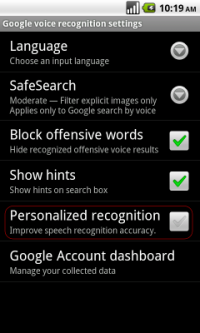
Users of the latest Android-powered smart phones can now allow Google to recognize the unique pattern of their speech by downloading a new app from the Android Market. The service gradually learns the patterns of a person's speech and eventually will more accurately understand their voice commands.
Google's ambitions don't stop at improving voice recognition. Its recent purchase of Phonetic Arts, a British company that specializes in speech output, highlights Google's plans to allow your computer or smart phone to speak back to you, in a "voice" that will sound increasingly natural, and even human.
Google earns the vast majority of its revenue through search advertising, and expects a majority of its Internet business to flow through smart phones and other wireless devices in the future, so high quality voice services are of critical importance.
The linguistic models that Cohen's team has helped develop over the past six years at Google, based on more than 230 billion searches typed into google.com and speech inflections recorded from millions of people who used voice search, are now so vast and complex that it would literally take several centuries for a single PC to create Google's digital model of spoken English.
For Google, said Al Hilwa, an analyst with the research firm IDC, "voice is a critical strategic competence."
Google's Dec. 3 announcement of the Phonetic Arts acquisition - terms were not disclosed - is "complementary to what Google is doing in social networking, video and mobile where it should be possible for people on the go to talk to their mobile devices, search engines or social networks as an alternative mechanism of interaction," Hilwa said.
Speech also is another key area where Google competes with Microsoft, which purchased Mountain View-based Tellme Networks, Inc., in 2007 to bulk up its speech services, and which also offers voice search through its Bing search engine.
Before joining Google, Cohen co-founded Nuance Communications, a Menlo Park, Calif., speech technology company, in 1994. Cohen, a part-time jazz guitarist whose first memory was the sound of the toy piano he received for Hanukkah in the Brooklyn apartment where he grew up, has been a research scientist in the field of using computer speech technology for more than a quarter century.
A bespectacled man with red hair who once worked as a piano tuner and whose sextet once played the Montreux Jazz Festival in Switzerland, Cohen likes to laugh at the irony of Google placing a native Brooklynite - given the New York borough's famously stretched and tangled dialect - in charge of speech recognition.
"I'm from Brooklyn," Cohen said. "I've never parked my car; I only 'paahhk' my car."
A person's accent, Cohen said, is one of the most difficult challenges for speech recognition services, and is one problem that the new personal voice recognition service should help overcome.
Still, much more than understanding different accents are involved in human speech, and a wide range of factors - variables include the shape of a person's mouth, teeth and throat, the cadence and pitch of their sentences - are elements the human ear has evolved to differentiate, but which computers have not.
"It's all different from one person to another, and that all affects the sounds that come out," Cohen said. "There is tremendous variation between individuals. It's been a known thing that you can do better (at speech recognition) if you can do something to try to adapt to an individual's speech patterns."
More information: http://googlemobil … ersonal.html
(c) 2010, San Jose Mercury News (San Jose, Calif.).
Distributed by McClatchy-Tribune Information Services.
-
From lemons to lemonade: Reaction uses carbon dioxide to make carbon-based semiconductor,
28 comments
-
Thioridazine kills cancer stem cells in human while avoiding toxic side-effects of conventional cancer treatments,
3 comments
-
SpaceX private rocket blasts off for space station (Update),
41 comments
-
Climate scientists say they have solved riddle of rising sea,
30 comments
-
Scotland passes turbine test to harness tidal power,
40 comments
-
length of wire in a coil of known dimensions?
17 hours ago
-
India Engineering Powerhouse
May 25, 2012
-
electromagnet core dereference between hard and soft iron
May 25, 2012
-
Measuring water pressure in an open tank
May 24, 2012
-
Question from a non-engineer: Pulley Systems
May 24, 2012
-
Formula to calculate psi required to deliver gpm through nozzel
May 23, 2012
- More from Physics Forums - General Engineering
More news stories
Yahoo kills 'Livestand' just 6 months after debut
(AP) -- Yahoo is killing a tablet magazine called Livestand just six months its debut on the iPad.
13 hours ago |
not rated yet |
1
Computers excel at identifying smiles of frustration (w/ Video)
(Phys.org) -- Researchers at the Massachusetts Institute of Technology (MIT) in the US have trained computers to recognize smiles, and they have turned out to be more adept at recognizing smiles of frustration ...
Yahoo! ditches digital newsstand for iPads
Yahoo! shuttered its fledgling digital newsstand for iPads on Friday in what it said was the start of a product purge intended to make the floundering Internet pioneer more nimble.
14 hours ago |
not rated yet |
0
Facebook IPO debacle raises investor dander
The spate of complaints and investigations over the Facebook stock offering suggests big institutions had an edge over small investors, raising questions about the process.
15 hours ago |
not rated yet |
0
Apple CEO Cook gives up $75M in stock dividends
(AP) -- Apple CEO Tim Cook is giving up $75 million in dividends on restricted stock that the company is awarding to all of its employees.
18 hours ago |
1.8 / 5 (4) |
2
Of mice and mental models: Neuroscientific implications of risk-optimized behavior in the mouse
(Medical Xpress) -- Regardless of an organism’s biological complexity, every encephalized animal continuously makes under-informed behavioral choices that can have serious consequences. Despite its ubiquity, ...
Dragon arrives at space station in historic 1st (Update 2)
The privately bankrolled Dragon capsule made a historic arrival at the International Space Station on Friday, triumphantly captured by astronauts wielding a giant robot arm.
Landmark calculation clears the way to answering how matter is formed
(Phys.org) -- An international collaboration of scientists, including Thomas Blum, associate professor of physics, is reporting in landmark detail the decay process of a subatomic particle called a kaon ...
High-speed method to aid search for solar energy storage catalysts
Eons ago, nature solved the problem of converting solar energy to fuels by inventing the process of photosynthesis.
It's in the genes: Research pinpoints how plants know when to flower
Scientists believe they've pinpointed the last crucial piece of the 80-year-old puzzle of how plants "know" when to flower.
Researchers solve structure of human protein critical for silencing genes
In a study published in the journal Cell on May 24, Cold Spring Harbor Laboratory (CSHL) scientists describe the three-dimensional atomic structure of a human protein bound to a piece of RNA that "guides" the pr ...
Dec 14, 2010
Rank: 3.6 / 5 (7)
Dec 14, 2010
Rank: 5 / 5 (2)
In theory it's a simple task of assigning your own voice to numbers, but you can't activate speech recognition without touching the phone! No good while driving when it's needed most.
Dec 14, 2010
Rank: 1.8 / 5 (9)
Dec 14, 2010
Rank: 4.7 / 5 (6)
Dec 14, 2010
Rank: 2.3 / 5 (3)
Probably the easiest implementation of that would be key word or key phrase activation. A background process monitors voice audio input and triggers when the key word or phrase is spoken.
Dec 15, 2010
Rank: 5 / 5 (1)
There isn't any viable reason they would do that, unless you've attracted attention to yourself and can be distinguished from nearly a billion other people. Sounds like a lot of wasted hard drive space to me.
Dec 15, 2010
Rank: not rated yet
Are you serious? Do you not know why we have so many privacy laws regarding personal data? Would you not mind if facebook sells your user data to third party organisations? But of course, it doesn't matter because unless you're unique, it's a waste of space.
Don't you even know google's goal?
Dec 15, 2010
Rank: 5 / 5 (1)
http://www.youtub...cHhA7M-Y
Dec 15, 2010
Rank: not rated yet
I use Google voice search on my iPhone and it's scary accurate. Voice commands on my old blackberry were a novelty and pretty much useless. Google is way beyond novelty. I can imagine a world in the not to distant future that we will be conversing with our electronic devices as if they were another person.
Just think -- between this and facebook we will never have to talk to an actual face to face human being again. Billions of social misfits on the planet.
Dec 19, 2010
Rank: not rated yet
there are already apps for that on the market to run even on old windows mobile 5 (I had it on windows mobile 5, 6, and 6.5). i believe windows phone 7 is still awaiting an app, but it'll come along sooner than later.
try 2001/2002....its much better now...
Dec 19, 2010
Rank: not rated yet
Dec 19, 2010
Rank: not rated yet
Yah don't suppose there might be a lot of nuances that this one patheticly tiny paragraph doesn't accurately explain or describe eh? Nah....couldn't be the case...
I've never even used this service. Didn't know it existed, because every tme I go to Google I just automaticly type in a search. I never even look at anything else on Google, except a few months ago the mapping technology, but uh, yeah....never used it, never needed it...