Fahrenheit -459: Neutron stars and string theory in a lab
(PhysOrg.com) -- Using lasers to contain some ultra-chilled atoms, a team of scientists has measured the viscosity or stickiness of a gas often considered to be the sixth state of matter. The measurements verify that this gas can be used as a "scale model" of exotic matter, such as super-high temperature superconductors, the nuclear matter of neutron stars, and even the state of matter created microseconds after the Big Bang.
The results may also allow experimental tests of string theory in the future.
Duke physicist John Thomas made the viscosity measurements using an ultra-cold Fermi gas of lithium-6 atoms trapped in a millimeter-sized bowl made of laser light. When cooled and placed inside a magnetic field of the correct size, the atoms interact as strongly as the laws of quantum mechanics allow. This strongly interacting gas exhibits "remarkable properties," such as nearly frictionless fluid flow, Thomas said.
The team's report appears in the Dec. 10 issue of Science.
Under the ultra-cold conditions, the properties of the gas are determined by a universal ruler, or natural length scale, much like the scale on an architect's drawing. The ruler for the atomic gas is the average spacing between the atoms. According to quantum physics, this spacing determines all other natural scales, such as the scale for energy, temperature and viscosity, making the ultra-cold gas a scale model for other exotic matter. Thomas said that he and others have verified the gas as a universal scale model for properties such as temperature, but this is the first time they've tested the scaling of viscosity, which happens to be of particular interest to scientists right now.
Thomas first measured the viscosity of the gas at a few billionths of a degree Kelvin, or
-459 degrees Fahrenheit. Turning off the trap that confines the gas, and then recapturing it caused the radius of the Fermi gas to vibrate. The oscillation, called a breathing mode, resembles the jiggling of a piece of jelly. The longer the vibrations lasted, the lower the viscosity. At slightly higher temperatures, millionths of a degree Kelvin, the researchers instead observed how fast the gas changed from a cigar shape to a pancake after being released from the trap. A slower change in shape had a higher viscosity.
These results are "extremely important to the field of condensed matter physics and to high temperature superconductivity in particular," said Kathy Levin, a theorist at the University of Chicago, who was not involved in the research. She said that the viscosity of the Fermi gas is similar to the conductivity of a superfluid, which flows with no resistance. This "perfect fluidity" is also observed in the condensed matter world, especially in materials used to make high temperature superconductors. The new data, especially at lower temperatures, "seem quite consistent" with predictions of how superconductors should flow, Levin said.
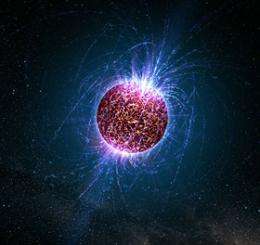
The Fermi gas as a scale model is also important for studying elements of the cosmos that scientists can't probe in a lab, said Duke physicist Berndt Mueller. Even a very small chunk of a neutron star, a dead star that hasn't become a black hole, would weigh billions of tons on Earth and be much too dense to study. The data showing the universal properties of the Fermi gas, however, let physicists calculate the scale from lithium-6 atomic spacing to the spacing between neutrons in these stars. The measurements made on the Fermi gas can then be used to determine the natural energy and other properties for these stars, which can be compared to theorists' predictions. Similar calculations can be made for the quark-gluon plasma, the state of matter created just microseconds after the Big Bang and being studied in particle accelerators such as the Large Hadron Collider in Geneva.
Thomas said the new results also give experimental insight into predictions made using string theory, the mathematical construct uniting the classical world of gravity with quantum physics. String theorists have provided a lower bound for the ratio of the viscosity or fluid flow to the entropy, or disorder, in a strongly-interacting system. The new experiments measured both properties in the Fermi gas and showed that the gas minimum is between four and five times the string theorists' lower bound.
"The measurements do not test string theory directly," Thomas said, noting a few caveats-- the lower bound is derived for high-energy systems, where Einstein's theory of relativity is essential, while the Fermi gas experiments study low-energy gases. If string theorists create new calculations specifically for a Fermi gas, scientists would be able to make precise experimental tests of the theory with equipment no larger than a desktop.
More information: "Universal Quantum Viscosity in a Unitary Fermi Gas," C. Cao et. al. Science 1195219 (2010) doi:10.1126/science.1195219
Provided by Duke University


