Ever-sharp urchin teeth may yield tools that never need honing
December 22, 2010 by Terry Devitt

Ever-sharp urchin teeth may yield tools that never need honing

Enlarge

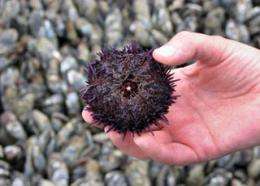
A California purple sea urchin is pictured in hand. Photo: Jeff Miller

(PhysOrg.com) -- To survive in a tumultuous environment, sea urchins literally eat through stone, using their teeth to carve out nooks where the spiny creatures hide from predators and protect themselves from the crashing surf on the rocky shores and tide pools where they live.

The rock-boring behavior is astonishing, scientists agree, but what is truly remarkable is that, despite constant grinding and scraping on stone, urchin never, ever get dull. The secret of their ever-sharp qualities has puzzled scientists for decades, but now a new report by scientists from the University of Wisconsin-Madison and their colleagues has peeled back the toothy mystery.

Writing today (Dec. 22, 2010) in the journal , a team led by UW-Madison professor of physics Pupa Gilbert describes the self-sharpening mechanism used by the California purple sea urchin to keep a razor-sharp edge on its choppers.

The urchin's self-sharpening trick, notes Gilbert, is something that could be mimicked by humans to make tools that never need honing.

"The sea urchin tooth is complicated in its design. It is one of the very few structures in nature that self-sharpen," says Gilbert, explaining that the sea urchin tooth, which is always growing, is a biomineral mosaic composed of calcite with two forms — plates and fibers — arranged crosswise and cemented together with super-hard calcite nanocement. Between the crystals are layers of organic materials that are not as sturdy as the calcite crystals.

"The organic layers are the weak links in the chain," Gilbert explains. "There are breaking points at predetermined locations built into the teeth. It is a concept similar to perforated paper in the sense that the material breaks at these predetermined weak spots."

Ever-sharp urchin teeth may yield tools that never need honing

Sea urchin teeth. Photo: courtesy Pupa Gilbert

The crystalline nature of sea urchin dentition is, on the surface, different from other crystals found in nature. It lacks the obvious facets characteristic of familiar crystals, but at the very deepest levels the properties of crystals are evident in the orderly arrangement of the atoms that make up the biomineral mosaic teeth of the sea urchin.

To delve into the fundamental nature of the crystals that form sea urchin teeth, Gilbert and her colleagues used a variety of techniques from the materials scientist's toolbox. These include microscopy methods that depend on X-rays to illuminate how nanocrystals are arranged in teeth to make the capable of grinding rock. Gilbert and her colleagues used these techniques to deduce how the crystals are organized and melded into a tough and durable biomineral.

Knowing the secret of the ever-sharp sea urchin tooth, says Gilbert, could one day have practical applications for human toolmakers. "Now that we know how it works, the knowledge could be used to develop methods to fabricate tools that could actually sharpen themselves with use," notes Gilbert. "The mechanism used by the urchin is the key. By shaping the object appropriately and using the same strategy the urchin employs, a tool with a self-sharpening edge could, in theory, be created."

Provided by University of Wisconsin-Madison search and more info website

4.5 /5 (17 votes)  

Filter


Move the slider to adjust rank threshold, so that you can hide some of the comments.


Display comments: newest first

Raveon
Dec 22, 2010

Rank: 4.5 / 5 (2)
"Now that we know how it works,...."

Now that they know how it works, maybe the writer of the article could have told us. I am assuming that layers at the angle of the edge continually shear away exposing a new edge. This principle is already known, how to make it is another question. The depleted uranium core of armor piercing projectiles operates on a similar principle If I'm not mistaken.
ormondotvos
Dec 22, 2010

Rank: 5 / 5 (1)
I thought beaver teeth were self sharpening...

http://www.fishin...nife.cfm
meerling
Dec 23, 2010

Rank: 5 / 5 (1)
I suspect Raveons guess is basically right as to the teeth, but as to the d.u.p. ammo, no.
D.U.P. (depleted uranium projectile) is a depleted uranium core surrounded by an aluminum shell that keeps it from deforming before it strikes the target. If it wasn't for deformation risk before impact, there would be no reason for the aluminum windscreen.
It is in no way similar to the self sharpening of urchin teeth.
Not trying to be a pain, just trying to make sure nobody gets the wrong idea.
fmfbrestel
Dec 23, 2010

Rank: 5 / 5 (1)
"On more properly military grounds, depleted uranium is favored for the penetrator because it is self-sharpening and pyrophoric.[27] On impact with a hard target, such as an armored vehicle, the nose of the rod fractures in such a way that it remains sharp. The impact and subsequent release of heat energy causes it to disintegrate to dust and burn when it reaches air because of its pyrophoric properties.[27" -- Wikipedia

Sorry Meerling, But DU is used precisely because it is self-sharpening. And it is also self-sharpening in much the same way as these teeth -- It sheers off in predictable ways such that there is always a sharp point at the front.

The other reason it is used is because all the material that sheers off burns at high temperatures. But without the sheering effect of DU it would not be nearly as effective at piercing armor.
fmfbrestel
Dec 23, 2010

Rank: 5 / 5 (3)
However, claiming that this property could lead to products that never need sharpening is a little disingenuous. While a material with similar properties would stay sharp, it would also be constantly eroding itself away. So it would stay sharp until it didn't exist any longer. So it would only be beneficial if the sheering took less material from the blade then manual sharpening does.
Scalziand
Dec 27, 2010

Rank: 5 / 5 (3)
However, claiming that this property could lead to products that never need sharpening is a little disingenuous. While a material with similar properties would stay sharp, it would also be constantly eroding itself away. So it would stay sharp until it didn't exist any longer. So it would only be beneficial if the sheering took less material from the blade then manual sharpening does.

You are ignoring the gains in productivity from not having to take a tool offline for sharpening.
gmurphy
Dec 29, 2010

Rank: not rated yet
This self-sharpening process is not so different from what is seen in an angle-grinder, imho.
Skeptic_Heretic
Dec 29, 2010

Rank: not rated yet
This self-sharpening process is not so different from what is seen in an angle-grinder, imho.

except an angle grinder becomes observably less useful for its task on each shearing event.
Rank 4.5 /5 (17 votes)
Relevant PhysicsForums posts
  • Transparency of molten substances?
    created23 hours ago
  • saturated paramagnetic and ferromagnetic
    createdMay 24, 2012
  • How to calculate the bandstructure of Twisted Bilayer Graphene
    createdMay 23, 2012
  • vast computational richness from swapping one proton
    createdMay 22, 2012
  • Oscillator strength of mixed LH- and HH-excitons
    createdMay 22, 2012
  • 2D Quantum Well and k-values
    createdMay 21, 2012
  • More from Physics Forums - Atomic, Solid State, Comp. Physics

More news stories

Landmark calculation clears the way to answering how matter is formed

(Phys.org) -- An international collaboration of scientists, including Thomas Blum, associate professor of physics, is reporting in landmark detail the decay process of a subatomic particle called a kaon – ...

Physics / General Physics

created 19 hours ago | popularity 4.8 / 5 (12) | comments 28 | with audio podcast

Is a classical electrodynamics law incompatible with special relativity?

(Phys.org) -- The laws of classical electromagnetism that were developed in the 19th century are the same laws that scientists use today. They include Maxwell’s four equations along with the Lorentz la ...

Physics / General Physics

created May 24, 2012 | popularity 5 / 5 (13) | comments 30 | with audio podcast feature

Lying in wait for WIMPs: Researchers seek to dramatically increase sensitivity of Large Underground Xenon detector

Although it's invisible, dark matter accounts for at least 80 percent of the matter in the universe. No one knows what it is, but most scientists would bet on weakly interacting massive particles, or WIMPs.

Physics / General Physics

created May 23, 2012 | popularity 4 / 5 (5) | comments 14 | with audio podcast

Hall effect at the speed of light: How can you demonstrate relativistic effects with your mobile phone?

The relativistic Hall effect describing objects rotating at speeds comparable with the speed of light has been reported.

Physics / General Physics

created May 21, 2012 | popularity 4.3 / 5 (3) | comments 8

Cloak of invisibility: Engineers use plasmonics to create an invisible photodetector

A team of engineers at Stanford and the University of Pennsylvania has for the first time used "plasmonic cloaking" to create a device that can see without being seen - an invisible machine that detects light. It is the first ...

Physics / General Physics

created May 21, 2012 | popularity 4.8 / 5 (16) | comments 7 | with audio podcast


Of mice and mental models: Neuroscientific implications of risk-optimized behavior in the mouse

(Medical Xpress) -- Regardless of an organism’s biological complexity, every encephalized animal continuously makes under-informed behavioral choices that can have serious consequences. Despite its ubiquity, ...

Dragon arrives at space station in historic 1st (Update 2)

The privately bankrolled Dragon capsule made a historic arrival at the International Space Station on Friday, triumphantly captured by astronauts wielding a giant robot arm.

High-speed method to aid search for solar energy storage catalysts

Eons ago, nature solved the problem of converting solar energy to fuels by inventing the process of photosynthesis.

It's in the genes: Research pinpoints how plants know when to flower

Scientists believe they've pinpointed the last crucial piece of the 80-year-old puzzle of how plants "know" when to flower.

Researchers solve structure of human protein critical for silencing genes

In a study published in the journal Cell on May 24, Cold Spring Harbor Laboratory (CSHL) scientists describe the three-dimensional atomic structure of a human protein bound to a piece of RNA that "guides" the pr ...

MIT researchers devise new means to synchronize a group of robots (w/ Video)

(Phys.org) -- For several years, roboticists have been working out ways to get a group of robots to perform synchronized activities as demonstrated most often in dance routines. It’s not just about trying ...