Chip provides its own power
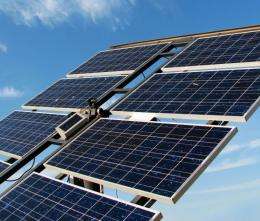
Microchips that 'harvest' the energy they need from their own surroundings, without depending on batteries or mains electricity. That will be possible now that Dutch researchers from the University of Twente's MESA+ Institute for Nanotechnology, together with colleagues from the universities of Nankai (China) and Utrecht, have for the first time succeeded in manufacturing a microchip with an efficient solar cell placed on top of the microelectronics.
The researchers presented their findings at the International Electron Device Meeting that was held from 5 to 8 December in San Francisco.
The placement of a solar cell directly on top of the electronics means the autonomous chip does not need batteries. In this way, for example, a sensor chip can be produced, complete with the necessary intelligence and even an antenna for wireless communication. However, the chip's energy use must be well below 1 milliwatt, say the researchers. The chip can then even collect enough energy to operate indoors.
The simplest solution would seem to be to manufacture the solar cell separately and then fit it on top of the electronics, but this is not the most efficient production process, so instead the researchers use the chip as a base and apply the solar cell to it layer by layer. This uses fewer materials, and also ultimately performs better. But the combination is not trouble-free: there is a risk that the steps in the production of the solar cell will damage the electronics so that they function less efficiently.
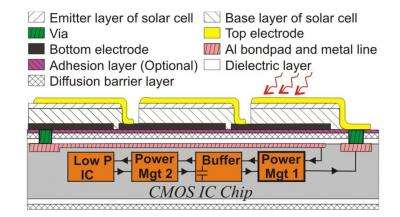
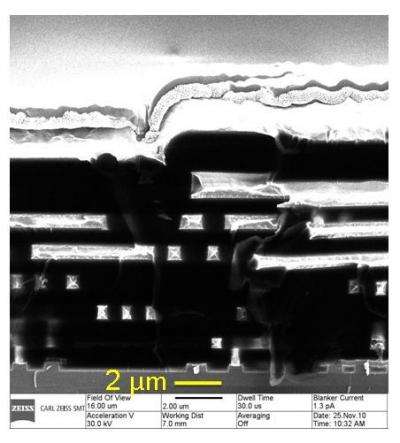
For this reason the researchers decided to use solar cells made of amorphous silicon or CIGS (copper - indium - gallium - selenide). The manufacturing procedure for these cells does not influence the electronics, and these types of solar cells also produce sufficient power, even in low light. Tests have shown that the electronics and the solar cells function properly, and the manufacturing process is also highly suitable for industrial serial production with the use of standard processes.
The research was carried out in the Semiconductor Components group led by Prof. Jurriaan Schmitz. The researchers collaborated with colleagues from Nankai University in Tianjin, China and the Debye Institute of Utrecht University. The research was made possible by the STW Technology Foundation.
More information: The paper 'Above-CMOS a-Si and CIGS Solar Cells for Powering Autonomous Microsystems' by J. Lu, W. Liu, C.H.M. van der Werf, A.Y. Kovalgin, Y. Sun, R.E.I. Schropp and J. Schmitz was presented at the International Electron Device Meeting in San Francisco.
Provided by
University of Twente
-
From lemons to lemonade: Reaction uses carbon dioxide to make carbon-based semiconductor,
28 comments
-
Thioridazine kills cancer stem cells in human while avoiding toxic side-effects of conventional cancer treatments,
3 comments
-
SpaceX private rocket blasts off for space station (Update),
41 comments
-
Climate scientists say they have solved riddle of rising sea,
30 comments
-
Scotland passes turbine test to harness tidal power,
40 comments
-
potential difference and EMF
8 hours ago
-
Zero point switching
10 hours ago
-
Cosmic ray detector help
12 hours ago
-
AC Voltage Across a POT
14 hours ago
-
Reverse Recovery Time
20 hours ago
-
Need help finding heat sink
May 24, 2012
- More from Physics Forums - Electrical Engineering
More news stories
Yahoo kills 'Livestand' just 6 months after debut
(AP) -- Yahoo is killing a tablet magazine called Livestand just six months its debut on the iPad.
9 hours ago |
not rated yet |
1
Computers excel at identifying smiles of frustration (w/ Video)
(Phys.org) -- Researchers at the Massachusetts Institute of Technology (MIT) in the US have trained computers to recognize smiles, and they have turned out to be more adept at recognizing smiles of frustration ...
Yahoo! ditches digital newsstand for iPads
Yahoo! shuttered its fledgling digital newsstand for iPads on Friday in what it said was the start of a product purge intended to make the floundering Internet pioneer more nimble.
10 hours ago |
not rated yet |
0
Facebook IPO debacle raises investor dander
The spate of complaints and investigations over the Facebook stock offering suggests big institutions had an edge over small investors, raising questions about the process.
11 hours ago |
not rated yet |
0
Apple CEO Cook gives up $75M in stock dividends
(AP) -- Apple CEO Tim Cook is giving up $75 million in dividends on restricted stock that the company is awarding to all of its employees.
14 hours ago |
1.8 / 5 (4) |
2
Of mice and mental models: Neuroscientific implications of risk-optimized behavior in the mouse
(Medical Xpress) -- Regardless of an organism’s biological complexity, every encephalized animal continuously makes under-informed behavioral choices that can have serious consequences. Despite its ubiquity, ...
Dragon arrives at space station in historic 1st (Update 2)
The privately bankrolled Dragon capsule made a historic arrival at the International Space Station on Friday, triumphantly captured by astronauts wielding a giant robot arm.
Landmark calculation clears the way to answering how matter is formed
(Phys.org) -- An international collaboration of scientists, including Thomas Blum, associate professor of physics, is reporting in landmark detail the decay process of a subatomic particle called a kaon ...
High-speed method to aid search for solar energy storage catalysts
Eons ago, nature solved the problem of converting solar energy to fuels by inventing the process of photosynthesis.
It's in the genes: Research pinpoints how plants know when to flower
Scientists believe they've pinpointed the last crucial piece of the 80-year-old puzzle of how plants "know" when to flower.
Researchers solve structure of human protein critical for silencing genes
In a study published in the journal Cell on May 24, Cold Spring Harbor Laboratory (CSHL) scientists describe the three-dimensional atomic structure of a human protein bound to a piece of RNA that "guides" the pr ...

