Increasing biomass through double-cropping system nets mixed results
December 6, 2010

Enlarge

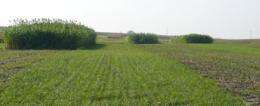
The research plots included single-cropping sorghum plants (three taller plots in the background). In the foreground are the double-cropping plots where sorghum has recently been harvested and triticale has been planted for the upcoming winter. This photo was taken in early fall. ISU courtesy photo

(PhysOrg.com) -- Trying to increase the amount of biomass available for ethanol production has led Iowa State University researchers to explore a double-cropping system that netted mixed results.

Researchers planted triticale, a relative of wheat, in the fall and harvested it in the spring. Then they planted in early June and harvested it in mid-September.

Twelve different varieties of sorghum were tested with the triticale. Of those, four test plots produced as much biomass as a single crop of sorghum alone yielded in the same year.

"The sorghums planted with the single-cropping system were planted a little earlier and harvested later," said Ben Goff, who received his master's degree from Iowa State University student and is now pursuing his doctoral degree at the University of Kentucky. Goff conducted the research under the guidance of Ken Moore, professor of at ISU.

The longer growing season for the single-cropping sorghum produced more biomass in eight of the 12 sorghum types. The other four types of sorghum were early maturing varieties, and they produced an equal amount of biomass as the single-crop sorghum. These yielded less ethanol than the single-crop sorghum.

While the research didn't produce an increase in biomass, there are benefits to the double-cropping system, according to Goff.

"The winter crop reduces ," said Goff. "And some studies have shown that having the crop in the field captures spring nitrogen early in the year so it doesn't move through the soil profile."

Sorghum and triticale were chosen as the crops to pair together for several reasons, according to Goff.

"Sorghum is a potential ," he said. "You can get a lot of biomass in a shorter growing season. Also, sorghum is more drought tolerant, and using a two-crop system may leave you with moisture limitations. Sorghum has many of the same farm practices as corn, so it would be a crop farmers would be comfortable with producing."

Sorghums, especially sweet sorghums, have high concentration of soluble sugars which are readily fermentable for ethanol, according to Moore.

Triticale is a good winter crop that produces much biomass during the winter, said Goff.

The research was conducted near the ISU campus in Ames and also at ISU's Northwest Research and Demonstration Farms in O'Brien County, and was funded by the Iowa Energy Center.

While the research didn't net an increase in biomass, Goff doesn't declare the idea a failure.

"This still has potential. If we can get an earlier maturing annual winter crop, I think we can get greater yields," said Goff. "Basically, we are trying to utilize more of the sun's energy to produce more biomass."

Moore thinks that sorghum double-cropping may be environmentally beneficial in certain farmland.

"Double-cropping may have some real benefits for land that should not be exposed to erosion in winter," Moore said.

Provided by Iowa State University search and more info website

Filter


Move the slider to adjust rank threshold, so that you can hide some of the comments.


Display comments: newest first

Ratfish
Dec 06, 2010

Rank: not rated yet
Even if this weren't a failure you'd still have a federally subsidized net loss of energy on ethanol production in general.

They should rename it redherringanol.
Rank not rated yet
Relevant PhysicsForums posts

More news stories

It's in the genes: Research pinpoints how plants know when to flower

Scientists believe they've pinpointed the last crucial piece of the 80-year-old puzzle of how plants "know" when to flower.

Biology / Biotechnology

created 11 hours ago | popularity 4 / 5 (5) | comments 1 | with audio podcast

Researchers solve structure of human protein critical for silencing genes

In a study published in the journal Cell on May 24, Cold Spring Harbor Laboratory (CSHL) scientists describe the three-dimensional atomic structure of a human protein bound to a piece of RNA that "guides" the pr ...

Biology / Cell & Microbiology

created 12 hours ago | popularity 5 / 5 (5) | comments 0 | with audio podcast

Study uncovers secret to speedy burrowing by razor clams

(Phys.org) -- If you look at a razor burrowing clam sitting in a bucket, you’d never guess that it could burrow itself down into the soil, much less do it with any speed. Razor clams look like fat straws, ...

Biology / Plants & Animals

created 21 hours ago | popularity not rated yet | comments 3 | with audio podcast report

Copy of the genetic makeup travels in a protein suitcase

Scientists from the Institute for Physical and Theoretical Chemistry at the University of Bonn have succeeded for the first time in the real time filming of the transport of an important information carrier in biological ...

Biology / Cell & Microbiology

created 17 hours ago | popularity not rated yet | comments 0 | with audio podcast

'Transformer' protein makes different sized transport pods

These spheres may look almost identical, but subtle differences between them revealed a molecular version of the robots from Transformers. Each sphere is a vesicle, a pod that cells use to transport materials ...

Biology / Cell & Microbiology

created 18 hours ago | popularity not rated yet | comments 0


Of mice and mental models: Neuroscientific implications of risk-optimized behavior in the mouse

(Medical Xpress) -- Regardless of an organism’s biological complexity, every encephalized animal continuously makes under-informed behavioral choices that can have serious consequences. Despite its ubiquity, ...

Dragon arrives at space station in historic 1st (Update 2)

The privately bankrolled Dragon capsule made a historic arrival at the International Space Station on Friday, triumphantly captured by astronauts wielding a giant robot arm.

Landmark calculation clears the way to answering how matter is formed

(Phys.org) -- An international collaboration of scientists, including Thomas Blum, associate professor of physics, is reporting in landmark detail the decay process of a subatomic particle called a kaon – ...

High-speed method to aid search for solar energy storage catalysts

Eons ago, nature solved the problem of converting solar energy to fuels by inventing the process of photosynthesis.

MIT researchers devise new means to synchronize a group of robots (w/ Video)

(Phys.org) -- For several years, roboticists have been working out ways to get a group of robots to perform synchronized activities as demonstrated most often in dance routines. It’s not just about trying ...

Researchers demonstrate possible primitive mechanism of chemical info self-replication

(Phys.org) -- When scientists think about the replication of information in chemistry, they usually have in mind something akin to what happens in living organisms when DNA gets copied: a double-stranded molecule ...