Australia Outback could soon get web via TV aerial

December 5, 2010 by Amy Coopes
An Australian high school student uses Wi-Fi to connect her laptop to the internet in a Sydney garden. Australia's sheer size makes universal Internet access a huge challenge, with many millions of square kilometres stretching through deserts and mountains from the Indian Ocean to the Pacific and from tropics to snow.
The humble old rooftop TV aerial could bring superfast Internet to even the most remote shack in the Australian Outback and help solve the problem of how to connect isolated communities across the globe.
Researchers in Australia from the government science agency CSIRO have developed new technology which could achieve connection speeds to compete with the best: through the tangled piece of metal already attached to most roofs.
"The basic premise is if you get good high quality analogue television you should be able to get reliable high-speed communications," project leader Ian Oppermann said.
Australia's sheer size makes universal Internet access a huge challenge, with many millions of square kilometres stretching through deserts and mountains from the Indian Ocean to the Pacific and from tropics to snow.
In some places the population is so sparse, Oppermann says they calculate the "nanopeople" per square kilometre.
The Australian government has the National Broadband Network (NBN) in the works which aims to connect 93 percent of the country to high speed Internet via a fibre optic network.
But that still leaves seven per cent without what is becoming, increasingly, a basic human right.
The NBN promises speeds of 100 megabits per second, but the new project team reckon they can match that and connect remote Australia through the spectrum once used for their TV sets.
Most people have access to a television signal and more remote communities have relatively little interference -- perfect conditions for low-frequency Internet transmission on the VHF/UHF bands.
Australia's "big bold" Internet experiment is being watched by a number of other countries mulling similar plans, many of whom Oppermann said had either completed the shift from analogue TV or were in the process of doing so.
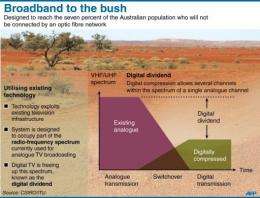
Graphic on an Australian scheme to use TV aerials to connect remote communities to the Internet. Researchers in Australia have developed new technology which could achieve high-speed broadband connection through the rooftop device.
"There are lots of parts of Australia which look a little bit like big parts of Canada, Russia, China, parts of the US, most of Africa from the perspective of where the population is distributed and the sort of conditions that people live in, purely from a communications perspective," Opperman said."I think Australia really stands a chance of being of global test case. If we get it right there is really an opportunity that other countries will follow what Australia is leading with."
Australia began switching off its analogue TV signals in June and the transition to digital-only transmission is expected to be complete by the end of 2013, five years before the rollout finishes for the NBN.
The spectrum is then expected to be auctioned off for communications purposes and this low-frequency analogue television spectrum could be the perfect solution.
"To give you an analogy, this is beachfront property," Oppermann told AFP.
"The reason that it's expensive is that it's relatively low frequency and low frequencies travel very well. If you're after reach it's a very good piece of spectrum to have."
Unlike current GSM or 3G networks which lose download speed exponential to increasing users, Oppermann said an analogue signal would provide a consistent speed no matter how many users there were.

A handout photo released by Marais-Lucas Technologies shows the cutting wheel of a trenching machine, designed and built in to lay the first of millions of kilometres of fibre-optic cable, the first step in a multi-billion dollar scheme to connect the nation to boradband.
This high-speed communication could revolutionise life for people living in Australia's isolated Outback, allowing for virtual appointments with a doctor or government officials.Six farms on the southern island state of Tasmania will test the technology, which will only work in towns of less than 1,000 homes because too many buildings will obstruct the signal, next month ahead of a wider field study.
"It's not just an idea anymore," Oppermann said. "We can demonstrate that it's actually something useful."
(c) 2010 AFP
-
From lemons to lemonade: Reaction uses carbon dioxide to make carbon-based semiconductor,
28 comments
-
Thioridazine kills cancer stem cells in human while avoiding toxic side-effects of conventional cancer treatments,
3 comments
-
SpaceX private rocket blasts off for space station (Update),
41 comments
-
Climate scientists say they have solved riddle of rising sea,
30 comments
-
Scotland passes turbine test to harness tidal power,
40 comments
-
length of wire in a coil of known dimensions?
16 hours ago
-
India Engineering Powerhouse
23 hours ago
-
electromagnet core dereference between hard and soft iron
May 25, 2012
-
Measuring water pressure in an open tank
May 24, 2012
-
Question from a non-engineer: Pulley Systems
May 24, 2012
-
Formula to calculate psi required to deliver gpm through nozzel
May 23, 2012
- More from Physics Forums - General Engineering
More news stories
Yahoo kills 'Livestand' just 6 months after debut
(AP) -- Yahoo is killing a tablet magazine called Livestand just six months its debut on the iPad.
11 hours ago |
not rated yet |
1
Computers excel at identifying smiles of frustration (w/ Video)
(Phys.org) -- Researchers at the Massachusetts Institute of Technology (MIT) in the US have trained computers to recognize smiles, and they have turned out to be more adept at recognizing smiles of frustration ...
Yahoo! ditches digital newsstand for iPads
Yahoo! shuttered its fledgling digital newsstand for iPads on Friday in what it said was the start of a product purge intended to make the floundering Internet pioneer more nimble.
12 hours ago |
not rated yet |
0
Facebook IPO debacle raises investor dander
The spate of complaints and investigations over the Facebook stock offering suggests big institutions had an edge over small investors, raising questions about the process.
13 hours ago |
not rated yet |
0
Apple CEO Cook gives up $75M in stock dividends
(AP) -- Apple CEO Tim Cook is giving up $75 million in dividends on restricted stock that the company is awarding to all of its employees.
16 hours ago |
1.8 / 5 (4) |
2
Of mice and mental models: Neuroscientific implications of risk-optimized behavior in the mouse
(Medical Xpress) -- Regardless of an organism’s biological complexity, every encephalized animal continuously makes under-informed behavioral choices that can have serious consequences. Despite its ubiquity, ...
Dragon arrives at space station in historic 1st (Update 2)
The privately bankrolled Dragon capsule made a historic arrival at the International Space Station on Friday, triumphantly captured by astronauts wielding a giant robot arm.
Landmark calculation clears the way to answering how matter is formed
(Phys.org) -- An international collaboration of scientists, including Thomas Blum, associate professor of physics, is reporting in landmark detail the decay process of a subatomic particle called a kaon ...
High-speed method to aid search for solar energy storage catalysts
Eons ago, nature solved the problem of converting solar energy to fuels by inventing the process of photosynthesis.
It's in the genes: Research pinpoints how plants know when to flower
Scientists believe they've pinpointed the last crucial piece of the 80-year-old puzzle of how plants "know" when to flower.
Researchers solve structure of human protein critical for silencing genes
In a study published in the journal Cell on May 24, Cold Spring Harbor Laboratory (CSHL) scientists describe the three-dimensional atomic structure of a human protein bound to a piece of RNA that "guides" the pr ...

Dec 05, 2010
Rank: 5 / 5 (2)
does this make sense to anyone? if so would appreciate an explanation.
Dec 05, 2010
Rank: 5 / 5 (2)
Dec 05, 2010
Rank: 5 / 5 (1)
Dec 05, 2010
Rank: 5 / 5 (2)