Study suggests that trace amounts of water created oceans on Earth, other terrestrial planets
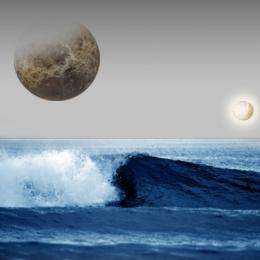
One question that has baffled planetary scientists is how oceans formed on the surface of terrestrial planets like Earth — rocky planets made of silicate and metals. It’s believed that in additionzq to Earth, the terrestrial planets Mars and Venus may have had oceans soon after their formation. There is ample evidence to suggest that these planets formed from rocky clumps called planetesimals that later combined in high-energy collisions and left their surfaces covered in molten rock, or magma. It didn’t take long for these magma oceans to cool, and many researchers contend that oceans of water were created later on, when icy objects like comets and asteroids deposited water on the rocky planets.
But a recent study by an MIT planetary scientist suggests that the planetesimals themselves provided the water that created oceans. As Lindy Elkins-Tanton, the Mitsui Career Development Assistant Professor of Geology in MIT’s Department of Earth, Atmospheric and Planetary Sciences, reports in a paper published last month in Astrophysics and Space Science, these planetesimals contained trace amounts of water — at least .01 to .001 percent of their total mass (scientists don’t know the precise size of planetesimals, but they estimate that those that created Earth were between hundreds and thousands of kilometers in diameter). In the paper, Elkins-Tanton says it is likely that even tiny amounts of water in the planetesimals could create steam atmospheres that later cooled and condensed into liquid oceans on terrestrial planets.
“These little bits of water get processed into planets in ways we can predict,” says Elkins-Tanton, who created new models to detail the chemistry and physics of planet solidification. By suggesting that the majority of rocky planets formed water oceans early in their history, her analysis could help determine which planets outside the solar system, or exoplanets, might have or have had water and would therefore be possible candidates for hosting — or having hosted — life. This only applies to rocky exoplanets because most of the more than 500 exoplanets discovered to date are thought to be too hot and gaseous to host life.
Cooling planets
Samples of meteorites that originated from planetesimals indicate that the rocky bodies contained tiny amounts of water. To determine what happened to the water inside the planetesimals, Elkins-Tanton examined every step of the solidification process for rocky planets in the solar system (she didn’t consider gas giants like Jupiter because the physics of how these planets form is entirely different). While this process had been modeled previously, no one had investigated whether water in planetesimals could produce oceans.
Elkins-Tanton first modeled how magma crystallizes into minerals on a theoretical rocky planet. This allowed her to calculate how much water from the planetesimals would be captured inside those minerals, and how much would remain in the magma as it cooled. She then incorporated details about the saturation level of magma into the models and observed that any water that doesn’t dissolve in the magma would form bubbles. The models revealed that as the planet cools and forms a solid mantle, the bubbles in its magma oceans would rise to form a thick, steam atmosphere covering the planet. That steam would eventually collapse to create liquid oceans.
The idea that trace amounts of water in planetesimals could give rise to vast oceans may seem far-fetched until one considers how small an ocean can be relative to the size and mass of a planet. Earth’s current oceans, for instance, make up just .02 percent of the planet’s mass, excluding its metal core. Thus, if the majority of the small amounts of water in a planetesimal reaches a planetary surface as its magma solidifies, this would be enough to form oceans that are similar to Earth’s.
For Earth, Elkins-Tanton estimates that this process occurred within tens of millions of years after the planetesimals crashed together, meaning that the planet could have been habitable pretty soon after it formed. She predicts that the same process could take up to hundreds of millions of years for super-Earths, or exoplanets that are at least twice as big as Earth and are just now being discovered. Because the research suggests that rocky super-Earths should have grown oceans soon after they formed, and because water is required for life as we know it, it’s possible that these planets may have hosted — or even still host — life.
The life of oceans
“The study gives us a very important starting point for understanding the evolution and history of planets,” says Pin Chen, a research scientist at NASA’s Jet Propulsion Laboratory, who studies planetary atmospheres. He is confident that the research can be used to make predictions about oceans on exoplanets because “it is so well-grounded in fundamental principles of physics, chemistry and thermal dynamics.”
Although the analysis suggests that oceans are expected to be prevalent in the early history of a rocky planet, it doesn’t provide details about how long these oceans would last, which Chen says is critical for figuring out what happened to the oceans that may have covered Mars and Venus. Because atmospheres are responsible for releasing water from oceans into space, he suggests additional modeling of the interactions between the atmosphere and mantle of a young rocky planet.
In future work, Elkins-Tanton plans to model the chemistry of these atmospheres to figure out what kinds of atmospheres could be created by the solidification process, such as an oxidizing atmosphere (contains oxygen) or a reducing atmosphere (contains hydrogen). She’s also interested in determining what conditions other than a liquid ocean might help initiate life on a terrestrial planet.
This story is republished courtesy of MIT News (web.mit.edu/newsoffice/), a popular site that covers news about MIT research, innovation and teaching.
Provided by Massachusetts Institute of Technology


