Tigers and polar bears are highly vulnerable to environmental change
November 24, 2010

Tigers and polar bears are highly vulnerable to environmental change

Enlarge

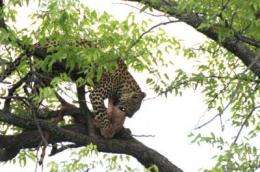
This is a leopard in a tree, eating a black-faced impala. Credit: Steve Willis, Durham University

Large predators are much more vulnerable than smaller species to environmental changes, such as over-hunting and habitat change, because they have to work so hard to find their next meal, according to a new study.

Scientists matched studies of predator populations to the abundance of their prey and found that the largest species, such as lions, tigers or , had much greater declines in population due to diminishing food supplies than smaller species, such as weasels or badgers.

The review of studies of eleven species of carnivores by researchers from Durham University and the Zoological Society of London published in the Royal Society journal Biology Letters. It suggests that the vulnerability of larger species may be linked with the high energetic costs of being "big".

The robustness and large size of these species, which are well suited for hunting large prey, might become a hindrance when times are tough, prey are rare, and individuals have to work harder to find their next meal.

Dr Philip Stephens, from the School of Biological and Biomedical Sciences, Durham University, said: "We found that the largest species exhibited a five to six fold greater decrease in relative abundance in response to a decrease in their prey.

"It's hard work being a large predator roaming and hunting across extensive areas to find food. The apparent vulnerability of tigers and polar bears to reductions in the availability of prey may be linked to the energetic costs of being a large carnivore."

The research has important implications for the conservation of our largest carnivore , which seem to be especially vulnerable to environmental threats and changes in the abundance of prey.

Dr Chris Carbone, Senior Research Fellow, Institute of Zoology, the Zoological Society of London, said: "This study helps us to understand why large carnivores are particularly sensitive to environmental disturbance and why the protection and conservation of their habitat and, in particular, of their prey, are so important to global initiatives to save large carnivores in the wild."

Dr Phil Stephens added: "The study highlights the need for more detailed study to aid carnivore conservation and shows how much more remains to be understood about the relationship between predators and their ."

Animals included in the study:

Least weasel
Arctic fox
Canadian lynx
European badger
Coyote
Wolf
Leopard
Spotted hyena
Lion
Tiger
Polar bear

Provided by Durham University search and more info website


Rank not rated yet
Relevant PhysicsForums posts

More news stories

It's in the genes: Research pinpoints how plants know when to flower

Scientists believe they've pinpointed the last crucial piece of the 80-year-old puzzle of how plants "know" when to flower.

Biology / Biotechnology

created 6 hours ago | popularity 4 / 5 (5) | comments 0 | with audio podcast

Researchers solve structure of human protein critical for silencing genes

In a study published in the journal Cell on May 24, Cold Spring Harbor Laboratory (CSHL) scientists describe the three-dimensional atomic structure of a human protein bound to a piece of RNA that "guides" the pr ...

Biology / Cell & Microbiology

created 6 hours ago | popularity 5 / 5 (3) | comments 0 | with audio podcast

Study uncovers secret to speedy burrowing by razor clams

(Phys.org) -- If you look at a razor burrowing clam sitting in a bucket, you’d never guess that it could burrow itself down into the soil, much less do it with any speed. Razor clams look like fat straws, ...

Biology / Plants & Animals

created 15 hours ago | popularity not rated yet | comments 3 | with audio podcast report

Copy of the genetic makeup travels in a protein suitcase

Scientists from the Institute for Physical and Theoretical Chemistry at the University of Bonn have succeeded for the first time in the real time filming of the transport of an important information carrier in biological ...

Biology / Cell & Microbiology

created 12 hours ago | popularity not rated yet | comments 0 | with audio podcast

'Transformer' protein makes different sized transport pods

These spheres may look almost identical, but subtle differences between them revealed a molecular version of the robots from Transformers. Each sphere is a vesicle, a pod that cells use to transport materials ...

Biology / Cell & Microbiology

created 12 hours ago | popularity not rated yet | comments 0


Of mice and mental models: Neuroscientific implications of risk-optimized behavior in the mouse

(Medical Xpress) -- Regardless of an organism’s biological complexity, every encephalized animal continuously makes under-informed behavioral choices that can have serious consequences. Despite its ubiquity, ...

Dragon arrives at space station in historic 1st (Update 2)

The privately bankrolled Dragon capsule made a historic arrival at the International Space Station on Friday, triumphantly captured by astronauts wielding a giant robot arm.

Landmark calculation clears the way to answering how matter is formed

(Phys.org) -- An international collaboration of scientists, including Thomas Blum, associate professor of physics, is reporting in landmark detail the decay process of a subatomic particle called a kaon – ...

High-speed method to aid search for solar energy storage catalysts

Eons ago, nature solved the problem of converting solar energy to fuels by inventing the process of photosynthesis.

MIT researchers devise new means to synchronize a group of robots (w/ Video)

(Phys.org) -- For several years, roboticists have been working out ways to get a group of robots to perform synchronized activities as demonstrated most often in dance routines. It’s not just about trying ...

Researchers demonstrate possible primitive mechanism of chemical info self-replication

(Phys.org) -- When scientists think about the replication of information in chemistry, they usually have in mind something akin to what happens in living organisms when DNA gets copied: a double-stranded molecule ...