Sulfur dioxide in Venus' atmosphere could be key to fighting global warming on Earth
Nov 16, 2010
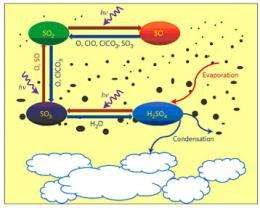
The reactions connecting SO, SO2, SO3 and H2SO4 in the fine mist of small droplets above the main cloud layer of Venus. © Nature GeoScience

An international team, including Jean-Loup Bertaux, CNRS senior researcher, has discovered a layer of sulfur dioxide (SO2) in the upper atmosphere of Venus. The researchers obtained this result using measurements performed by ESA's Venus Express spacecraft. They propose a new mechanism to explain this unexpected result. SO2 is of particular interest to them since this gas could be used to cool down the Earth via a geo-engineering process put forward by Chemistry Nobel Laureate Paul Crutzen.

Venus is entirely covered by a thick layer of clouds, between 50 and 70 km altitude, above which a thinner mist extend s to around 100 km altitude. The clouds and mist consist of droplets of concentrated sulphuric acid.

Using ESA's Venus Express , in orbit a round Venus since 2006, and its on-board SPICAV instrument, the researchers discovered the presence of gaseous high up in the atmosphere, at an altitude of 90- 110 kilometers.

This discovery was confirmed by US researchers , who detected sulfur dioxide in Venus's atmosphere using a different method (i.e. by observing micro-wave radiation from an Earth-based observatory), but were not able to specify its altitude.

The researchers believe that the sulfur dioxide derives from the sulphuric acid mist in the of Venus. On the day side of , the temperature increases with altitude above 90 kilometers , which causes the sulphuric acid to evaporate. It then decomposes under the effect of , producing sulfur dioxide (see diagram above).

Sulfur dioxide is also found on Earth, released mainly by . Sometimes reaching altitudes as high as 20 kilometers , it turns into sulphuric acid, causing the formation of small droplets. The droplets reflect part of the solar radiation back out to space, leading to a fall in surface temperatures. Drawing inspiration from this process, chemist and meteorologist Paul Crutzen, winner of the 1995 Nobel Prize in Chemistry, suggested several years ago that it would be possible to artificially release massive quantities of sulfur dioxide at an altitude of 20 kilometers in order to cool down surface temperatures and offset the growing greenhouse effect.

Although we are not technically or ethically prepared to undertake this type of operation, known as geo-engineering, we might be forced to do so in 20 or 30 years' time if global warming becomes unbearable. From this viewpoint, it is necessary to study the effects that releasing the SO2 would have, and consider all potential reaction chains. Understanding the reactions that take place in Venus's will help us to do so.

Explore further: NASA's STEREO detects a CME from the sun

More information: Photolysis of sulphuric acid as the source of sulphur oxides in the mesosphere of Venus, Xi Zhang, et al. Nature Geoscience, published online on 1 November 2010.

add to favorites email to friend print save as pdf

Related Stories

New details on venusian clouds revealed

May 30, 2008

As ESA's Venus Express orbits our sister planet, new images of the cloud structure of one of the most enigmatic atmospheres of the Solar System reveal brand-new details.

Setting stars reveal planetary secrets

Nov 05, 2007

Watching the stars set from the surface of the Earth may be a romantic pastime but when a spacecraft does it from orbit, it can reveal hidden details about a planet’s atmosphere.

1 year at Venus, and going strong

Apr 11, 2007

One year has passed since 11 April 2006, when Venus Express, Europe's first mission to Venus and the only spacecraft now in orbit around the planet, reached its destination. Since then, this advanced probe, ...

Recommended for you

Mars rover Opportunity examines clay clues in rock

2 hours ago

(Phys.org) —NASA's senior Mars rover, Opportunity, is driving to a new study area after a dramatic finish to 20 months on "Cape York" with examination of a rock intensely altered by water.

NASA's STEREO detects a CME from the sun

15 hours ago

On 5:24 a.m. EDT on May 17, 2013, the sun erupted with an Earth-directed coronal mass ejection or CME, a solar phenomenon that can send billions of tons of solar particles into space that can reach Earth ...

Nine-year-old Mars rover passes 40-year-old record

May 17, 2013

While Apollo 17 astronauts Eugene Cernan and Harrison Schmitt visited Earth's moon for three days in December 1972, they drove their mission's Lunar Roving Vehicle 19.3 nautical miles (22.210 statute miles ...

Bright explosion on the Moon

May 17, 2013

For the past 8 years, NASA astronomers have been monitoring the Moon for signs of explosions caused by meteoroids hitting the lunar surface. "Lunar meteor showers" have turned out to be more common than anyone ...

User comments : 8

Adjust slider to filter visible comments by rank

Display comments: newest first

jsa09
5 / 5 (3) Nov 16, 2010
20 or 30 years? seeding Sulphur dioxide into the atmosphere on purpose? I sure hope they are desperate before they even think about actually doing that.

I am wondering if spewing artificial volcanic byproducts into the upper atmosphere might be a "cure" worse than the disease.
mikiwud
1.8 / 5 (5) Nov 17, 2010
When Laki erupted in 1783, the SO2 caused cooling that devestated crops and killed hundreds of thousands through starvation. These Prats are thinking of doing it on purpose!
And then expect the people they are planning to kill to pay them to think up this crap.
Absolutely un-f***ing-believable.
ThanderMAX
not rated yet Nov 17, 2010
Better create fast-multiplying algae (by genetic changes) and seed this to oceans. :)
LuckyExplorer
5 / 5 (2) Nov 17, 2010
Rarely heard something stupid like this idea!
The world is not just dead material - the domaine of physics, it is also biology.
After some time the sulphuric acid might come back to the ground, what about that?
Or what would be the correct dose?
What happens if CO2 is reduced, maybe some 10 or 100 years later? Will this system then cool down earth to an artificial ice-age?
More questions than answers.
Why are even scientists that stupid to believe men can really control the eco-system earth?
Skeptic_Heretic
5 / 5 (1) Nov 17, 2010
Better create fast-multiplying algae (by genetic changes) and seed this to oceans. :)

Just as dangerous if not more so than SO2 release.

Invasive genetically engineered species with no natural predators have entirely unexpected results in the wild.
technicalengeneering
4 / 5 (1) Nov 17, 2010
Can't these people think? SO2 caused chaos and destruction just thirty years ago. Did I hear someone say acid rain?
Sadly we're all dumming down, including 'scientists'.
LKD
2 / 5 (4) Nov 17, 2010
I am curious how no one questions the very premis since Venus is over heated and obviously this acid layer in the atmosphere does absolutely nothing.
upthefeels
5 / 5 (1) Nov 22, 2010
we can do that... but just think about it's result... is it good to have a cloud of sulpher di oxide over our head... n when it comes down with rain.. then what happens...

More news stories

Alaska volcano shoots ash 15,000 feet into the air

(AP)—One of Alaska's most restless volcanoes has shot an ash cloud 15,000 feet into the air in an ongoing eruption that has drawn attention from a nearby community but isn't expected to threaten air traffic.

Chinese, Indian airlines face EU pollution fines

Eight Chinese and two Indian airlines face fines of up to several million euros for not paying for their greenhouse gas emissions during flights within the bloc, the European Commission said on Friday.

US seizes Bitcoin operator accounts

US authorities seized the accounts of a Bitcoin digital currency exchange operator, claiming it was functioning as an "unlicensed money service business," court documents showed Friday.