Progress made on protecting sharks, groups say
November 28, 2010 By ANGELA DOLAND , Associated Press
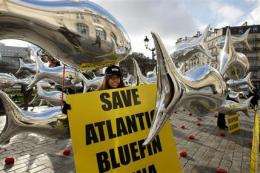
Tuna balloons are displayed by World Wide Fund For Nature (WWF) members in Paris, Friday, Nov. 26, 2010. Conservation group WWF teamed up with supermarket chains and restaurants Wednesday to press countries to set stricter fishing regulations for Atlantic bluefin tuna during an international conference in Paris. (AP Photo/Jacques Brinon)
(AP) -- An international conservation conference in Paris made progress Saturday on protecting sharks but didn't do anything to save the Atlantic bluefin tuna, which has been severely overfished to feed the market for sushi in Japan, environmental groups said.
Delegates from 48 nations spent 11 days in Paris haggling over fishing quotas for the Atlantic and Mediterranean, poring over scientific data and pitting the demands of environmentalists against those of the fishing industry.
Conservation groups said delegates took steps in the right direction with moves to protect oceanic whitetip sharks and many hammerheads in the Atlantic, though they had hoped for more. Sharks were once an accidental catch for fishermen but have been increasingly targeted because of the growing market in Asia for their fins, an expensive delicacy used in soup.
WWF, Greenpeace, Oceana and the Pew Environment Group all strongly criticized the 2011 bluefin quotas set by the International Commission for the Conservation of Atlantic Tunas, or ICCAT, which manages tuna in the Atlantic and Mediterranean as well as species that have traditionally been accidental catches for tuna fishermen.
Environmental groups had hoped to see bluefin fishing slashed or suspended, saying illegal fishing is rampant in the Mediterranean and that scientists don't have good enough data to evaluate the problem.
The commission agreed to cut the bluefin fishing quota in the eastern Atlantic and Mediterranean from 13,500 to 12,900 metric tons annually - about a 4 percent reduction. It also agreed on measures to try to improve enforcement of quotas on bluefin, prized for its tender red meat.
Sergi Tudela, head of WWF Mediterranean's fisheries program, attacked the "measly quota reduction." Oliver Knowles, Greenpeace oceans campaigner, complained that "the word 'conservation' should be removed from ICCAT's name."
Russell F. Smith, representing the U.S. delegation, told The AP, "I think we made some progress. I wish we'd made more."
Meanwhile, the CNPMEM French fishing industry union praised the decision, saying "reason prevailed."
The international commission's committee of scientists had said keeping the status quo was acceptable, but environmentalists say there is so much unreported fishing that doing so is irresponsible.
Japan buys nearly 80 percent of the annual Atlantic bluefin catch. Top-grade sushi with fatty bluefin can go for as much as 2,000 yen ($24) a piece in high-end Tokyo restaurants.
While the focus of the Paris meeting was tuna, sharks have become a growing concern. Environmentalists say there are disastrously inadequate rules on shark capture.
Although there are elaborate international fishing regulations and quotas for other types of fish, sharks have long been an afterthought, even though some species have declined by 99 percent, Oceana said.
The international commission banned fishermen from catching and retaining oceanic whitetip sharks. It voted to limit the catch of several types of hammerhead sharks and to require countries to keep data on shortfin mako sharks.
Delegates also decided that Atlantic fishermen will now be required to carry special gear to remove hooks from sea turtles.
While the International Commission for the Conservation of Atlantic Tunas and other regional commissions regulate fishing, trade bans are handled by the Convention on International Trade in Endangered Species, or CITES. Environmentalists were sorely disappointed by a meeting of that body in March, where Atlantic bluefin and six species of sharks failed to get protection.
©2010 The Associated Press. All rights reserved. This material may not be published, broadcast, rewritten or redistributed.
-
From lemons to lemonade: Reaction uses carbon dioxide to make carbon-based semiconductor,
28 comments
-
Thioridazine kills cancer stem cells in human while avoiding toxic side-effects of conventional cancer treatments,
3 comments
-
SpaceX private rocket blasts off for space station (Update),
41 comments
-
Climate scientists say they have solved riddle of rising sea,
30 comments
-
Scotland passes turbine test to harness tidal power,
40 comments
-
Why Do Dogs do Strange things...
10 hours ago
-
What does exophillic and endophillic mean in terms of mosquito and their control?
May 24, 2012
-
Semen stains glows under black lights (uv light)?
May 23, 2012
-
Question on Human Chromosome 2
May 23, 2012
-
How important is composition of TBST in diluting antibodies and Western Blotting?
May 22, 2012
-
Does the medulla monitor blood pH
May 20, 2012
- More from Physics Forums - Biology
More news stories
It's in the genes: Research pinpoints how plants know when to flower
Scientists believe they've pinpointed the last crucial piece of the 80-year-old puzzle of how plants "know" when to flower.
8 hours ago |
4 / 5 (5) |
1
|
Researchers solve structure of human protein critical for silencing genes
In a study published in the journal Cell on May 24, Cold Spring Harbor Laboratory (CSHL) scientists describe the three-dimensional atomic structure of a human protein bound to a piece of RNA that "guides" the pr ...
9 hours ago |
5 / 5 (4) |
0
|
Study uncovers secret to speedy burrowing by razor clams
(Phys.org) -- If you look at a razor burrowing clam sitting in a bucket, youd never guess that it could burrow itself down into the soil, much less do it with any speed. Razor clams look like fat straws, ...
Copy of the genetic makeup travels in a protein suitcase
Scientists from the Institute for Physical and Theoretical Chemistry at the University of Bonn have succeeded for the first time in the real time filming of the transport of an important information carrier in biological ...
14 hours ago |
not rated yet |
0
|
'Transformer' protein makes different sized transport pods
These spheres may look almost identical, but subtle differences between them revealed a molecular version of the robots from Transformers. Each sphere is a vesicle, a pod that cells use to transport materials ...
15 hours ago |
not rated yet |
0
Of mice and mental models: Neuroscientific implications of risk-optimized behavior in the mouse
(Medical Xpress) -- Regardless of an organism’s biological complexity, every encephalized animal continuously makes under-informed behavioral choices that can have serious consequences. Despite its ubiquity, ...
Dragon arrives at space station in historic 1st (Update 2)
The privately bankrolled Dragon capsule made a historic arrival at the International Space Station on Friday, triumphantly captured by astronauts wielding a giant robot arm.
Landmark calculation clears the way to answering how matter is formed
(Phys.org) -- An international collaboration of scientists, including Thomas Blum, associate professor of physics, is reporting in landmark detail the decay process of a subatomic particle called a kaon ...
High-speed method to aid search for solar energy storage catalysts
Eons ago, nature solved the problem of converting solar energy to fuels by inventing the process of photosynthesis.
MIT researchers devise new means to synchronize a group of robots (w/ Video)
(Phys.org) -- For several years, roboticists have been working out ways to get a group of robots to perform synchronized activities as demonstrated most often in dance routines. Its not just about trying ...
Researchers demonstrate possible primitive mechanism of chemical info self-replication
(Phys.org) -- When scientists think about the replication of information in chemistry, they usually have in mind something akin to what happens in living organisms when DNA gets copied: a double-stranded molecule ...