Infections detected by new dressing
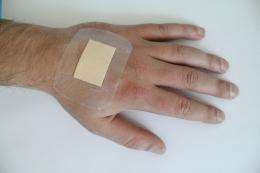
Wounds have to be regularly checked, to make sure any complications in the healing process are detected at an early stage. A new material will make it possible to check wounds without changing the dressing: If an infection arises, the material changes its color.
Whether a small cut with a fruit knife, a surgical wound or a major injury caused by a fall – the body’s defense and repair system leaps into action and tries to close the wound as quickly as possible. Small injuries usually heal within a few days, but a gaping wound will take longer to heal, and an infection can take hold even after several days. Dressings protect the site of the injury but to check the wound they have to be removed. This can be painful for the patient and moreover it risks giving germs the chance to enter and cause infection.
German scientists at the Fraunhofer Research Institution for Modular Solid State Technologies EMFT in Munich have developed dressing materials and plasters which indicate pathological changes in the skin. If an infection is present, the color of the dressing changes from yellow to purple.
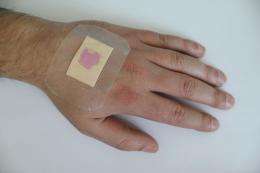
“We have developed an indicator dye which reacts to different pH values, and we have integrated it into a dressing and a plaster. Healthy skin and healed wounds usually show a pH value of below 5. If this value increases, it is shifting from the acid to the alkaline range, which indicates complications in the healing of the wound. If the pH value is between 6.5 und 8.5 an infection is frequently present and the indicator color strip turns purple,” states Dr. Sabine Trupp, scientist at the EMFT, explaining the chemical reaction. In this way the intelligent dressing material makes it possible to regularly check wounds from the outside without disrupting the healing process.
Production of the color control strip posed a number of challenges for the research scientists as it had to meet several different requirements: “The dye has to remain chemically stable when bonded to the fibers of the dressing material or the plaster to ensure that it does not get into the wound. At the same time, the indicator must show a clear change in color and also react sensitively in the right pH range,” says Trupp. The experts succeeded in meeting all these requirements. A prototype of the dressing has already been produced and initial tests have proved successful. The researchers are now thinking about how to develop their innovation further. There are plans to integrate optical sensor modules into the dressing to measure the pH value and indicate the results on a reader unit. This method would allow the value to be read off precisely, providing information about how the wound is healing.
How do we go from here? The next step will be to use the dressing in a hospital environment at the University of Regensburg’s dermatology clinic. Dr. med. Philipp Babilas will be medical supervisor to the project: “Our studies of the pH value in acute as well as in chronic wounds have shown that it plays a key role in wound healing.” At present Dr. Trupp and her team are looking for an industrial partner to produce the dressing commercially.
Provided by Fraunhofer-Gesellschaft


