Hubble captures new life in an ancient galaxy
November 18, 2010

Hubble Captures New Life in an Ancient Galaxy

Enlarge

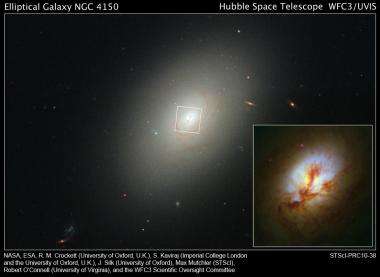
These images, taken with NASA's Hubble Space Telescope, reveal fresh star birth in the ancient elliptical galaxy NGC 4150, located about 44 million light-years away. The images combine observations taken in visible and near-ultraviolet light with Hubble's Wide Field Camera 3. Ultraviolet light traces the glow of young stars. Credit: NASA, ESA

(PhysOrg.com) -- Elliptical galaxies were once thought to be aging star cities whose star-making heyday was billions of years ago.

But new observations with NASA's are helping to show that still have some youthful vigor left, thanks to encounters with smaller galaxies.

Images of the core of NGC 4150, taken in near-ultraviolet light with the sharp-eyed 3 (WFC3), reveal streamers of dust and gas and clumps of young, blue stars that are significantly less than a billion years old. Evidence shows that the star birth was sparked by a merger with a .

The new study helps bolster the emerging view that most elliptical galaxies have young stars, bringing new life to old galaxies.

"Elliptical galaxies were thought to have made all of their stars billions of years ago," says astronomer Mark Crockett of the University of Oxford, leader of the Hubble observations. "They had consumed all their gas to make new stars. Now we are finding evidence of star birth in many elliptical galaxies, fueled mostly by cannibalizing smaller galaxies.

"These observations support the theory that galaxies built themselves up over billions of years by collisions with dwarf galaxies," Crockett continues. "NGC 4150 is a dramatic example in our galactic back yard of a common occurrence in the ."

The Hubble images reveal turbulent activity deep inside the galaxy's core. Clusters of young, blue stars trace a ring around the center that is rotating with the galaxy. The stellar breeding ground is about 1,300 light-years across. Long strands of dust are silhouetted against the yellowish core, which is composed of populations of older stars.

From a Hubble analysis of the stars' colors, Crockett and his team calculated that the star-formation boom started about a billion years ago, a comparatively recent event in cosmological history. The galaxy's star-making factory has slowed down since then.

"We are seeing this galaxy after the major starburst has occurred," explains team member Joseph Silk of the University of Oxford. "The most massive stars are already gone. The youngest stars are between 50 million and 300 to 400 million years old. By comparison, most of the stars in the galaxy are around 10 billion years old."

The encounter that triggered the star birth would have been similar to our Milky Way swallowing the nearby Large Magellanic Cloud.

"We believe that a merger with a small, gas-rich galaxy around one billion years ago supplied NGC 4150 with the fuel necessary to form new stars," says team member Sugata Kaviraj of the Imperial College London and the University of Oxford. "The abundance of 'metals'—elements heavier than hydrogen and helium—in the young stars is very low, suggesting the galaxy that merged with NGC 4150 was also metal-poor. This points towards a small, dwarf galaxy, around one-twentieth the mass of NGC 4150."

Minor mergers such as this one are more ubiquitous than interactions between hefty galaxies, the astronomers say. For every major encounter, there are probably up to 10 times more frequent clashes between a large and a small galaxy. Major collisions are easier to see because they create incredible fireworks: distorted galaxies, long streamers of gas, and dozens of young star clusters. Smaller interactions are harder to detect because they leave relatively little trace.

Over the past five years, however, ground- and space-based telescopes have offered hints of fresh in elliptical galaxies. Ground-based observatories captured the blue glow of stars in elliptical galaxies, and satellites such as the Galaxy Evolution Explorer (GALEX), which looks in far- and near-ultraviolet light, confirmed that the blue glow came from fledgling stars much less than a billion years old. Ultraviolet light traces the glow of hot, young stars.

Crockett and his team selected NGC 4150 for their Hubble study because a ground-based spectroscopic analysis gave tantalizing hints that the galaxy's core was not a quiet place. The ground-based survey, called the Spectrographic Areal Unit for Research on Optical Nebulae (SAURON), revealed the presence of young stars and dynamic activity that was out of sync with the galaxy.

"In visible light, elliptical galaxies such as NGC 4150 look like normal elliptical galaxies," Silk says. "But the picture changes when we look in ultraviolet light. At least a third of all elliptical galaxies glow with the blue light of young stars."

Adds Crockett: "Ellipticals are the perfect laboratory for studying minor mergers in ultraviolet light because they are dominated by old red stars, allowing astronomers to see the faint blue glow of ."

The astronomers hope to study other elliptical galaxies in the SAURON survey to look for the signposts of new star birth. The team's results have been accepted for publication in The Astrophysical Journal.

Provided by ESA/Hubble Information Centre search and more info website

4.5 /5 (13 votes)  

Filter


Move the slider to adjust rank threshold, so that you can hide some of the comments.


Display comments: newest first

El_Nose
Nov 18, 2010

Rank: not rated yet
I love Hubble -- damn the economics make the Webb and we will find even more.
Tuxford
Nov 18, 2010

Rank: 1 / 5 (4)
If it walks like a duck.... LaViolette predicts giant ellipticals to the the final evolutionary stage, with massive active cores, producing both new matter and energy in large quantity. Is that not what is seen here? One-third of ellipticals have young stars due to collisions????? Come on. Think. You can do it.
Thadieus
Nov 18, 2010

Rank: not rated yet
Obviously this is amazing. However the delivery of this message is a real bore. We want to excite the youth, I have some, how can we get this info to Disney? They (Disney)are a machine.
Jonseer
Nov 19, 2010

Rank: 1 / 5 (5)
You mean something astronomers determined to be fact turns out to not to be? Heaven forfend! Surely this has never happened before. Astronomers are always right the first time right? I mean that's why scoff n snort whenever someone mentions obvious things likes this as possible due to being otherwise lacks common sense, but lacking "real data" it is nevertheless deemed not true.
yyz
Nov 19, 2010

Rank: 5 / 5 (2)
"We want to excite the youth, I have some, how can we get this info to Disney?"

Haven't you heard, Hubble GOTCHU!: http://blogs.disc...-gotchu/
LKD
Nov 19, 2010

Rank: 5 / 5 (1)
Haven't you heard, Hubble GOTCHU!: http://blogs.disc...-gotchu/


Thanks for that. A great act they did, and really helps the science. I can only imagine how long that man took to memorize the names in the pictures to say them without stumbling.
Rank 4.5 /5 (13 votes)
Relevant PhysicsForums posts
  • revamping general concept and cosmological principle
    created7 hours ago
  • Transiting Exoplanet Light Curve
    created17 hours ago
  • Math behind Theoretical Physics
    createdMay 24, 2012
  • Do we know whats at the center of galaxies yet?
    createdMay 23, 2012
  • Structure of the Milky Way?
    createdMay 20, 2012
  • What would it take to terraform Pluto and Charon?
    createdMay 19, 2012
  • More from Physics Forums - General Astronomy

More news stories

Dragon arrives at space station in historic 1st (Update 2)

The privately bankrolled Dragon capsule made a historic arrival at the International Space Station on Friday, triumphantly captured by astronauts wielding a giant robot arm.

Space & Earth / Space Exploration

created 10 hours ago | popularity 5 / 5 (7) | comments 10

Dragon makes history with space station docking

The private company SpaceX made history Friday with the docking of its Dragon capsule to the International Space Station, the most impressive feat yet in turning routine spaceflight over to the commercial ...

Space & Earth / Space Exploration

created 3 hours ago | popularity 4.8 / 5 (6) | comments 0

NASA sees Hurricane Bud threaten western Mexico's coast

NASA satellites are providing rainfall, temperature, pressure, visible and infrared data to forecasters as Hurricane Bud is expected to make a quick landfall in western Mexico this weekend before turning back ...

Space & Earth / Earth Sciences

created 5 hours ago | popularity not rated yet | comments 0

Typhoon Sanvu affecting Iwo To, then expected to fade over weekend

Infrared and visible imagery from NASA's Aqua satellite taken on May 25, 2012, showed an impressive Typhoon Sanvu already affecting the islands of Iwo To and Chichi Jima, Japan. The typhoon is expected to ...

Space & Earth / Earth Sciences

created 5 hours ago | popularity not rated yet | comments 0

SKA super telescope to be built in Australia, South Africa (Update 2)

A long-running joust to host a radio telescope that would give mankind its farthest peek into the Universe ended on Friday with a Solomon-like judgement to split the site between Australia and South Africa.

Space & Earth / Astronomy

created 11 hours ago | popularity 5 / 5 (5) | comments 2


It's in the genes: Research pinpoints how plants know when to flower

Scientists believe they've pinpointed the last crucial piece of the 80-year-old puzzle of how plants "know" when to flower.

High-speed method to aid search for solar energy storage catalysts

Eons ago, nature solved the problem of converting solar energy to fuels by inventing the process of photosynthesis.

Researchers solve structure of human protein critical for silencing genes

In a study published in the journal Cell on May 24, Cold Spring Harbor Laboratory (CSHL) scientists describe the three-dimensional atomic structure of a human protein bound to a piece of RNA that "guides" the pr ...

Of mice and mental models: Neuroscientific implications of risk-optimized behavior in the mouse

(Medical Xpress) -- Regardless of an organism’s biological complexity, every encephalized animal continuously makes under-informed behavioral choices that can have serious consequences. Despite its ubiquity, ...

Yahoo kills 'Livestand' just 6 months after debut

(AP) -- Yahoo is killing a tablet magazine called Livestand just six months its debut on the iPad.

Landmark calculation clears the way to answering how matter is formed

(Phys.org) -- An international collaboration of scientists, including Thomas Blum, associate professor of physics, is reporting in landmark detail the decay process of a subatomic particle called a kaon – ...