Gene discovery suggests way to engineer fast-growing plants
November 11, 2010 By Kendall Morgan
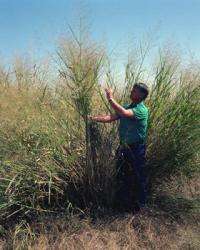
Switchgrass is being considered as feed stock for biofuels production, but it takes two years to reach harvest. | USDA via Wikimedia
(PhysOrg.com) -- Tinkering with a single gene may give perennial grasses more robust roots and speed up the timeline for creating biofuels, according to researchers at the Duke Institute for Genome Sciences & Policy (IGSP).
Perennial grasses, including switchgrass and miscanthus, are important biofuels crops and can be harvested repeatedly, just like lawn grass, said Philip Benfey, director of the IGSP Center for Systems Biology. But before that can happen, the root system needs time to get established.
"These biofuel crops usually can't be harvested until the second or third year," Benfey said. "A method to improve root growth could have a major role in reducing the time to harvest for warm season grasses."
Benfey's team appears to have found a way to do just that. They took a directed genomic approach aimed at identifying genes that become active when cells stop dividing and start taking on the characteristics of the mature, adult cell they are to become. "We systematically looked for those genes that come 'on' precisely when cells transition from proliferation to differentiation and then turn 'off' again just as quickly," Benfey said.
That genome-wide search in the roots of the familiar laboratory plant Arabidopsis and subsequent screening of mutant lines turned up a single gene, which the researchers call UPBEAT1 (UPB1). Further study showed that UPB1 controls the gene expression of enzymes known as peroxidases.
They then showed that these peroxidases control the balance of free radicals between the zone of cell proliferation and the zone of cell elongation where differentiation begins. (Although free radicals are probably most familiar as agents of stress to be combated with antioxidants, Benfey noted that the balance of free radicals has also been implicated in the control of a similar transition from proliferation to differentiation in animals.)
When the researchers experimentally disrupted UPB1 activity in the plant root, it altered the balance of free radicals such that cells delayed their differentiation and continued growing. Those plants ended up with faster-growing roots, having more and larger cells. When UPB1 activity was artificially increased, the growth of plant roots slowed.
"It's possible that by manipulating a single gene, you could get a plant with rapid growth," Benfey said. Interestingly, UPB1 appears to act independently of plant hormones that play well-known roles in the balance between cell division and differentiation.
From an engineering perspective, the prospect of enhancing growth by taking a gene away, as opposed to adding one, is particularly appealing, Benfey notes.
"It also suggests that plants are not growing at their full potential," he says. That makes sense, of course, as plants in the real world have to make tradeoffs, for example, between growth and reproduction.
In addition to their potential in biofuels production, the findings might also lead to new ways to produce bigger and stronger plants with the capacity to sequester more earth-warming carbon dioxide from the atmosphere, Benfey says. His startup company, GrassRoots Biotechnology Inc., has acquired the patent for this discovery with its potential in mind. The company's primary goals are the development of next-generation biofuels and the use of root systems for carbon sequestration.
Provided by
Duke University
-
From lemons to lemonade: Reaction uses carbon dioxide to make carbon-based semiconductor,
28 comments
-
Every black hole contains a new universe: A physicist presents a solution to present-day cosmic mysteries,
215 comments
-
New silicon memory chip developed,
16 comments
-
Thioridazine kills cancer stem cells in human while avoiding toxic side-effects of conventional cancer treatments,
3 comments
-
SpaceX private rocket blasts off for space station (Update),
41 comments
-
What does exophillic and endophillic mean in terms of mosquito and their control?
May 24, 2012
-
Semen stains glows under black lights (uv light)?
May 23, 2012
-
Question on Human Chromosome 2
May 23, 2012
-
How important is composition of TBST in diluting antibodies and Western Blotting?
May 22, 2012
-
Does the medulla monitor blood pH
May 20, 2012
-
What physically constitutes memory?
May 17, 2012
- More from Physics Forums - Biology
More news stories
Copy of the genetic makeup travels in a protein suitcase
Scientists from the Institute for Physical and Theoretical Chemistry at the University of Bonn have succeeded for the first time in the real time filming of the transport of an important information carrier in biological ...
4 hours ago |
not rated yet |
0
|
Study uncovers secret to speedy burrowing by razor clams
(Phys.org) -- If you look at a razor burrowing clam sitting in a bucket, youd never guess that it could burrow itself down into the soil, much less do it with any speed. Razor clams look like fat straws, ...
'Transformer' protein makes different sized transport pods
These spheres may look almost identical, but subtle differences between them revealed a molecular version of the robots from Transformers. Each sphere is a vesicle, a pod that cells use to transport materials ...
4 hours ago |
not rated yet |
0
A new invading sea crab reaches the Ebro Delta
Originally endemic to the Atlantic Coast of North America, over the past 30 years Dyspanopeus sayi has been involuntarily introduced in the UK, France, the Netherlands, the Black Sea and the Adriatic Sea. A ...
5 hours ago |
not rated yet |
0
A mating dance with Popeye arms
A research team at Bielefeld University headed by the evolutionary biologist Dr. Holger Schielzeth is now studying how far a comparable mechanism is involved in mate choice among locusts. The male Siberian ...
3 hours ago |
not rated yet |
0
Skp2 activates cancer-promoting, glucose-processing Akt
HER2 and its epidermal growth factor receptor cousins mobilize a specialized protein to activate a major player in cancer development and sugar metabolism, scientists report in the May 25 issue of Cell.
Math predicts size of clot-forming cells
UC Davis mathematicians have helped biologists figure out why platelets, the cells that form blood clots, are the size and shape that they are. Because platelets are important both for healing wounds and in strokes and other ...
Early physical therapist treatment associated with reduced risk of healthcare utilization and reduced overall healthcare
A new study published in Spine shows that early treatment by a physical therapist for low back pain (LBP), as compared to delayed treatment, was associated with reduced risk of subsequent healthcare utilization and lower ...
Flesh-Eating bacteria no cause for panic, experts say
(HealthDay) -- Despite scary headlines by the score, most people don't have to fear that they'll be the next victim of the so-called flesh-eating bacteria disease, experts say.
Typhoon Sanvu affecting Iwo To, then expected to fade over weekend
Infrared and visible imagery from NASA's Aqua satellite taken on May 25, 2012, showed an impressive Typhoon Sanvu already affecting the islands of Iwo To and Chichi Jima, Japan. The typhoon is expected to ...
NASA sees Hurricane Bud threaten western Mexico's coast
NASA satellites are providing rainfall, temperature, pressure, visible and infrared data to forecasters as Hurricane Bud is expected to make a quick landfall in western Mexico this weekend before turning back ...