Reducing faults created by vegetation contact on utility lines
It’s the last play of the big game, only seconds left and the quarterback throws toward the end zone and … blackness.
The electricity has gone out and the biggest play of the year is missed. Who’s to blame? In many instances it can be blamed on the trees outside your house.
In August 2003, the Northeast experienced the worst blackout in history that put 50 million people in the United States and Canada in the dark, some for many days. The root cause of this blackout was trees growing into electric power lines causing electric faults that disrupted power transmission. In 2008 during Hurricane Ike, which left millions of people in the dark for periods as long as two weeks, the single biggest cause of long duration outages that occurred in the gulf coast region like Houston was vegetation tearing down the lines.
Closer to home, on utility distribution systems (the lines behind the house) it is estimated that as many as one third of the faults that cause power outages are related to vegetation intrusion. Current research being conducted in The Department of Electrical and Computer Engineering at Texas A&M University could help solve this problem.
For many years, Dr. B. Don Russell, Distinguished Professor and holder of the Harry E. Bovay Jr. Endowed Chair, and Carl Benner from the department’s Power System Automation Laboratory (PSAL) have conducted research on ways to enhance power system reliability through automation. Their work has created the world’s largest signature database of naturally occurring faults and failures in electric distribution systems. However, the researchers say the 2003 blackout influenced them to begin studying the characteristics and the failure mechanisms of faults created by vegetation contact.
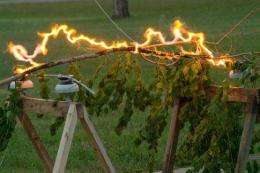
In an attempt to better understand how vegetation affects electric power lines, Russell and Benner collaborated on a research investigation with other researchers and electric utility personnel to study the behavior of vegetation faults. This project, funded by utilities under the National Science Foundation’s (NSF) Power Systems Engineering Research Center, carefully studied the process whereby a power system fault is created by vegetation such as a tree branch. Experimentation conducted in the PSAL included staged faults on an active electric utility feeder which yielded data previously unavailable.
The objective of the research project was to:
• Scientifically investigate and document the characteristics of vegetation faults on electric distribution systems;
• Document and understand the “electrical precursors” resulting from vegetation intrusion prior to fault conditions that cause a power outage;
• Investigate the use of intelligent system monitoring to “predict” vegetation intrusion on power lines prior to faults that create an outage;
• Investigate the potential for “conditioned based maintenance” on electric distribution systems utilizing vegetation intrusion detection as a cost saving alternative to periodic vegetation management;
• Develop “recommended practices” for vegetation management by electric utilities based on increased use of real time monitoring systems to detect deteriorating distribution feeder health resulting from vegetation intrusion or failure of system apparatus and components.
This research will improve the reliability of electric power distribution, improve the quality of power and service to electric utility customers and reduce the cost of delivery of electricity, as most electric utility customers do not realize that a major cost to deliver electricity to end users is the trimming of trees under electric power lines.
Currently, most vegetation management (i.e. tree trimming) is done on a calendar-based system, which doesn’t account for real problems and may or may not help; therefore it can be quite costly. In 2002, Transmission and Distribution World, a widely read trademagazine for engineers and operations professionals in the electric power transmission and distribution industry, noted that “Vegetation management activities…. usually are the largest cost element in an electric utility’s operating budget (tree trimming alone is a U.S. $7-$10 billion business).” Russell said he hopes his research will not only cut these costs, but improve automation to enable better maintenance, resulting in fewer faults and fewer outages of shorter duration.
“Our research at the (Texas A&M) Riverside campus has provided the best understanding of how vegetation interacts with electric distribution lines causing these faults,” Russell said. “As a consequence we’re now working with electric utilities to determine ways to predict these outages by looking at the very first signs of vegetation intrusion on the lines, automatically alerting the utility company that on a specific line they have a problem that needs to be corrected before they have a major outage.”
Their research so far has encompassed two phases, the first part was experimentation and studying the fault characteristics using staged experiments and accumulating real time measurements on about a dozen electric utilities across North America that have allowed monitoring for vegetation intrusion.
Phase two has been to study whether they could predict through measurements that vegetation incursion is occurring which could potentially cause a major outage.
Russell said so far utility companies and researchers are excited about the results, and he hopes it also will make a difference to consumers, who may not only save money, but won’t have to miss “the play of the year” because of a tree.
“Utilities state that patrolling, inspecting, cutting and managing vegetation is their largest single maintenance expense,” Russell said. “So to the extent we can reduce or defer those costs could in a major way affect the cost of energy to the consumer. The other objective, of course, is improving reliability to keep the lights and TV on.”
More information: To see more pictures or to view actual video of the experiments, visit dfa-share.tamu.edu/vegetation/
Provided by Texas A&M University


