DNA reveals origins of first European farmers
November 9, 2010

DNA reveals origins of first European farmers

Enlarge

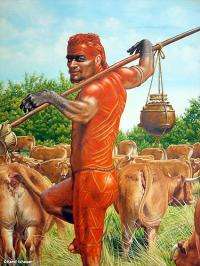
An artist's impression of a Neolithic farmer. Image by Karol Schauer, LDA Sachsen-Anhalt.

A team of international researchers led by ancient DNA experts from the University of Adelaide has resolved the longstanding issue of the origins of the people who introduced farming to Europe some 8000 years ago.

A detailed genetic study of one of the first farming communities in Europe, from central Germany, reveals marked similarities with populations living in the Ancient Near East (modern-day Turkey, Iraq and other countries) rather than those from Europe.

Project leader Professor Alan Cooper, Director of the Australian Centre for Ancient DNA (ACAD) at the University of Adelaide, says: "This overturns current thinking, which accepts that the first European farming populations were constructed largely from existing populations of hunter-gatherers, who had either rapidly learned to or interbred with the invaders."

The results of the study have been published today in the online peer-reviewed science journal PLoS Biology.

"We have finally resolved the question of who the first farmers in Europe were – invaders with revolutionary new ideas, rather than populations of Stone Age hunter-gatherers who already existed in the area," says lead author Dr Wolfgang Haak, Senior Research Associate with ACAD at the University of Adelaide.

"We've been able to apply new, high-precision ancient DNA methods to create a detailed genetic picture of this ancient farming population, and reveal that it was radically different to the nomadic populations already present in Europe.

"We have also been able to use genetic signatures to identify a potential route from the Near East and Anatolia, where farming evolved around 11,000 years ago, via south-eastern Europe and the Carpathian Basin (today's Hungary) into Central Europe," Dr Haak says.

The project involved researchers from the University of Mainz and State Heritage Museum in Halle, Germany, the Russian Academy of Sciences and members of the National Geographic Society's Genographic Project, of which Professor Cooper is a Principal Investigator and Dr Haak is a Senior Research Associate.

The used in this study comes from a complete graveyard of Early Neolithic unearthed at the town of Derenburg in Saxony-Anhalt, central Germany.

"This work was only possible due to the close collaboration of archaeologists excavating the skeletons, to ensure that no modern human DNA contaminated the remains, and nicely illustrates the potential when archaeology and genetics are combined," says Professor Kurt Werner Alt from the collaborating Institute of Anthropology in Mainz, Germany.

Provided by University of Adelaide search and more info website

4.7 /5 (18 votes)  

Rank 4.7 /5 (18 votes)
Relevant PhysicsForums posts

More news stories

Copy of the genetic makeup travels in a protein suitcase

Scientists from the Institute for Physical and Theoretical Chemistry at the University of Bonn have succeeded for the first time in the real time filming of the transport of an important information carrier in biological ...

Biology / Cell & Microbiology

created 2 hours ago | popularity not rated yet | comments 0 | with audio podcast

A mating dance with Popeye arms

A research team at Bielefeld University headed by the evolutionary biologist Dr. Holger Schielzeth is now studying how far a comparable mechanism is involved in mate choice among locusts. The male Siberian ...

Biology / Plants & Animals

created 1 hour ago | popularity not rated yet | comments 0

'Transformer' protein makes different sized transport pods

These spheres may look almost identical, but subtle differences between them revealed a molecular version of the robots from Transformers. Each sphere is a vesicle, a pod that cells use to transport materials ...

Biology / Cell & Microbiology

created 2 hours ago | popularity not rated yet | comments 0

A new invading sea crab reaches the Ebro Delta

Originally endemic to the Atlantic Coast of North America, over the past 30 years Dyspanopeus sayi has been involuntarily introduced in the UK, France, the Netherlands, the Black Sea and the Adriatic Sea. A ...

Biology / Ecology

created 3 hours ago | popularity not rated yet | comments 0

Study uncovers secret to speedy burrowing by razor clams

(Phys.org) -- If you look at a razor burrowing clam sitting in a bucket, you’d never guess that it could burrow itself down into the soil, much less do it with any speed. Razor clams look like fat straws, ...

Biology / Plants & Animals

created 5 hours ago | popularity not rated yet | comments 2 | with audio podcast report


New device allows pacemaker patients to safely undergo MRIs

For many, it's a medical conundrum: The very pacemaker keeping their heart in rhythm prevents them from undergoing an MRI to diagnose other ailments, because interaction between the two devices could prove deadly.

Astronauts capture SpaceX's Dragon for station dock

Astronauts aboard the International Space Station reached out and caught SpaceX's Dragon capsule for docking at the orbiting lab on Friday in a historic first for commercial spaceflight.

More mental health care urged for kids who self-harm

(HealthDay) -- Doctors have long known that some kids suffering severe emotional turmoil find relief in physical pain -- cutting or burning or sticking themselves with pins to achieve a form of release.

Neck strength, cervical spine mobility don't predict pain

(HealthDay) -- Neither isometric neck muscle strength nor passive mobility of the cervical spine, two physical capacity parameters found to be associated with neck pain in other studies, predicts later neck ...

Cancer patients share web info with docs for insight, advice

(HealthDay) -- Cancer patients' primary goal in talking with their doctors about information they've found on the Internet is to get more insight and advice on the online information, new research indicates.

Dragon arrives at space station in historic 1st (Update 2)

The privately bankrolled Dragon capsule arrived at the International Space Station for a historic docking Friday, captured by astronauts wielding a giant robot arm.