Can we grow crops on other planets?
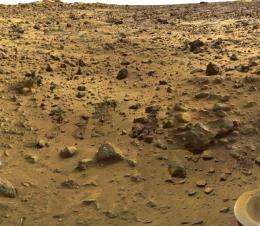
Science fiction lovers aren’t the only ones captivated by the possibility of colonizing another planet. Scientists are engaging in numerous research projects that focus on determining how habitable other planets are for life. Mars, for example, is revealing more and more evidence that it probably once had liquid water on its surface, and could one day become a home away from home for humans.
“The spur of colonizing new lands is intrinsic in man,” said Giacomo Certini, a researcher at the Department of Plant, Soil and Environmental Science (DiPSA) at the University of Florence, Italy. “Hence expanding our horizon to other worlds must not be judged strange at all. Moving people and producing food there could be necessary in the future.”
Humans traveling to Mars, to visit or to colonize, will likely have to make use of resources on the planet rather than take everything they need with them on a spaceship. This means farming their own food on a planet that has a very different ecosystem than Earth’s. Certini and his colleague Riccardo Scalenghe from the University of Palermo, Italy, recently published a study in Planetary and Space Science that makes some encouraging claims. They say the surfaces of Venus, Mars and the Moon appear suitable for agriculture.
Defining Soil
Before deciding how planetary soils could be used, the two scientists had to first explore whether the surfaces of the planetary bodies can be defined as true soil.
“Apart from any philosophical consideration about this matter, definitely assessing that the surface of other planets is soil implies that it ‘behaves’ as a soil,” said Certini. “The knowledge we accumulated during more than a century of soil science on Earth is available to better investigate the history and the potential of the skin of our planetary neighbors.”
One of the first obstacles in examining planetary surfaces and their usefulness in space exploration is to develop a definition of soil, which has been a topic of much debate.
“The lack of a unique definition of ‘soil,’ universally accepted, exhaustive, and (one) that clearly states what is the boundary between soil and non-soil makes it difficult to decide what variables must be taken into account for determining if extraterrestrial surfaces are actually soils,” Certini said.
At the proceedings of the 19th World Congress of Soil Sciences held in Brisbane, Australia, in August, Donald Johnson and Diana Johnson suggested a “universal definition of soil.” They defined soil as “substrate at or near the surface of Earth and similar bodies altered by biological, chemical, and/or physical agents and processes.”
On Earth, five factors work together in the formation of soil: the parent rock, climate, topography, time and biota (or the organisms in a region such as its flora and fauna). It is this last factor that is still a subject of debate among scientists. A common, summarized definition for soil is a medium that enables plant growth. However, that definition implies that soil can only exist in the presence of biota. Certini argues that soil is material that holds information about its environmental history, and that the presence of life is not a necessity.
“Most scientists think that biota is necessary to produce soil,” Certini said. “Other scientists, me included, stress the fact that important parts of our own planet, such as the Dry Valleys of Antarctica or the Atacama Desert of Chile, have virtually life-free soils. They demonstrate that soil formation does not require biota.”
The researchers of this study contend that classifying a material as soil depends primarily on weathering. According to them, a soil is any weathered veneer of a planetary surface that retains information about its climatic and geochemical history.
On Venus, Mars and the Moon, weathering occurs in different ways. Venus has a dense atmosphere at a pressure that is 91 times the pressure found at sea level on Earth and composed mainly of carbon dioxide and sulphuric acid droplets with some small amounts of water and oxygen. The researchers predict that weathering on Venus could be caused by thermal process or corrosion carried out by the atmosphere, volcanic eruptions, impacts of large meteorites and wind erosion.
Mars is currently dominated by physical weathering caused by meteorite impacts and thermal variations rather than chemical processes. According to Certini, there is no active volcanism that affects the martian surface but the temperature difference between the two hemispheres causes strong winds. Certini also said that the reddish hue of the planet’s landscape, which is a result of rusting iron minerals, is indicative of chemical weathering in the past.
On the Moon, a layer of solid rock is covered by a layer of loose debris. The weathering processes seen on the Moon include changes created by meteorite impacts, deposition and chemical interactions caused by solar wind, which interacts with the surface directly.
Some scientists, however, feel that weathering alone isn’t enough and that the presence of life is an intrinsic part of any soil.
“The living component of soil is part of its unalienable nature, as is its ability to sustain plant life due to a combination of two major components: soil organic matter and plant nutrients,” said Ellen Graber, researcher at the Institute of Soil, Water and Environmental Sciences at The Volcani Center of Israel’s Agricultural Research Organization.
One of the primary uses of soil on another planet would be to use it for agriculture—to grow food and sustain any populations that may one day live on that planet. Some scientists, however, are questioning whether soil is really a necessary condition for space farming.
Soilless Farming – Not Science Fiction
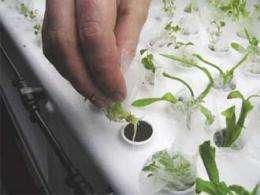
Growing plants without any soil may conjure up images from a Star Trek movie, but it’s hardly science fiction. Aeroponics, as one soilless cultivation process is called, grows plants in an air or mist environment with no soil and very little water. Scientists have been experimenting with the method since the early 1940s, and aeroponics systems have been in use on a commercial basis since 1983.
“Who says that soil is a precondition for agriculture?” asked Graber. “There are two major preconditions for agriculture, the first being water and the second being plant nutrients. Modern agriculture makes extensive use of ‘soilless growing media,’ which can include many varied solid substrates.”
In 1997, NASA teamed up with AgriHouse and BioServe Space Technologies to design an experiment to test a soilless plant-growth system on board the Mir Space Station. NASA was particularly interested in this technology because of its low water requirement. Using this method to grow plants in space would reduce the amount of water that needs to be carried during a flight, which in turn decreases the payload. Aeroponically-grown crops also can be a source of oxygen and drinking water for space crews.
“I would suspect that if and when humankind reaches the stage of settling another planet or the Moon, the techniques for establishing soilless culture there will be well advanced,” Graber predicted.
Soil: A Key to the Past and the Future
The surface and soil of a planetary body holds important clues about its habitability, both in its past and in its future. For example, examining soil features have helped scientists show that early Mars was probably wetter and warmer than it is currently.
“Studying soils on our celestial neighbors means to individuate the sequence of environmental conditions that imposed the present characteristics to soils, thus helping reconstruct the general history of those bodies,” Certini said.
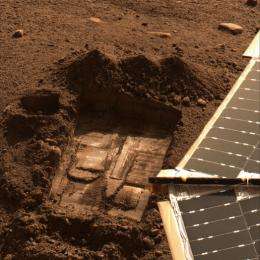
In 2008, NASA’s Phoenix Mars Lander performed the first wet chemistry experiment using martian soil. Scientists who analyzed the data said the Red Planet appears to have environments more appropriate for sustaining life than was expected, environments that could one day allow human visitors to grow crops.
“This is more evidence for water because salts are there,” said Phoenix co-investigator Sam Kounaves of Tufts University in a press release issued after the experiment. “We also found a reasonable number of nutrients, or chemicals needed by life as we know it.”
Researchers found traces of magnesium, sodium, potassium and chloride, and the data also revealed that the soil was alkaline, a finding that challenged a popular belief that the martian surface was acidic.
This type of information, obtained through soil analyses, becomes important in looking toward the future to determine which planet would be the best candidate for sustaining human colonies.
Source: Astrobio.net


