Cometary poison gas geyser heralds surprises
November 3, 2010 By Dr. Tony Phillips

Cometary poison gas geyser heralds surprises

Enlarge

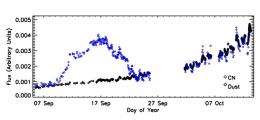
The atmosphere of Comet Hartley 2 was flooded with cyanogen radicals in mid-September 2010. Credit: EPOXI

As NASA's Deep Impact (EPOXI) probe approaches Comet Hartley 2 for a close encounter on Nov. 4th, mission scientists are certain of only one thing:

"We're about to be surprised," says principal investigator Mike A'Hearn of the University of Maryland. "This comet is unlike any we've visited before, and we don't know what we're going to find."

In recent years, international have buzzed the cores of four comets: Halley, Tempel 1, Borrelly and Wild 2. Deep Impact even blew a hole in one of them (Tempel 1) to see what was beneath the surface. Those previous flybys, however, may not have prepared researchers for the comet at hand.

This video is not supported by your browser at this time.

Video Credit: Donald J. Lindler, Sigma Space Corporation and NASA/JPL-Caltech/UMD

"Comet Hartley 2 is smaller yet much more active than the others," explains A'Hearn. "Although its core is only 2 km wide—about a third the size of Tempel 1—it is spewing five times more gas and dust."

The comet has already shocked the science team by producing a massive surge of CN, the cyanogen radical commonly known as "cyanide." Cyanide itself wasn't the surprise; CN is a common ingredient of comet cores. Rather, it was the size and purity of the outburst that has researchers puzzled.

"The abundance of CN in the comet's atmosphere jumped by a factor of five over an eight day period in September—that's huge," says A'Hearn. "Curiously, however, there was no corresponding increase in dust."
Cometary poison gas geyser heralds surprises
Enlarge

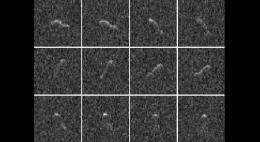
This just in... Arecibo radar images provide a first look at Hartley's nucleus.

This flies in the face of conventional wisdom. Comet cores are thought to be a mish-mash of volatile ices, rock, and dust particles, generally well mixed. When the ice evaporates to produce a jet of gas, dust naturally comes along for the ride. Yet this outburst was pure gas.

"We have never seen this kind of activity in a comet before. The amount of gas suggests a global event—but how could such an event occur without dust? It's a mystery."

A'Hearn stresses that readers shouldn't worry about a "poisonous comet." For one thing, Comet Hartley 2 is more than 11 million miles from Earth. There's no direct contact between our planet and the comet's gaseous shroud. Furthermore, the cyanide gas is very diffuse. If it did touch Earth, it would not be able to penetrate our planet's dense atmosphere.

May of 1910 provides a relevant example: Astronomers had just announced that Earth was passing through the cyanide-containing tail of Comet Halley, triggering a minor panic. People walked the streets of New York wearing gas masks, and unscrupulous merchants made a pretty penny selling "comet pills" to counteract poisoning. Nothing happened. Even direct contact with Halley’s tail produced no ill effects.

The real significance of Hartley 2's cyanide surge is the tease. Something mysterious is happening … and we're about to find out what.

The flyby officially begins on the evening of Nov. 3rd when Deep Impact/EPOXI is about 18 hours from closest approach. During the early stages of the encounter, all of the close-up images will be stored onboard the spacecraft. This is because Deep Impact cannot simultaneously point its high gain antenna toward Earth and its imagers toward the comet.

Closest approach occurs around 10 am EDT on Nov.4th at a distance of 435 miles. About a half an hour later, the changing geometry of the encounter will allow simultaneous communications and imaging. With its big antenna once again pointing toward Earth, /EPOXI will begin transmitting close-up pictures of Hartley 2. The complete data dump will take several hours.

"We will be waiting," said A'Hearn. "The best images won't reach Earth until many hours after the actual encounter."

Data from the close approach will continue to download through the 6th of November, but NASA will release preliminary results sooner than that. A live press conference is scheduled for 4 pm EDT (1 pm PDT) on Nov. 4th.

More information: http://epoxi.umd.edu/

Provided by JPL/NASA search and more info website

Filter


Move the slider to adjust rank threshold, so that you can hide some of the comments.


Display comments: newest first

yyz
Nov 03, 2010

Rank: not rated yet
Hopefully Deep Impact won't get 'sandblasted' as did the Soviet Vegas and ESA's Giotto probe during their flybys of the nucleus of Halley's Comet. As for Giotto:

"Giotto passed Halley successfully on 14 March 1986 at 600 km distance, and surprisingly survived despite being hit by some small particles. One impact sent it spinning off its stabilized spin axis so that its antenna no longer always pointed at the Earth, and importantly, its dust shield no longer protected its instruments. After 32 minutes Giotto re-stabilized itself and continued gathering science data. Another impact destroyed the Halley Multicolor Camera, but not before it took spectacular pictures of the nucleus at closest approach."(-wiki)

So far, the dust output of Hartley 2 seems relatively weak compared to its (variable) gas output.
Rank 4 /5 (5 votes)
Relevant PhysicsForums posts

More news stories

Dragon arrives at space station in historic 1st (Update 2)

The privately bankrolled Dragon capsule arrived at the International Space Station for a historic docking Friday, captured by astronauts wielding a giant robot arm.

Space & Earth / Space Exploration

created 1 hour ago | popularity 5 / 5 (3) | comments 3

SKA super telescope to be built in Australia, South Africa (Update 2)

A long-running joust to host a radio telescope that would give mankind its farthest peek into the Universe ended on Friday with a Solomon-like judgement to split the site between Australia and South Africa.

Space & Earth / Astronomy

created 2 hours ago | popularity 5 / 5 (1) | comments 1

Organic carbon from Mars, but not biological

(Phys.org) -- Molecules containing large chains of carbon and hydrogen--the building blocks of all life on Earth--have been the targets of missions to Mars from Viking to the present day. While these molecules ...

Space & Earth / Space Exploration

created 21 hours ago | popularity 4.4 / 5 (5) | comments 2 | with audio podcast

Aliens don't want to eat us, says former SETI director

Alien life probably isn’t interested in having us for dinner, enslaving us or laying eggs in our bellies, according to a recent statement by former SETI director Jill Tarter.

Space & Earth / Space Exploration

created 2 hours ago | popularity 5 / 5 (4) | comments 6

Research: Negative leakage could be key to reducing carbon emissions

(Phys.org) -- The unilateral efforts of a single country or region to reduce the emissions of greenhouse gases could reduce exports, increase imports and lead to higher emissions elsewhere – what economists call “leakage.” ...

Space & Earth / Environment

created 5 hours ago | popularity 5 / 5 (2) | comments 1


Inherited DNA change explains overactive leukemia gene

A small inherited change in DNA is largely responsible for overactivating a gene linked to poor treatment response in people with acute leukemia.

Copy of the genetic makeup travels in a protein suitcase

Scientists from the Institute for Physical and Theoretical Chemistry at the University of Bonn have succeeded for the first time in the real time filming of the transport of an important information carrier in biological ...

Cancer may require simpler genetic mutations than previously thought

Chromosomal deletions in DNA often involve just one of two gene copies inherited from either parent. But scientists haven't known how a deletion in one gene from one parent, called a "hemizygous" deletion, can contribute ...

Beyond oil, can Alaska be tapped as a source for renewable energy?

Alaska has massive hydro, wind, geothermal and other renewable resources, but the state's rural villages are chained to diesel and suffer oppressive energy costs they say threaten their existence. Lawmakers, energy experts ...

Implantable pain disk may help those with cancer

An estimated 3.5 million cancer patients around the globe are in severe pain from their disease, but many get no relief.

'Transformer' protein makes different sized transport pods

These spheres may look almost identical, but subtle differences between them revealed a molecular version of the robots from Transformers. Each sphere is a vesicle, a pod that cells use to transport materials ...