Cisco's shortfall an omen for rest of tech world (Update)
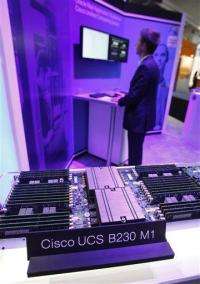
(AP) -- A gloomy outlook from Cisco Systems Inc. is shaking some investors' faith in the strength of the technology industry's recovery.
Corporations have loosened their purse strings after slashing their budgets. Some governments have poured money into stimulus-fueled technology projects. Consumers are starting to snap up cell phones and gadgets again after backing off in the past few quarters.
But Cisco revealed severe slowdowns in spending by state and local governments in the U.S. and by governments in Japan and Europe. That has investors worried that other companies will show similar trends when they report their next earnings.
Cisco is a soothsayer of sorts for the technology world because it is the world's No. 1 maker of computer networking equipment, and its quarterly results lag others' by a month, meaning it includes an extra month of sales that most other companies haven't reported yet.
Cisco's stock got clobbered Thursday, and investors lopped off a sixth of Cisco's market value, annihilating $23 billion in shareholder wealth. The sell-off drove the tech-laden Nasdaq down, too.
Shaw Wu, an analyst with Kaufman Bros., said Cisco's results raise concerns about the level of information-technology spending in the months ahead.
"The economic environment is still very difficult," he said. "Unemployment remains high. That hasn't been solved."
He added that "one quarter is too early to call a trend, but it definitely raises a red flag."
Cisco's results Wednesday provided buzzkill for an industry that has become accustomed to signs that a strong, broad recovery in technology spending is under way. The market's reaction was so forceful because the trends Cisco has spotted contradict the sentiment expressed by other technology heavyweights.
Many other companies have raised their guidance recently. Intel Corp., EMC Corp., Xerox Corp. and IBM Corp. all offered reassuring signs about their respective industries and painted the picture of a slow but steady rise in companies' willingness to pay for new computers, equipment and services.
Then along came Cisco, whose networking products help manage the flow of Internet and other data traffic and are critical parts of the backbone of the Internet. Cisco is now calling for revenue for the November-January period to rise just 3 percent to 5 percent, less than half the growth rate that analysts expected.
One reason for the shortfall in state and local government spending is that costs are being cut to balance budgets. That process has taken longer in government than in corporations, which clamp down on spending almost instantly when times get tough. Cisco also had some trouble selling to Internet services providers because of lingering constraints in their budgets for capital investments. The kinks there weren't as much of a surprise as the scale of the weakness in government spending, though.
Jeff Kvaal, an analyst with Barclays Capital, wrote in a note to clients that Cisco's shares are likely to stay under pressure until it becomes clearer how much of its troubles are being caused by its losses in market share rather than macroeconomic problems - namely lowered spending by governments. He noted that Cisco's tone about public sector spending is a change from the company's message at a meeting with analysts in September.
It's not surprising that governments are cutting their budgets given pressures to slash deficits. But the size of Cisco's exposure to the downturn, as well as the sudden emergence of state and local governments as key players with the ability to swing results for a company the size of Cisco, triggered widespread worry about other companies' exposure to the same pressures.
Most companies don't break out how much business they get from state and local governments, compared with the federal government. It's generally lumped into a category of public sector spending, if it's broken out at all, so the effect on other companies might not be immediately clear when they report their results.
Two technology heavyweights slated to report their earnings in the next few weeks are Dell Inc., which reports next Thursday, and Hewlett-Packard Co., which reports Nov. 22.
Cisco shares fell $3.97, or 16 percent, to close Thursday at $20.52. Dell fell 56 cents, or 3.9 percent, to $13.93, and HP shares lost $1.06, or 2.4 percent, to $43.10. Shares in IBM, EMC and Xerox each fell by about 1 percent, while Intel rose nearly 1 percent to $21.21.
A particular worry was Cisco's acknowledgement that orders from state governments in the U.S. have been cut nearly in half in the latest quarter compared with the previous one.
Jayson Noland, an analyst with Robert W. Baird & Co., said he hadn't heard worries from Cisco resellers about the strength of those orders prior to Cisco's earnings report Wednesday for the fiscal first quarter. He noted that federal spending has remained strong, but that it now appears that states and municipalities are imposing the same kind of deep cuts that corporations imposed at the start of the recession.
"When something goes wrong in the corporate world, they lock it up quickly," he said in an interview. "I don't feel like state and local governments really act until it's the 11th hour."
The cuts are likely to spill over into other sectors beyond technology, he added. While some portion of Cisco's weaker-than-expected guidance can be chalked up to company-specific problems - such as apparent losses in market share for cable set-top boxes, which represents a small fraction of Cisco's total business - Noland said the results paint a troubling picture for other technology companies.
"Cisco is big enough, and that miss was bad enough, that it's hard to argue that it's just company-specific," he said.
©2010 The Associated Press. All rights reserved. This material may not be published, broadcast, rewritten or redistributed.


