Analysis of teeth suggests modern humans mature more slowly than Neanderthals did
Nov 15, 2010
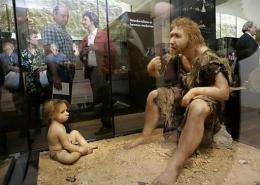
A Neanderthal man ancestor's reconstruction. Neanderthal children grew up faster than humans, according a study Monday that suggested that modern kids' lengthy childhoods may be a relatively new phenomenon that has boosted our longevity.

A sophisticated new examination of teeth from 11 Neanderthal and early human fossils shows that modern humans are slower than our ancestors to reach full maturity. The finding suggests that our characteristically slow development and long childhood are recent and unique to our own species, and may have given early humans an evolutionary advantage over Neanderthals.

The research, led by scientists at Harvard University, the Max Planck Institute for Evolutionary Biology (MPI-EVA), and the European Synchrotron Radiation Facility (ESRF), is detailed in the .

"Teeth are remarkable time recorders, capturing each day of growth much like rings in trees reveal yearly progress," says Tanya M. Smith, assistant professor of human evolutionary biology at Harvard. "Even more impressive is the fact that our first molars contain a tiny 'birth certificate,' and finding this birth line allows scientists to calculate exactly how old a juvenile was when it died."

Compared to even , other primates have shorter gestation, faster childhood maturation, younger age at first reproduction, and a shorter overall lifespan. It's been unclear exactly when, in the 6 to 7 million years since our evolutionary split from non-human primates, the life course shifted.

Smith and her colleagues found that young Neanderthals' teeth growth -- a proxy for overall development -- was significantly faster than in our own species, including some of the earliest groups of to leave Africa some 90,000 to 100,000 years ago. This indicates that the elongation of childhood has been a relatively recent development.
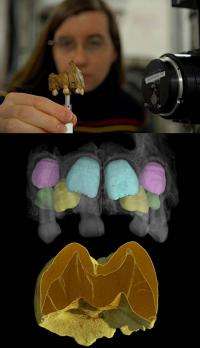
State-of-the-art synchrotron imaging of the tiny upper jaw of a Neanderthal child allows scientists to count tiny growth lines inside the first molar teeth and determine that it died at age 3. Image: Fossil courtesy: Université de Ličge, Belgium; Photo credit: Graham Chedd, Paul Tafforeau, Tanya Smith

Such studies add to the growing body of evidence that subtle developmental differences exist between us and our Neanderthal cousins. The recent sequencing of the has provided tantalizing genetic clues pointing to differences in cranial and skeletal development between and modern humans.

The current study involves some of the most famous Neanderthal children ever discovered, including the first hominin fossil, discovered in Belgium in the winter of 1829-30. This individual was previously thought, based on comparisons with modern humans, to have been four to five years old at the time of death. Now, powerful synchrotron X-rays and biological rhythms inside teeth have revealed the child was only three years old.

While counting lines in teeth isn't a new method, Smith says, doing it "virtually" using synchrotron micro-computed tomography is.

"These new methods present a unique opportunity to assess the origins of a fundamentally human condition: the costly yet advantageous shift from a primitive 'live fast and die young' strategy to the 'live slow and grow old' strategy that has helped to make humans one of the most successful organisms on the planet," Smith says. Humans' extended maturation may have facilitated additional learning and complex cognition, possibly giving early Homo sapiens an advantage over their Neanderthal cousins.

Explore further: Prehistoric rock art maps cosmological belief

More information: Smith, T.M., Tafforeau, et al. Dental evidence for ontogenetic differences between modern humans and Neanderthals, Proc. Natl. Acad. Sci. USA, November 15, 2010.

Related Stories

Handsome by Chance

Aug 02, 2007

Chance, not natural selection, best explains why the modern human skull looks so different from that of its Neanderthal relative, according to a new study led by Tim Weaver, assistant professor of anthropology at UC Davis.

Scientists redate Neanderthal fossils

Jan 05, 2006

Scientists say two Neanderthal fossils excavated from Vindija Cave in Croatia in 1998 may be 3,000-4,000 years older than originally thought.

'You will give birth in pain': Neanderthals too

Apr 21, 2009

(PhysOrg.com) -- Researchers from the University of California at Davis (USA) and the Max Planck Institute for Evolutionary Anthropology in Leipzig (Germany) present a virtual reconstruction of a female Neanderthal ...

New ancestor? Scientists ponder DNA from Siberia

Mar 24, 2010

(PhysOrg.com) -- An international team of scientists from the Max Planck Institute for Evolutionary Anthropology in Leipzig has sequenced ancient mitochondrial DNA from a finger bone found in southern Siberia. ...

Recommended for you

UNESCO warns Syrian heritage sites endangered

3 hours ago

UNESCO on Thursday added six ancient sites in Syria including a fortress of Saladin and a Crusader castle to the endangered World Heritage list, warning that more than two years of civil war had inflicted ...

Wooden beam could be detached part of shipwreck

14 hours ago

A wooden beam that has long been the focus of the search for a 17th century shipwreck in northern Lake Michigan was not attached to a buried vessel as searchers had suspected, but still may have come from the elusive Griffin ...

Prehistoric rock art maps cosmological belief

21 hours ago

It is likely some of the most widespread and oldest art in the United States. Pieces of rock art dot the Appalachian Mountains, and research by University of Tennessee, Knoxville, anthropology professor Jan ...

User comments : 5

Adjust slider to filter visible comments by rank

Display comments: newest first

RobertKarlStonjek
1 / 5 (1) Nov 15, 2010
Pygmies mature fast ~ they stop growing at 12 and typically have their first child by 16. So the Neanderthals are not quicker to mature than all modern humans...
see http://www.physor...722.html

Also of note is the error regarding the most successful organism, which are bacteria, viruses, single celled eukaryotes and many other microorganisms. In the mammals I'd say rats and mice are doing better than humans. Humans are the most successful primate.
Squirrel
5 / 5 (1) Nov 16, 2010
Actually, people called "pygmies" grow at the same rate as other people. To quote from the link given above “The pygmies grow in the same rates as the Turkana [eastern African Pastoralists], who also suffer from poor nutrition – but because the Turkana have longer life expectancy, they have time to grow for longer and achieve larger body size.

Squirrel
not rated yet Nov 16, 2010
The Smith et al paper is online with open access
http://www.pnas.o...full.pdf
jjoensuu
not rated yet Nov 16, 2010
So maybe their teeth just grew faster?
RobertKarlStonjek
1 / 5 (1) Nov 17, 2010
@Squirrel:
There is a difference between maturity and growth rates.
'Growth' describes the increase in body mass and the lengthening of limbs etc.
'Maturity' describes the completion of various stages of growth.
People can grow quickly or slowly and still reach maturity at the same age, but those who grow quicker will be taller.
Thus the pygmy, growing at normal rate, is shorter because they mature faster ie stop growing sooner than non-pygmies.
If two mature individuals are of the same hight but one of them matured earlier then that individual would also have had to have grown faster.

The paper indicates that Neanderthals both grew faster and matured earlier whereas the article above only mentioned earlier maturity.

More news stories

Probing Question: Are MOOCs here to stay?

In higher education, 2013 may be remembered as the year of the MOOC. For those playing catch-up, MOOCs, or Massive Open Online Courses, are college-level classes taught entirely over the Internet. Like students ...

Dispelling the myth of gay affluence

(Phys.org) —As poverty rates for virtually every demographic group increased during the recent recession, lesbian, gay and bisexual Americans are more likely to be poor than heterosexual people, according ...

Key link found in Cosmic Distance Ladder

(Phys.org) —When observing the bright explosion of a White Dwarf star in our neighbouring galaxy last year, researchers from The Australian National University collected the largest ever data set on what ...

CERN's ISOLTRAP reveals new magic in the atomic nucleus

(Phys.org) —The ISOLTRAP collaboration has measured the mass of exotic calcium nuclei using a new instrument installed at the ISOLDE facility at CERN. The measurements, published on 20 June in the journal Nature, clearl ...