Voracious comb jellyfish 'invisible' to prey
Oct 12, 2010
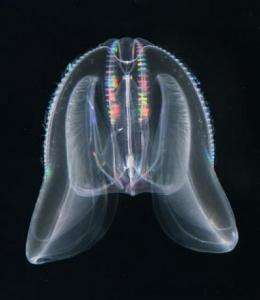
The North American comb jellyfish Mnemiopsis leidyi has a simple structure with two large oral lobes for catching prey. Credit: Lars Johan Hansson

Despite its primitive structure, the North American comb jellyfish can sneak up on its prey like a high-tech stealth submarine, making it a successful predator. Researchers, including one from the University of Gothenburg, have now been able to show how the jellyfish makes itself hydrodynamically 'invisible'.

The North American comb Mnemiopsis leidyi has long been known to consume vast quantities of zooplankton. A few years ago the species became established in Northern Europe.

Like many other jellyfish, Mnemiopsis leidyi has a large gelatinous body. The large size increases its chances of encountering prey, but can also be a disadvantage since the prey organisms are often highly sensitive to movements in the water. Nevertheless, the comb jellyfish manages to catch large amounts of copepod plankton, which are known for their acute escape response.

'Copepods have a well developed ability to detect even the slightest water disturbance,' says Lars Johan Hansson, a researcher at the Department of at the University of Gothenburg. 'They can swim well clear of the source of water deformation in just a split second. How the comb jellyfish is able to approach and catch some of the animal world's most vigilant plankton has up until now been unknown.'

The researchers used advanced video technology to study water flows around and within the comb jellyfish. These measurements were then used to calculate the water deformation generated by the jellyfish and compare this with the levels that trigger an escape response in .

'It emerged that the comb jellyfish uses microscopic, hairlike cilia inside its oral lobes to generate a feeding current that carefully transports water between the lobes. As the water accelerates slowly and is transported undisturbed into the jellyfish together with the prey, there is nothing that alarms the prey until it is next to the capture site inside the lobes, by which time it's too late to escape. This makes the jellyfish a hydrodynamically silent predator.'

Explore further: Navy dolphins discover rare old torpedo off Calif. coast near Coronado

More information: The study – Stealth predation and the predatory success of the invasive ctenophore Mnemiopsis leidyi – has been published in the scientific journal PNAS.

add to favorites email to friend print save as pdf

Related Stories

New parasite could be late summer beach pest

Jun 09, 2010

Researchers at the University of Gothenburg have discovered a new sea anemone that is thought to have established itself in Swedish waters. Larvae from similar anemones causes skin problems for sea bathers ...

Dutch zoo breeds own jellyfish

Sep 29, 2007

Marine biologists at a Dutch zoo say they have succeeded in the difficult task of breeding jellyfish in captivity.

Australian jellyfish range grows larger

Aug 20, 2007

U.S. marine scientists have discovered the range of the Australian spotted jellyfish (Phylllorhiza punctata) now extends from Texas to North Carolina.

Red Sea coral seen to feed on jellyfish

Nov 17, 2009

(PhysOrg.com) -- Corals depends on the products of photosynthetic algae for most of their food, but they also eat tiny plankton. Now, for the first time, there is evidence of a coral eating jellyfish.

Recommended for you

Scientists take a new look at an ancient crop

14 hours ago

Though the price makes you wince, you might just buy that bottle of your favorite olive oil anyway. Perhaps it's exactly what you want for the salad dressing you're making tonight and for your special stir-fry ...

Bittersweet: Bait-averse cockroaches shudder at sugar

May 23, 2013

Sugar isn't always sweet to German cockroaches, especially to the ones that avoid roach baits. In a study published May 24 in the journal Science, North Carolina State University entomologists show the ne ...

White tiger mystery solved

May 23, 2013

White tigers today are only seen in zoos, but they belong in nature, say researchers reporting new evidence about what makes those tigers white. Their spectacular white coats are produced by a single change ...

User comments : 0

More news stories

EU bans three pesticides harmful to bees

The European Commission said Friday that it will ban for two years beginning in December pesticides blamed for killing the bees that pollinate food and fruit crops.

Galaxies fed by funnels of fuel

(Phys.org) —Computer simulations of galaxies growing over billions of years have revealed a likely scenario for how they feed: a cosmic version of swirly straws.

Google eyes emerging markets networks

Google has become deeply involved in a series of projects to build and operate wireless networks in emerging markets including sub-Saharan Africa and Southeast Asia, a report said Friday.