UC Riverside physicists pave the way for graphene-based spin computer
October 14, 2010 by Iqbal Pittalwala

UC Riverside Physicists Pave the Way for Graphene-based Spin Computer

Enlarge

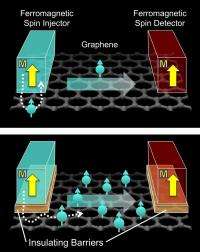
Atomically-thin insulating barriers greatly improve spin injection into graphene. Top image shows flow of electrons (dotted line) when no insulator is used. Flow of electron spin polarization is greatly improved (bottom image) when a magnesium oxide insulator is used as shown. Image credit: Kawakami lab, UC Riverside.

(PhysOrg.com) -- Physicists at the University of California, Riverside have taken an important step forward in developing a "spin computer" by successfully achieving "tunneling spin injection" into graphene.

An electron can be polarized to have a directional orientation, called “spin.” This spin comes in two forms – are said to be either “spin up” or “spin down” – and allows for more data storage than is possible with current electronics.

Spin computers, when developed, would utilize the electron’s spin state to store and process vast amounts of information while using less energy, generating less heat and performing much faster than conventional computers in use today.

Tunneling spin injection is a term used to describe conductivity through an insulator. , brought into the limelight by this year’s Nobel Prize in physics, is a single-atom-thick sheet of carbon atoms arrayed in a honeycomb pattern. Extremely strong and flexible, it is a good conductor of electricity and capable of resisting heat.

“Graphene has among the best spin transport characteristics of any material at room temperature,” explained Roland Kawakami, an associate professor of physics and astronomy, who led the research team, “which makes it a promising candidate for use in spin computers. But electrical spin injection from a ferromagnetic electrode into graphene is inefficient. An even greater concern is that the observed spin lifetimes are thousands of times shorter than expected theoretically. We would like longer spin lifetimes because the longer the lifetime, the more computational operations you can do.”

To address these problems, in the lab Kawakami and colleagues inserted a nanometer-thick insulating layer, known as a “tunnel barrier,” in between the ferromagnetic electrode and the graphene layer. They found that the spin injection efficiency increased dramatically.

“We found a 30-fold increase in the efficiency of how spins were being injected by quantum tunneling across the insulator and into graphene,” said Kawakami, who is also a member of UC Riverside’s Center for Nanoscale Science and Engineering. “Equally interesting is that the insulator was operating like a one-way valve, allowing electron flow in one direction – from the electrode to graphene – but not the other. The insulator helps to keep the injected spin inside the graphene, which is what leads to high spin injection efficiency. This counterintuitive result is the first demonstration of tunneling spin injection into graphene. We now have world record values for spin injection efficiency into graphene.”

Study results appear this week in Physical Review Letters.

In their experiments, the Kawakami lab also made an unexpected discovery that explains short spin lifetimes of electrons in graphene that have been reported by other experimental researchers.

Kawakami explained that spin lifetimes are typically investigated through an experiment, known as a Hanle measurement, which uses a ferromagnetic spin detector to monitor the electron spins in graphene as they change direction in an external magnetic field. When his team placed a tunnel barrier in between the ferromagnetic spin detector and the graphene, the spin lifetime from the Hanle measurement jumped up to about 500 picoseconds (compared to typical values of 100 picoseconds) even though the researchers did nothing different to the graphene itself.

“People usually assume that the Hanle measurement accurately measures the spin lifetime, but this result shows that it severely underestimates the spin lifetime when the ferromagnet is touching the graphene,” said Wei Han, the first author of the research paper and a graduate student in Kawakami’s lab. “This is good news because it means the true spin lifetime in graphene must be longer than reported previously – potentially a lot longer.”

Kawakami explained that, theoretically, graphene has the potential for extremely long spin lifetimes.

“This lifetime could be microseconds long,” he said. “A long lifetime is a special property of graphene, making it a very attractive material for a spin computer.”

Growing insulating barriers on graphene is neither a simple nor easy process. The insulator tends to form clumps on the graphene sheet, due in part to graphene’s reluctance to form strong bonds with materials. To circumvent the problem of clumping, in their experiments the Kawakami team layered the graphene sheet with titanium (about half an atom thick) using a method called molecular beam epitaxy. The titanium layer, the researchers found, prevented the insulator from clumping on graphene or sliding off it.

Next in the research, the Kawakami lab plans to demonstrate a working logic device.

Provided by University of California, Riverside

4.9 /5 (23 votes)  

Filter


Move the slider to adjust rank threshold, so that you can hide some of the comments.


Display comments: newest first

maxcypher
Oct 14, 2010

Rank: not rated yet
"...in their experiments the Kawakami team layered the graphene sheet with titanium (about half an atom thick) using a method called molecular beam epitaxy." Is it even possible to have a layer that is 1/2 of an atom thick??
PinkElephant
Oct 14, 2010

Rank: not rated yet
Is it even possible to have a layer that is 1/2 of an atom thick??
I take that to mean that the layer is not continuous. One could envision, for instance, a titanium atom nestled on top of (and centered on) each "hexagon" of the graphene lattice. Once you average the thickness over a given area, you end up with average of less than 1 titanium atom per carbon atom, and so average thickness of less than 1 atom thick. (Sort of like average family size in U.S. is currently 3.2 according to the Census Bureau.)
trekgeek1
Oct 14, 2010

Rank: 5 / 5 (2)
I'm sitting in a UCR quantum mechanics lecture right now. I'm so proud.
Rank 4.9 /5 (23 votes)
Relevant PhysicsForums posts
  • AC Electric field in the conducting media
    created25 minutes ago
  • The physics of the greenhouse effect.
    created46 minutes ago
  • Electric Dipole Moment
    created7 hours ago
  • Paradox of motion implies discrete space?
    created11 hours ago
  • acceleration decceleration
    created12 hours ago
  • Spiral motion and the centripetal force
    created12 hours ago
  • More from Physics Forums - General Physics

More news stories

Is a classical electrodynamics law incompatible with special relativity?

(Phys.org) -- The laws of classical electromagnetism that were developed in the 19th century are the same laws that scientists use today. They include Maxwell’s four equations along with the Lorentz la ...

Physics / General Physics

created 21 hours ago | popularity 5 / 5 (11) | comments 26 | with audio podcast feature

Thousands of invisibility cloaks trap a rainbow

Many people anticipating the creation of an invisibility cloak might be surprised to learn that a group of American researchers has created 25 000 individual cloaks.

Physics / General Physics

created 12 hours ago | popularity 4.8 / 5 (6) | comments 0 | with audio podcast

Excitons: Exotic particles, chilled and trapped, form giant matter wave

Physicists have trapped and cooled exotic particles called excitons so effectively that they condensed and cohered to form a giant matter wave.

Physics / General Physics

created 19 hours ago | popularity 4.9 / 5 (9) | comments 1 | with audio podcast

Slip-and-slide power generators

Researchers from Vestfold University College in Norway have created a simple, efficient energy harvesting device that uses the motion of a single droplet to generate electrical power.

Physics / General Physics

created 13 hours ago | popularity 4 / 5 (1) | comments 0

Photonics: Beam me up

'Tractor beams' of light that pull objects towards them are no longer science fiction. Haifeng Wang at the A*STAR Data Storage Institute and co-workers have now demonstrated how a tractor beam can in fact be realized on a ...

Physics / General Physics

created 21 hours ago | popularity 4.5 / 5 (4) | comments 0


New study should end debate over magnesium treatment for preventing poor outcome after haemorrhagic stroke

An international randomised trial and meta-analysis published Online First in The Lancet should put an end to the debate about the use of intravenous magnesium sulphate to prevent poor outcomes after haemorrhagic stroke. The in ...

Computers excel at identifying smiles of frustration (w/ Video)

(Phys.org) -- Researchers at the Massachusetts Institute of Technology (MIT) in the US have trained computers to recognize smiles, and they have turned out to be more adept at recognizing smiles of frustration ...

OmniVision tops up sensors for cameras, phones

(Phys.org) -- OmniVision has announced two high-resolution image sensors for the digital still and digital video camera market (DS/DVC) and higher end smartphones. In end-user language, it is a claim for superior ...

Research: Negative leakage could be key to reducing carbon emissions

(Phys.org) -- The unilateral efforts of a single country or region to reduce the emissions of greenhouse gases could reduce exports, increase imports and lead to higher emissions elsewhere – what economists call “leakage.” ...

Progestin treatment for polycystic ovarian syndrome may reduce pregnancy chances

(Medical Xpress) -- The hormone progestin, often given as a first step in infertility treatment for polycystic ovary syndrome (PCOS), appears to decrease the odds of conception and of giving birth, according to a study by ...

Talking works: UB professor develops method to analyze creative problem solving

(Phys.org) -- Talk -- if it's the right kind -- can increase creativity, leading students to create useful, new ideas that solve problems, a University at Buffalo professor has found by using a statistical tool that he invented.