New tool to map malaria developed
October 15, 2010 by Elaine Bible
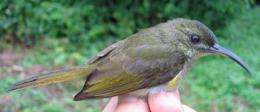
The olive sunbird, a tropical rainforest bird that SF State scientists studied in order to map malaria in Africa.
Malaria kills an estimated 1 million people each year, but humans aren't the only animals under attack. Birds also contract the disease through mosquito bites. SF State biologists have been studying malaria among birds in Africa in an effort to understand the geography of the disease, and their work has culminated in the creation of a new model, capable of predicting where malaria is present now and where future outbreaks could occur.
"We can now predict where malaria will show up in Africa," said Ravinder Sehgal, assistant professor of biology. "We expect our results could apply to malaria in humans, too, since mosquitoes are mosquitoes, whether they are biting people or birds."
Malaria is caused by tiny parasites which are transmitted from a mosquito's saliva into the human body, where the parasite, called Plasmodium, multiplies within red blood cells.
For the last 20 years, SF State scientists have been collecting blood samples from the olive sunbird, a tropical rainforest bird found across West Africa. Recently they mapped the prevalence of the parasite Plasmodium in these birds. Studying birds enabled them to examine the dynamics of the disease, even in remote areas where there are no human inhabitants, and allowed them to analyze the relationship between ecological conditions and malaria without human factors getting in the way.
The researchers collected hundreds of blood samples from birds at 28 sites in West Africa, and compared the results against maps of conditions, such as rainfall, temperature and vegetation type, identifying relationships between environmental conditions and malaria infections.
"We used this data to create complex computer algorithms that can predict the prevalence of malaria in regions where malaria levels aren't known, or predict future scenarios, when climate change or deforestation might affect the spread of the disease," Sehgal said.
So far, testing has proved the model to be accurate in predicting avian malaria in Cameroon, Ghana and Cote d'Ivoire, countries where levels of the disease are moderate. However, Sehgal says more work is needed to refine the model for use in areas where the parasite Plasmodium is extremely prevalent. "We're going to refine the model to work better in the very humid Nigerian rainforests where malaria levels are thought to be very high, and we also hope to expand the model for use in East and South Africa," Sehgal said.
More information: Sehgal and colleagues published their research in September in the biology journal Proceedings of the Royal Society B.
Provided by
San Francisco State University
-
From lemons to lemonade: Reaction uses carbon dioxide to make carbon-based semiconductor,
28 comments
-
Every black hole contains a new universe: A physicist presents a solution to present-day cosmic mysteries,
215 comments
-
New silicon memory chip developed,
16 comments
-
Thioridazine kills cancer stem cells in human while avoiding toxic side-effects of conventional cancer treatments,
2 comments
-
SpaceX private rocket blasts off for space station (Update),
41 comments
-
What does exophillic and endophillic mean in terms of mosquito and their control?
19 hours ago
-
Semen stains glows under black lights (uv light)?
May 23, 2012
-
Question on Human Chromosome 2
May 23, 2012
-
How important is composition of TBST in diluting antibodies and Western Blotting?
May 22, 2012
-
Does the medulla monitor blood pH
May 20, 2012
-
What physically constitutes memory?
May 17, 2012
- More from Physics Forums - Biology
More news stories
Diagnostic labs analyze from bugs to toenails
Found an odd bug in your closet? Rhododendrons inexplicably wilting? Need a toenail analyzed? There's a lab for that.
1 hour ago |
not rated yet |
0
Global warming winner: Once rare butterfly thrives
(AP) -- Global warming is rescuing the once-rare brown Argus butterfly, scientists say.
15 hours ago |
4 / 5 (3) |
3
Gourmet butterflies speed north: study
A new study led by scientists in the Department of Biology at the University of York has shown how a butterfly has changed its diet, and consequently has sped northwards in response to climate change. Their study is published ...
17 hours ago |
5 / 5 (3) |
1
|
Researchers find a way to delay aging of stem cells
Stem cells are essential building blocks for all organisms, from plants to humans. They can divide and renew themselves throughout life, differentiating into the specialized tissues needed during development, ...
21 hours ago |
5 / 5 (5) |
0
|
Fungi shifted plant balance of power
Cooperating with fungi didn't just help the earliest plants spread across a barren, rocky landscape; it also played a decisive role in the rise of more complex plants with roots and leaves that make up most ...
22 hours ago |
5 / 5 (2) |
0
|
New study should end debate over magnesium treatment for preventing poor outcome after haemorrhagic stroke
An international randomised trial and meta-analysis published Online First in The Lancet should put an end to the debate about the use of intravenous magnesium sulphate to prevent poor outcomes after haemorrhagic stroke. The in ...
Research: Negative leakage could be key to reducing carbon emissions
(Phys.org) -- The unilateral efforts of a single country or region to reduce the emissions of greenhouse gases could reduce exports, increase imports and lead to higher emissions elsewhere what economists call leakage. ...
Computers excel at identifying smiles of frustration (w/ Video)
(Phys.org) -- Researchers at the Massachusetts Institute of Technology (MIT) in the US have trained computers to recognize smiles, and they have turned out to be more adept at recognizing smiles of frustration ...
OmniVision tops up sensors for cameras, phones
(Phys.org) -- OmniVision has announced two high-resolution image sensors for the digital still and digital video camera market (DS/DVC) and higher end smartphones. In end-user language, it is a claim for superior ...
Progestin treatment for polycystic ovarian syndrome may reduce pregnancy chances
(Medical Xpress) -- The hormone progestin, often given as a first step in infertility treatment for polycystic ovary syndrome (PCOS), appears to decrease the odds of conception and of giving birth, according to a study by ...
Talking works: UB professor develops method to analyze creative problem solving
(Phys.org) -- Talk -- if it's the right kind -- can increase creativity, leading students to create useful, new ideas that solve problems, a University at Buffalo professor has found by using a statistical tool that he invented.