New snub-nosed monkey discovered in Northern Myanmar

October 26, 2010

New snub-nosed monkey discovered in Northern Myanmar

Enlarge

An image reconstructed by Photoshop, based on a Yunnan snub-nosed monkey and the carcass of the newly discovered species, is also available. This image should be credited to Dr. Thomas Geissmann. Credit: Dr. Thomas Geissmann

An international team of primatologists have discovered a new species of monkey in Northern Myanmar (formerly Burma.) The research, published in the American Journal of Primatology, reveals how Rhinopithecus strykeri, a species of snub-nosed monkey, has an upturned nose which causes it to sneeze when it rains.

Field biologists led by Ngwe Lwin from the Myanmar Biodiversity And Nature Conservation Association and supported by an international team of from Fauna & Flora International (FFI) and the People Resources and Foundation, discovered the new during the nationwide Hoolock Gibbon Status Review in early 2010. Hunters reported the presence of a monkey species with prominent lips and wide upturned nostrils.

Sightings were reported from the eastern Himalayas to the northeastern Kachin state leading the team to conduct field surveys which led to the discovery of a small population of a new species which displays characteristics unlike any other snub-nosed species previously described.

Thomas Geissmann, who is leading the taxonomic description, describes the monkey as having almost entirely blackish fur with white fur only on ear tufts, chin beard and perineal area. It also has a relatively long tail, approximately 140% of its body size.

The species has been named Rhinopithecus strykeri in honour of Jon Stryker, President and Founder of the Arcus Foundation who supported the project. However, in local dialects it is called mey nwoah, 'monkey with an upturned face.'
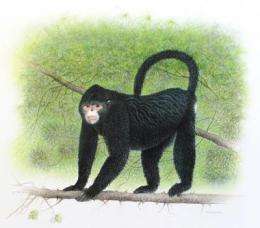
New snub-nosed monkey discovered in Northern Myanmar
Enlarge

Fauna & Flora International has commissioned the attached artists impression of the new species in its habitat, based on field sightings and a carcass of the newly discovered species. The image should be credited to Martin Aveling/Fauna & Flora International. Credit: Martin Aveling/Fauna & Flora International

While the species is new to science the local people know it well and claim that it is very easy to find when it is raining because the often get rainwater in their upturned noses causing them to sneeze. To avoid getting rainwater in their noses they spend rainy days sitting with their heads tucked between their knees

Frank Momberg, FFI's Regional Programme Development Coordinator, Asia Pacific, who interviewed local hunters during the field surveys suggests that the species is limited to the Maw River area. The distribution area is believed to be 270 km (squared) with an approximate population of 260-330 individuals, meaning that it is classified as Critically Endangered by IUCN.

As this new species of snub-nosed monkey inhabits the Kachin State in northeastern Myanmar it is geographically isolated from other species by two major barriers, the Mekong and the Salween Rivers, which may explain why the species has not been discovered earlier.

According to local hunters the monkeys spend the summer months, between May and October, at higher altitudes in mixed temperate forests. In winter they descend closer to villages when snowfall makes food scarcer.

Species of snub-nosed monkeys are found in parts of China and Vietnam. Presently all species are considered endangered. Until now no species have been reported in Myanmar. However, this latest addition to the snub nosed family is already critically endangered due to increasing hunting pressure resulting from the building of logging roads by Chinese companies beginning to invade the previously isolated distribution area of this newly discovered monkey.

Mark Rose, Chief Executive of Fauna & Flora International said, "We are committed to taking immediate conservation action to safeguard the survival of this important new species together with our partners and local communities in Myanmar."

Provided by Wiley search and more info website

4.4 /5 (13 votes)  

Filter


Move the slider to adjust rank threshold, so that you can hide some of the comments.


Display comments: newest first

Mercury_01
Oct 27, 2010

Rank: 3 / 5 (2)
Oh my god. Michael Jackson was beautiful after all.
yOnsa
Oct 27, 2010

Rank: 1 / 5 (1)
And he had a schweet hair style!
Rank 4.4 /5 (13 votes)
Relevant PhysicsForums posts

More news stories

Diagnostic labs analyze from bugs to toenails

Found an odd bug in your closet? Rhododendrons inexplicably wilting? Need a toenail analyzed? There's a lab for that.

Biology / Other

created 28 minutes ago | popularity not rated yet | comments 0

Global warming winner: Once rare butterfly thrives

(AP) -- Global warming is rescuing the once-rare brown Argus butterfly, scientists say.

Biology / Ecology

created 14 hours ago | popularity 4 / 5 (3) | comments 3

Gourmet butterflies speed north: study

A new study led by scientists in the Department of Biology at the University of York has shown how a butterfly has changed its diet, and consequently has sped northwards in response to climate change. Their study is published ...

Biology / Ecology

created 16 hours ago | popularity 5 / 5 (3) | comments 1 | with audio podcast

Researchers find a way to delay aging of stem cells

Stem cells are essential building blocks for all organisms, from plants to humans. They can divide and renew themselves throughout life, differentiating into the specialized tissues needed during development, ...

Biology / Cell & Microbiology

created 20 hours ago | popularity 5 / 5 (5) | comments 0 | with audio podcast

Fungi shifted plant balance of power

Cooperating with fungi didn't just help the earliest plants spread across a barren, rocky landscape; it also played a decisive role in the rise of more complex plants with roots and leaves that make up most ...

Biology / Plants & Animals

created 21 hours ago | popularity 5 / 5 (2) | comments 0 | with audio podcast


Progestin treatment for polycystic ovarian syndrome may reduce pregnancy chances

(Medical Xpress) -- The hormone progestin, often given as a first step in infertility treatment for polycystic ovary syndrome (PCOS), appears to decrease the odds of conception and of giving birth, according to a study by ...

World 'no tobacco day' puts spotlight on dangers of smoking

It’s not just smokers who are at-risk when it comes to tobacco smoke exposure—and the health concerns of smoking cigarettes are not limited to the most known consequence: lung cancer. 

Talking works: UB professor develops method to analyze creative problem solving

(Phys.org) -- Talk -- if it's the right kind -- can increase creativity, leading students to create useful, new ideas that solve problems, a University at Buffalo professor has found by using a statistical tool that he invented.

Nonsmoking lung cancer survivor encourages others to consider risk

Carol Seibert had an upper respiratory infection she just couldn’t seem to shake. The timing of her illness was awful, as she had just returned from a trip to Florida for her youngest son’s surgery and was preparing ...

OmniVision tops up sensors for cameras, phones

(Phys.org) -- OmniVision has announced two high-resolution image sensors for the digital still and digital video camera market (DS/DVC) and higher end smartphones. In end-user language, it is a claim for superior ...

Nasa receives widespread concepts for future Mars missions

NASA's call to scientists and engineers to help plan a new strategy to explore Mars has resulted in almost double the amount of expected submissions with unique and bold ideas.