Origin of skillful stone-tool-sharpening method pushed back more than 50,000 years
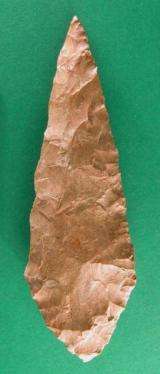
Pictured is a Still Bay bifacial point from Blombos Cave in South Africa made of silcrete and finished by pressure flaking, primarily at the tip. Credit: Image courtesy Science/AAAS
A highly skillful and delicate method of sharpening and retouching stone artifacts by prehistoric people appears to have been developed at least 75,000 years ago, more than 50,000 years earlier than previously thought, according to a new study led by the University of Colorado at Boulder.
The new findings show that the technique, known as pressure flaking, took place at Blombos Cave in South Africa during the Middle Stone Age by anatomically modern humans and involved the heating of silcrete -- quartz grains cemented by silica -- used to make tools. Pressure flaking takes place when implements previously shaped by hard stone hammer strikes followed by softer strikes with wood or bone hammers are carefully trimmed on the edges by directly pressing the point of a tool made of bone on the stone artifact.
The technique provides a better means of controlling the sharpness, thickness and overall shape of bifacial tools like spearheads and stone knives, said Paola Villa, a curator at the University of Colorado Museum of Natural History and a study co-author. Prior to the Blombos Cave discovery, the earliest evidence of pressure flaking was from the Upper Paleolithic Solutrean culture in France and Spain roughly 20,000 years ago.
"This finding is important because it shows that modern humans in South Africa had a sophisticated repertoire of tool-making techniques at a very early time," said Villa. "This innovation is a clear example of a tendency to develop new functional ideas and techniques widely viewed as symptomatic of advanced, or modern, behavior."
A paper on the subject was published in the Oct. 29 issue of Science. Other study co-authors included Vincent Mourre of the French National Institute for Preventive Archaeological Research in France and Christopher Henshilwood of the University of Bergen in Norway and director of the Blombos Cave excavation. The research was funded by the Wenner Gren Foundation of New York.
"Using the pressure flaking technique required strong hands and allowed toolmakers to exert a high degree of control on the final shape and thinness that cannot be achieved by percussion," Villa said. "This control helped to produce narrower and sharper tool tips." The bifacial points, known as Still Bay points, likely were spearheads, she said.
The authors speculated that the pressure flaking technique may have been invented in Africa and used sporadically before its later, widespread adoption in Europe, Australia and North America. North American archaeologists have shown that Paleoindians used the pressure flaking technique to fashion stone points likely used to hunt a menagerie of now-extinct mammals like mammoths, mastodons and ancient horses.
With the exception of obsidian, jasper and some high-quality flint, few stone materials can be pressure flaked without first heating them, Villa said. While there is evidence of silcrete heating some 164,000 years ago at the Pinnacle Point site in South Africa, the Blombos Cave artifacts are the first clear evidence of the skillful pressure flaking technique being used to carefully shape, refine and retouch tools, said Villa.
There are several ways to confirm whether silcrete has been heat-treated, Villa said. Archaeologists at Pinnacle Point used two common methods called thermoluminescence and archaeomagnetism that require the destruction of stone tool samples, as well as a non-destructive technique known as maximum gloss analysis.
Villa, Mourre and Henshilwood used a visual method for the Blombos Cave artifact analysis based on the contrast between heated and unheated tool surfaces observed microscopically at low magnification. While the removal of flakes from unheated silcrete produces scar surfaces with a rough, dull texture, heat-treated silcrete scar surfaces have a smooth, glossy appearance, said Villa.
The researchers analyzed 159 silcrete points and fragments, 179 other retouched pieces and more than 700 flakes from a layer in Blombos Cave linked to the so-called Still Bay industry, a Middle Stone Age tool manufacturing style that started roughly 76,000 years ago and which may have lasted until 72,000 years ago. The researchers concluded that at least half of the ancient, finished points at Blombos Cave were retouched by pressure flaking.
In addition to the microscopic analysis of the tools, the team also used experimental replication to show that pressure flaking was used in the final retouching phase of the points. The shaping of both heated and non-heated tools -- known as knapping -- was done by Mourre using silcrete chunks collected by Henshilwood from outcrops roughly 20 miles from Blombos Cave.
The silcrete samples used in the replication stage of the study were heated by Henshilwood in collaboration with Kyle Brown of Arizona State University, who published a 2009 paper in Science on the heat-treatment of silcrete in South Africa.
The team members compared attributes of points and flakes created for the experiments by percussion and pressure with points and flakes found in Blombos Cave, finding that unheated silcrete chunks first shaped with quartzite stone hammers and further worked on with wooden hammers known as billets could not be pressure flaked.
"Pressure flaking adds to the repertoire of technological advances during the Still Bay (period) and helps define it as a time when novel ideas were rapidly introduced," wrote the authors in Science. "This flexible approach to technology may have conferred an advantage to the groups of Homo sapiens who migrated out of Africa about 60,000 years ago."
Provided by
University of Colorado at Boulder
-
From lemons to lemonade: Reaction uses carbon dioxide to make carbon-based semiconductor,
28 comments
-
Every black hole contains a new universe: A physicist presents a solution to present-day cosmic mysteries,
215 comments
-
New silicon memory chip developed,
16 comments
-
Thioridazine kills cancer stem cells in human while avoiding toxic side-effects of conventional cancer treatments,
2 comments
-
SpaceX private rocket blasts off for space station (Update),
41 comments
-
What does exophillic and endophillic mean in terms of mosquito and their control?
18 hours ago
-
Semen stains glows under black lights (uv light)?
May 23, 2012
-
Question on Human Chromosome 2
May 23, 2012
-
How important is composition of TBST in diluting antibodies and Western Blotting?
May 22, 2012
-
Does the medulla monitor blood pH
May 20, 2012
-
What physically constitutes memory?
May 17, 2012
- More from Physics Forums - Biology
More news stories
Talking works: UB professor develops method to analyze creative problem solving
(Phys.org) -- Talk -- if it's the right kind -- can increase creativity, leading students to create useful, new ideas that solve problems, a University at Buffalo professor has found by using a statistical tool that he invented.
Other Sciences / Social Sciences
just added |
not rated yet |
0
Dinosaur with tiny arms unearthed in Argentina
Argentine experts have discovered the near-complete remains of a new species of Jurassic-era dinosaur that stood on its rear legs and had tiny arms, according to a leading paleontologist.
Other Sciences / Archaeology & Fossils
2 hours ago |
5 / 5 (1) |
0
Social welfare cuts ultimately come with heavy price, researchers say
(Phys.org) -- Slashing government funding for Medicaid, food stamps and other programs that serve the poor while politically popular with some lawmakers and many conservatives may do more harm ...
Other Sciences / Social Sciences
23 hours ago |
4.5 / 5 (8) |
71
Relatively speaking: Researchers identify principles that shape kinship categories across languages
Different languages refer to family relationships in different ways. For example, English speakers use two terms grandmother and grandfather to refer to grandparents, while Mandarin Chinese uses four terms. ...
Other Sciences / Social Sciences
15 hours ago |
4 / 5 (4) |
0
|
Oldest art even older
New dates from Geißenklösterle Cave in Southwest Germany document the early arrival of modern humans and early appearance of art and music.
Other Sciences / Archaeology & Fossils
10 hours ago |
5 / 5 (2) |
1
OmniVision tops up sensors for cameras, phones
(Phys.org) -- OmniVision has announced two high-resolution image sensors for the digital still and digital video camera market (DS/DVC) and higher end smartphones. In end-user language, it is a claim for superior ...
Diagnostic labs analyze from bugs to toenails
Found an odd bug in your closet? Rhododendrons inexplicably wilting? Need a toenail analyzed? There's a lab for that.
Computers excel at identifying smiles of frustration (w/ Video)
(Phys.org) -- Researchers at the Massachusetts Institute of Technology (MIT) in the US have trained computers to recognize smiles, and they have turned out to be more adept at recognizing smiles of frustration ...
Is a classical electrodynamics law incompatible with special relativity?
(Phys.org) -- The laws of classical electromagnetism that were developed in the 19th century are the same laws that scientists use today. They include Maxwell’s four equations along with the Lorentz la ...
HyperSolar shows dirty water no barrier to power world
(Phys.org) -- The Santa Barbara, California, company, HyperSolar, is set to transparently share the ups and downs of its research experiences toward the companys ultimate vision, successfully producing ...
Solar plane ends first leg of intercontinental bid
The Swiss sun-powered aircraft Solar Impulse landed safely in Madrid early Friday at the end of the first leg of its attempt at an intercontinental flight without using a drop of fuel.
Oct 28, 2010
Rank: 1.4 / 5 (7)
the stone arrowhead took something like 100 times longer to make than just a sharm stick, and there was no appreciable difference in penetration or accuracy.
The only difference was that the arrowhead made a slightly wider entrance wound, which may cause the target to bleed out fasters.
It probably was not even "worth it" for these people to be making stone heads for spears or arrows.
They concluded that stone tips were probably more for ornamental purposes than practical purposes.
Oct 28, 2010
Rank: 4.6 / 5 (9)
Yes, and "Mythbusters" are honored the world over for their scientific accuracy and adherence to rigid testing protocol.
Exhaustive analysis aside, what the mythbusters failed to note in their conclusions is that this toolmaking technology PUPOSEFULLY includes, as part of it's design, either a) the GEOMETRY to create a "wound gap" or b) a "blood groove", specifically to cause a muchly increased rapid bleed out in prey animals.
contd
Oct 28, 2010
Rank: 4.6 / 5 (9)
When you are dependent upon your own two legs to run down the only animal that you've been able to shoot all day, in order to feed your family, with temp dropping, darkening skies, snow starting, and roar of a cave lion nearby, a chase of only 100 yards vs a mile is a lifesaver, and this intentional "accelerated bleed" design feature represents a quantum leap in lithic technology. PRECISELY because it speeds up the killing process of prey/enemies.
The conclusion by the "mythbusters" that the additional time required to manufacture these points "wasn't worth it"(unless, of course, you consider preservation of your life, and those you care about "worth it") only goes to show how valid their "science-ism" is and how opportunistically self-serving your definition of (acceptable evidentiary level) Science is.
Keep watching "Mythbusters", QC -and pretty soon you'll have ALL the answers.
Oct 28, 2010
Rank: 1 / 5 (3)
Oct 28, 2010
Rank: 5 / 5 (4)
Oct 28, 2010
Rank: 5 / 5 (3)
Oct 28, 2010
Rank: 5 / 5 (7)
Oct 28, 2010
Rank: 5 / 5 (3)
Exactly! And don't forget, stone weapons are reusable until they break-and even then can often be resharpened- maybe the amount of time devoted has been overestimated by our friends at MB
Oct 28, 2010
Rank: not rated yet
Oct 28, 2010
Rank: 1 / 5 (3)
You expect wrong.
They tested ballistics gel with a hide covering, and there was no appreaciable difference in penetration. In fact, the hide made no difference at all.
Oct 28, 2010
Rank: 2 / 5 (4)
I have extensive martial arts training in ancient weapons, and I'll take two sharp sticks over one stone-headed spear, thanks.
"Given ancient cultures spent so much time sacrificing animals and humans to pagan gods is proof enough it was worth it..."
"Given asbestos was used in so many industrial and household products, it must have been worth it..."
Oh, wait, no it isn't.
People do completely pointless, unhealthy, and irrational things all the time, like driving around with their tailgates down believing it saves gas money, or blood letting believing it cures a cold.
Oct 28, 2010
Rank: 1 / 5 (3)
Have you ever actually killed an animal?
My brother and cousins and I used to hunt with 10 minute special, home-made bows and arrows back when I was like 8 or 9 years old.
It really isn't as hard to kill an animal as you seem to think.
Oct 28, 2010
Rank: 5 / 5 (5)
Have you ever lived on a farm and butchered animals on a regular basis for food? Try that for a while (and yes, I have). Let me know how well a sharp stick works.
What kind of hide did they cover the gel with? Elephants (closest thing we have to a mastadon or wooly mamouth) have hide up to an inch thick.
You're welcome to your views, but I still think you're full of over educated bull fertilizer.
Oct 29, 2010
Rank: 5 / 5 (2)
I agree with half of your assertion.
Oct 29, 2010
Rank: not rated yet
Oct 29, 2010
Rank: not rated yet
http://mythbustersresults.com/
Oct 29, 2010
Rank: 5 / 5 (2)
Coupled with that I too am a martial artist and also - not recently an archer. When shooting targets you use a pointed stick yes it has a steel end but basically it is a stick with a point on it. For shooting game your change to a wide blade tip. Much more efficient and useful. In fact a target arrow if left in a wound will not cause much blood loss and an animal could easily survive for a time what would otherwise be a fatal wound.
I have a friend that is a vet and they have treated cats and dogs that were shot with target arrows this is fact. Whereas a much larger animal like a boar does not survive long after being shot with a wide blade arrow.
For carving and skinning, a nice sharp stone is wonderful.
Oct 29, 2010
Rank: not rated yet
Oct 29, 2010
Rank: not rated yet
Oct 29, 2010
Rank: 5 / 5 (3)
What if they wear their ignorance as a badge of honour and willfully refuse to be educated?
Oct 29, 2010
Rank: 5 / 5 (1)
Then we put them in the cage with the other monkeys and watch them fling their poo at one another.
Oct 29, 2010
Rank: 5 / 5 (2)
I think this quote of Caliban's, pretty much says it.
Oct 29, 2010
Rank: not rated yet
Think about hardness... If you shoot a wooden arrow into a tree, since the hardness of the wood in the arrow and the tree should be relatively similar, the head of the wooden arrow is likely to deform and/or dull. A stone arrowhead would sink into the tree, but could likely be removed and reused and still be nearly as sharp.
Oct 31, 2010
Rank: 5 / 5 (2)
Oct 31, 2010
Rank: 4.3 / 5 (3)
Sharpened sticks would have an advantage in that if the tip is damaged, it's quickly and easily repaired. And, it'd be easy enough to carve or attach barbs for a similar bleed out effect.
I wonder how fire-hardened sticks might compare? I know from personal experience that fire-hardened spear points are pretty tough (less prone to splintering).
Another consideration: Sticks alone (coming from many possible species of trees) might have widely variable properties that would make stone tips more attractive for their reliability. That is, they could "standardize" the manufacture of arrows, without significant regard to the material qualities of the shaft.
Anyway, my great uncle had a huge collection of arrowheads. The craftsmanship was incredible. And you can't deny that they held an edge. You could mount ancient arrowheads on new shafts and use them just as effectively today!
Oct 31, 2010
Rank: not rated yet
Oct 31, 2010
Rank: not rated yet
I would agree with this. As a child when we made 'bows and arrows' accuracy and extra range would be achieved by wrapping a length of steel wire around the tip of the arrow. The amount of wire would have to be gauged relative to the weight and length of the arrow for best results. If the stone arrowhead weight is taken into account the dimensions of the original arrow could possibly be calculated assuming our ancestors were interested in the most efficient tool possible.
Nov 01, 2010
Rank: not rated yet
I also agree with Ramadamses and Liamo above. I think, with a weighted tip, they'd tend to be less vulnerable to aerodynamic imperfections and crosswinds and such.
Of course, it's also possible they did use sharpened sticks too. There's just no way to tell, as organic materials aren't preserved.
Nov 01, 2010
Rank: 5 / 5 (1)
After all, they'd just be sharpened sticks.